Omnichannel in Medical Retail: What It Means for You
- Qubit Technology
- 5 hours ago
- 6 min read

What does omnichannel mean in medical retail?
Omnichannel in medical retail means every channel you use to interact with suppliers, patients, or healthcare organizations operates as one connected system rather than a collection of separate tools. Online platforms, mobile apps, physical storefronts, telehealth portals, and phone support all share the same data and deliver the same consistent experience, regardless of where the interaction starts.

That last part is what separates omnichannel from simply offering multiple channels. A hospital procurement team that orders gloves online, tracks delivery via a mobile app, and calls customer support without repeating their account details is experiencing omnichannel done right. The channels are not just available; they are integrated.
Key characteristics of omnichannel in the US medical retail context include:
Unified data flows across clinical, procurement, and patient-facing systems
Consistent messaging whether a provider contacts you by phone, portal, or in person
Coordinated service delivery that carries context forward across every interaction
Integrated human and digital channels covering the full range of communication preferences among healthcare professionals and patients
Compliance-aware architecture that meets HIPAA and other US regulatory requirements at every touchpoint
Healthcare maturity models frame this as a shift from an “AS IS” state of institutional silos to a “TO BE” future where omnichannel strategies replace fragmented workflows. TTEC Digital describes this evolution as “Healthcare 3.0,” a model where patient preferences drive channel design rather than the other way around. McKinsey reinforces that the goal is not channel proliferation but channel alignment. Queenssurgical operates within this framework, supporting healthcare organizations across the Americas with a product catalog and procurement experience built for integrated purchasing workflows.
Table of Contents
Why omnichannel adoption pays off in US medical retail
The business case for omnichannel in healthcare is not theoretical. Companies adopting omnichannel in healthcare gain measurable improvements in patient satisfaction, care coordination, data analytics, and operational efficiency, all of which translate into competitive advantages in a crowded US market.
Customers engaging across multiple integrated omnichannel platforms purchase more frequently and spend more than single-channel shoppers. For medical retailers, that behavioral pattern directly affects revenue per account and long-term contract value.
The US pharmacy and medical retail segment is already moving in this direction. Providers are leveraging omnichannel hubs to move beyond transactional models and build health-anchored relationships with their customers. A distributor that only processes orders is replaceable. One that also provides compliance guidance, product education, and proactive restocking alerts through connected channels is a partner.
An integrated omnichannel experience increases purchasing because consumers prefer frictionless interaction and are willing to spend more when issues get resolved quickly across their preferred channels. In medical procurement, that friction reduction matters enormously. A clinic manager who can reorder surgical supplies, check compliance documentation, and get shipping updates without switching systems or repeating information will keep coming back.
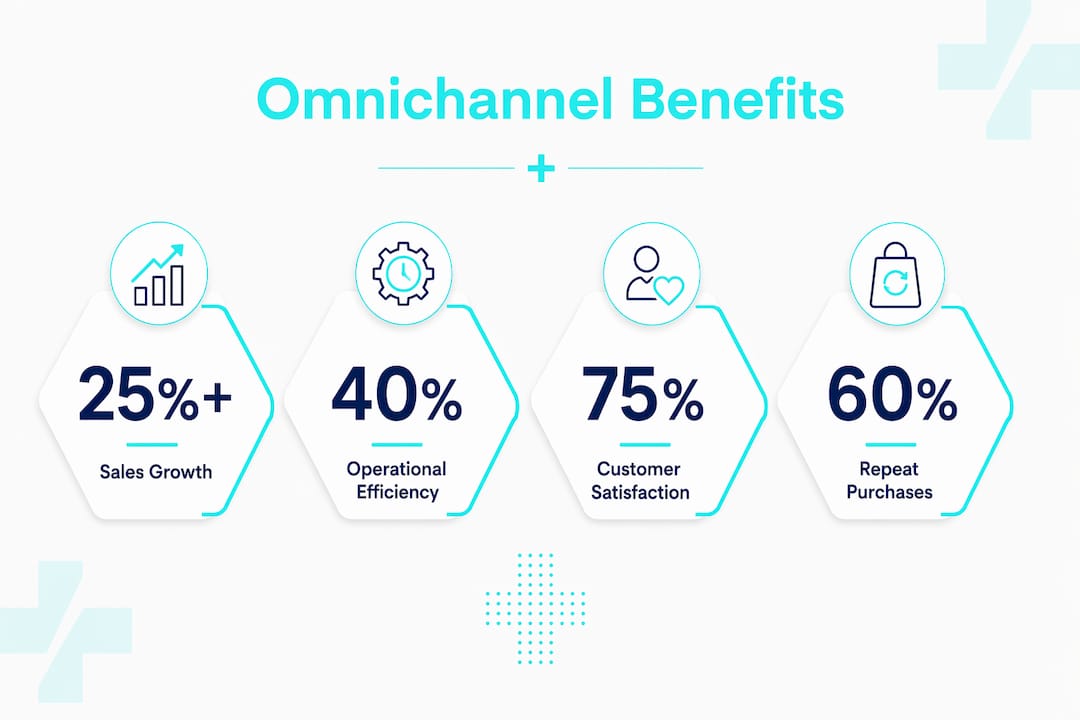
Operational efficiency gains are equally concrete. When procurement data, patient records, and care coordination systems share a common infrastructure, staff spend less time reconciling information across disconnected platforms. That time goes back into patient care.
Strategic considerations before you build an omnichannel approach
Getting omnichannel right in medical retail requires more than adding new channels. The strategic decisions you make before launch determine whether the result feels unified or just busy.
Assess your current connectivity honestly. Healthcare maturity models recommend mapping your “AS IS” state before designing the future. Where do data silos exist between your procurement system, patient portal, and clinical records? Those gaps are where the strategy breaks down.
Prioritize backend interoperability over front-end expansion. Adding a mobile app or a chat widget without connecting it to your core data infrastructure fragments the patient experience rather than improving it. The power of omnichannel lies in what happens behind the interface.
Align channel investments with real business drivers. McKinsey’s guidance is direct: retailers must align omnichannel ambitions with realistic value drivers to avoid margin pressure. Adding channels because competitors have them, without a clear link to revenue or retention, is how organizations end up with expensive technology that nobody uses.
Plan for regulatory complexity from day one. HIPAA, state pharmacy board requirements, and FDA regulations on medical device marketing all affect how you can collect, store, and use patient and customer data across channels. Compliance is not a late-stage concern; it shapes which platforms you can use and how.
Account for human channel preferences. TTEC Digital’s research is clear that phone and email remain preferred for most provider interactions outside direct care. Digital channels handle convenience tasks well; complex clinical or procurement decisions still benefit from human contact. Your omnichannel strategy needs both.
Train your team, not just your technology. Healthcare professionals need to understand how to use integrated tools effectively and when to escalate from digital to human interaction. Technology without trained users produces inconsistent experiences.
Best practices for medical retailers implementing omnichannel in the US
The gap between a working omnichannel strategy and an expensive failed one usually comes down to execution discipline. These practices reflect what actually works in US medical retail environments.
Build a phased roadmap. Start with the integrations that solve the most pressing pain points, typically connecting procurement data with inventory visibility and compliance documentation. Expand from there. Trying to connect every system at once is how projects stall.
Unify your data before you expand your channels. Patient and customer data scattered across disconnected systems cannot support personalized, continuous care. A single source of truth for account history, order status, and compliance records makes every channel interaction more useful. Queenssurgical’s online medical retail best practices address this directly for healthcare procurement teams.
Use digital catalogs as an omnichannel anchor. A well-structured digital catalog in medical retail connects product information, compliance documentation, and purchasing workflows in one place. When that catalog syncs with your ordering system and customer account data, it becomes a genuine omnichannel touchpoint rather than a static PDF.
Integrate teleconsultations and mobile tools thoughtfully. Patient engagement technologies like teleconsultations, mobile apps, and digital catalogs strengthen omnichannel outcomes when they connect to clinical and procurement systems. The keyword is “connect.” A telehealth tool that does not feed visit data back into the patient record adds a channel without adding value.
Stay current on compliance requirements. US retail medical compliance requirements evolve regularly, and omnichannel platforms that handle patient data must keep pace. Build compliance review into your annual technology assessment, not just your initial setup.
For organizations managing pharmacy supply chains, pharmacy supply management that integrates omnichannel ordering, tracking, and vendor communication reduces both stockouts and overstock situations.
Pro Tip: Avoid purchasing disconnected point solutions that each solve one problem. A scheduling tool that does not talk to your billing system, which does not talk to your inventory platform, creates the exact fragmentation omnichannel is supposed to eliminate. Prioritize platforms with open APIs and proven integrations over feature-rich tools that operate in isolation.
Integrated healthcare solutions like Hadaco Health Solutions demonstrate how connecting employee health touchpoints across channels reduces downstream claims costs, a model directly applicable to how medical retailers think about connecting procurement and care coordination workflows.
Where omnichannel in US medical retail is headed
Omnichannel is now a baseline expectation in US medical retail, not a differentiator. Healthcare organizations that have not yet built integrated channel strategies are already behind the procurement and patient experience standards their counterparts are setting.
The next phase involves deeper AI integration at key touchpoints, expanded telehealth services connected to procurement and follow-up workflows, and data-driven personalization that anticipates what a healthcare organization needs before they ask. Messaging, text alerts, contact center tools, and telehealth channels working together to help patients and providers manage health continuously is the direction TTEC Digital describes as the near-term standard.
Queenssurgical supports healthcare organizations navigating this shift with a product catalog built for integrated procurement, compliance expertise across US medical retail regulations, and a platform designed to connect with the digital workflows healthcare professionals already use. The work of building a true omnichannel approach is ongoing, and the organizations that treat it as a continuous process rather than a one-time project will hold the advantage.
Key Takeaways
Omnichannel in medical retail requires backend interoperability, not just front-end channel additions, to deliver consistent experiences and sustainable competitive advantage.
Point | Details |
Integration over addition | Connecting existing systems matters more than launching new channels without shared data infrastructure. |
Business case is proven | Customers on integrated omnichannel platforms purchase more frequently and spend more than single-channel shoppers. |
Compliance shapes architecture | HIPAA and US regulatory requirements must be built into omnichannel design from the start, not added later. |
Human channels remain critical | Phone and email stay preferred for complex provider interactions; digital tools handle convenience tasks best. |
Phased execution wins | Starting with high-impact integrations and expanding deliberately outperforms trying to connect everything at once. |
Recommended
Comments