Point-of-Care Testing Equipment: A Clinical Guide for Professionals

Point-of-care testing (POCT) equipment refers to clinical laboratory diagnostic devices used at or near the patient care site to generate rapid test results, often within seconds to minutes, enabling immediate treatment decisions without waiting for a centralized lab. Unlike traditional lab workflows that require sample transport, processing queues, and delayed reporting, POCT brings the diagnostic capability directly to the bedside, the clinic exam room, the emergency bay, or even a remote field setting.
The clinical case for POCT is straightforward: faster results mean faster decisions. Regulatory oversight in the United States comes primarily from the Clinical Laboratory Improvement Amendments (CLIA), with accreditation bodies like the College of American Pathologists (CAP) and standards organizations like CLSI setting the quality benchmarks that govern every testing site. The Food and Drug Administration (FDA) also classifies POCT devices by complexity, determining whether a test is waived, moderate, or high complexity.
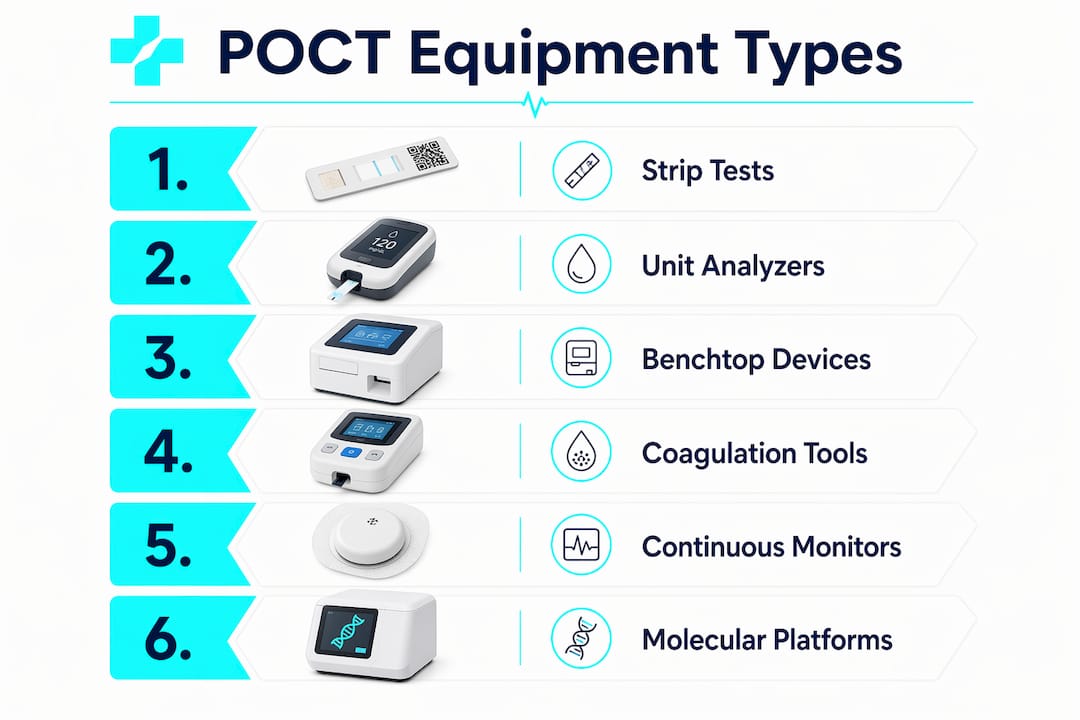
POCT devices span a wide range of form factors and capabilities:
Handheld qualitative strip tests (pregnancy tests, urine dipsticks)
Unit-use quantitative analyzers (glucometers, INR monitors)
Benchtop analyzers for chemistry and hematology panels
Coagulation analyzers for hemostasis assessment
Continuous monitoring systems such as continuous glucose monitors (CGMs)
Molecular biology platforms for nucleic acid detection of infectious agents
1. What are the main types of point-of-care testing equipment?
POCT devices are classified by testing modality and physical size, ranging from a simple dipstick you can read with the naked eye to a benchtop analyzer that runs a full chemistry panel. Understanding these categories is the foundation for any procurement decision.
Type 1: Qualitative strip-based tests
These are the simplest POCT devices. They produce a binary result, positive or negative, through a color change or line appearance. The underlying chemistry spans basic indicator reactions to immunochromatographic lateral flow assays. Common examples include urine pregnancy tests detecting beta-hCG, urine dipsticks for glucose and protein, rapid strep throat antigen tests, and COVID-19 lateral flow tests. No reader device is required for most, though optical readout accessories exist for higher-volume settings.
Type 2: Unit-use analyzers
Unit-use analyzers are the simplest form of quantitative POCT. Most of the reaction occurs on a disposable test strip; the reader device interprets the result. Blood glucose meters are the most familiar example, used by millions of patients and clinicians daily. INR monitors for patients on warfarin therapy fall into this category as well, using whole blood from a fingerstick and single-use strips. Multi-parameter cartridge systems like the i-STAT also fit here, running blood gases, electrolytes, and cardiac markers from a single whole-blood sample.
Type 3: Benchtop analyzers
Benchtop POCT analyzers sit at the higher end of complexity. They require dedicated counter space near the patient area and typically run a broader menu, including hemoglobin A1c, C-reactive protein (CRP), and general chemistry analytes. These units often need trained personnel to operate and maintain them, and they carry stricter quality control requirements. The clinical payoff is a richer diagnostic picture without sending samples off-site.

Type 4: Coagulation analyzers
Hemostaseological coagulation analyzers assess plasma clotting, platelet function, and fibrinolysis, a combined analysis called viscoelastic coagulation testing. These are high-complexity instruments. Only qualified personnel, typically a laboratory physician or trained technical assistant, should operate them. They are most commonly used in surgical suites and critical care settings where real-time coagulation data drives transfusion decisions.
Type 5: Continuous monitoring systems
Continuous glucose monitors (CGMs) are the defining example of this category. Rather than a single-point measurement, CGMs track interstitial glucose concentrations over 24 hours, providing trend data that single fingerstick readings cannot capture. For patients and clinicians managing diabetes, this continuous data stream has produced measurable improvements in HbA1c control and reductions in hypoglycemic events. Home-based continuous monitoring devices represent the consumer-facing edge of this technology.

Type 6: Molecular biology platforms
Nucleic acid testing (NAT) systems detect bacterial or viral DNA and RNA using cartridge-based extraction followed by PCR or isothermal amplification. These platforms are particularly valuable in infectious disease diagnosis, including respiratory pathogens, sexually transmitted infections, and emerging outbreak agents. The cartridge design prevents cross-contamination of nucleic acids, a critical safety feature in high-throughput settings. For a broader view of how these fit within preventive care equipment, the device landscape extends well beyond diagnostics alone.
2. What specimen types and procedures does POCT require?
Specimen quality is where most POCT errors originate, not in the device itself. Common specimen types for POCT include capillary blood, venous whole blood, urine, nasopharyngeal swabs, oropharyngeal swabs, and saliva, each with specific handling requirements that vary by test and manufacturer.
Key specimen considerations by category:
Capillary blood: Used for glucometers and INR monitors; fingerstick technique, site selection, and the first-drop discard rule all affect result accuracy.
Urine: Used for pregnancy tests and dipstick panels; first-morning specimens are preferred for hCG testing; contamination from improper collection invalidates results.
Swabs: Nasopharyngeal and oropharyngeal swabs for respiratory pathogen tests require correct anatomical placement and the right swab material; cotton-tipped swabs can inhibit some molecular assays.
Whole blood cartridges: Multi-parameter analyzers like the i-STAT require careful filling to avoid air bubbles, which skew blood gas results.
Standard POCT procedure, step by step:
Verify patient identity and confirm test indication.
Review manufacturer instructions for the specific device and lot.
Confirm the device has been properly calibrated and quality control has passed for the current shift.
Prepare the patient: fasting status, medication timing, and hydration all affect certain analytes.
Collect the specimen using the correct technique for the sample type.
Apply any required reagent solution before loading the sample (for example, some COVID-19 NAT units require the swab to be placed in a buffer solution first to release antigens).
Load the sample or cartridge into the device per the package insert.
Wait for the result within the manufacturer-specified time window; reading too early or too late can alter qualitative results.
Document the result immediately in the patient record.
Dispose of the cartridge, strip, or lancet per biohazard waste protocols.
Following the manufacturer’s package insert is not optional. Calibration before use and adherence to the stated specimen volume are the two steps most often skipped under time pressure, and both directly affect result validity.
3. What factors interfere with POCT accuracy and reliability?
POCT accuracy depends on far more than the device itself. Environmental factors, operator skill, and specimen handling each contribute to error, and in a decentralized testing environment, these variables are harder to control than in a centralized lab.
Environmental influences:
Temperature extremes degrade reagents and affect enzymatic reactions; most POCT strips and cartridges have a rated operating range, typically 59°F–86°F (15°C–30°C).
High humidity causes premature reagent activation in strip-based tests.
Altitude affects blood gas measurements on some platforms.
Operator-related errors:
Inadequate training is the leading cause of POCT inaccuracy. Non-laboratory staff performing tests without proper instruction on quality control interpretation, calibration steps, and result documentation introduce errors that go undetected.
Skipping the quality control run before patient testing removes the only check that the device and reagents are functioning correctly.
Timing errors on qualitative tests, reading a lateral flow result outside the specified window, produce false positives or false negatives.
Specimen and patient factors:
Hemolysis from aggressive fingerstick squeezing falsely lowers potassium and elevates lactate dehydrogenase.
Lipemia and icterus interfere with optical detection methods.
Certain medications affect specific analytes; biotin supplementation, for instance, is a known interferent in immunoassay-based POCT platforms.
Dehydration concentrates urine analytes and can produce false-positive dipstick readings.
Device and reagent factors:
Expired reagent strips or cartridges produce unreliable results; lot-to-lot variation in some strip-based tests adds another layer of variability.
Inadequate device maintenance, including failure to clean optical sensors or replace batteries, degrades performance over time.
Improper storage of reagents, such as leaving test strips exposed to air or storing them outside the recommended temperature range, renders them unusable even before the expiration date.
Pro Tip: Run quality control at the start of every shift and after any event that could compromise device integrity, such as a drop, a temperature excursion, or a new reagent lot. Document every QC result. A quality assurance program that tracks QC trends over time will catch reagent drift or device degradation before it affects a patient result.
4. How should you interpret and report POCT results?
POCT results fall into two categories: qualitative and quantitative. Qualitative results report a binary outcome, positive or negative, present or absent. A positive rapid strep test, a two-line pregnancy test, a reactive HIV antigen screen. Quantitative results report a numeric value against a reference range, a blood glucose of 312 mg/dL, an INR of 3.8, a troponin above the 99th percentile cutoff.
Interpretation requires knowing the clinical context. A blood glucose of 312 mg/dL in a fasting patient with known type 1 diabetes carries different weight than the same value in a post-meal reading from a patient on corticosteroids. POCT results should always be interpreted alongside the patient’s clinical presentation, not in isolation.
Reporting and documentation obligations:
All POCT results must be entered into the patient’s medical record promptly, whether through direct electronic health record (EHR) integration or manual entry.
HIPAA-compliant EHR integration requires cybersecurity planning and compatibility assessment between the POCT device and the hospital IT infrastructure.
The operator performing the test is responsible for verifying the result before it is acted upon, including confirming that quality control passed and that the specimen was collected correctly.
Critical values, those outside the range where immediate clinical intervention is required, must be communicated to the ordering provider immediately, following the facility’s critical value notification protocol.
Common reporting challenges include inconsistent documentation when non-laboratory staff perform tests, gaps in critical value notification when the testing operator is not the treating clinician, and failure to flag results that fall outside the device’s reportable range. Facilities that use middleware or connectivity software to route POCT data to the EHR reduce manual transcription errors, but those systems require their own validation and maintenance.
5. What are the clinical advantages of point-of-care diagnostic tools?
The core clinical benefit of POCT is time. Eliminating transport and processing delays is especially critical in emergency and critical care contexts, where a 30-minute difference in troponin result availability can change whether a patient goes to the cath lab or the observation unit.
Faster treatment initiation: When a clinician has a result in hand during the patient encounter, treatment can start before the patient leaves the room. This is particularly valuable for antibiotic prescribing decisions in strep pharyngitis, INR management in anticoagulated patients, and glucose management in diabetic emergencies.
Improved clinical decision-making: POCT supports real-time decisions rather than probabilistic ones. A clinician who suspects influenza can confirm it with a rapid antigen test in 15 minutes and prescribe oseltamivir appropriately, rather than treating empirically and potentially contributing to unnecessary antibiotic use.
Accessibility in underserved and remote settings: POCT devices are portable and often battery-powered, making them deployable in rural clinics, disaster response settings, mobile health units, and community pharmacies. For populations without easy access to centralized laboratory services, POCT can be the only available diagnostic option.
Patient engagement: Patients who see their glucose, INR, or HbA1c result during the visit are more likely to engage with the treatment plan. The immediacy of the result creates a teachable moment that a mailed lab report two days later does not.
Operational efficiency: Faster results reduce the time patients spend waiting in emergency departments and outpatient clinics. Shorter length of stay in the ED has downstream effects on bed availability and throughput. For diagnostic tools in patient assessment, POCT is one of the most direct levers available to improve workflow without adding staff.
One accuracy caveat: POCT devices are generally validated against central laboratory methods, but they do not always match laboratory precision, particularly at the extremes of the analytical measurement range. For critical decisions where a borderline result could change management, confirmatory central lab testing remains the standard.
6. What should healthcare providers and procurement specialists know before selecting POCT equipment?
Procurement decisions for POCT equipment are more complex than they appear. The device price is rarely the most significant cost over a three-year horizon.
Total cost of ownership: The full cost of POCT equipment includes consumables such as proprietary test strips and cartridges, calibration materials, preventive maintenance contracts, and training for non-laboratory staff. Handheld devices carry lower upfront costs but higher per-test consumable costs. Benchtop systems require larger capital investment but may offer lower per-test costs at volume. Failing to model these ongoing expenses accurately leads to budget overruns and, in some cases, devices that sit unused because the consumable budget was not sustained.
Regulatory compliance: All POCT programs in the United States must comply with CLIA '88 regulations regardless of testing location, whether in a hospital, clinic, pharmacy, or nursing facility. The FDA determines test complexity; CAP accreditation applies the same standards to POCT sites as to the main laboratory. ISO 22870 provides the international quality management framework for POCT programs. Procurement teams should verify that any device under consideration has the appropriate FDA clearance or waiver status for the intended use.
EHR integration and cybersecurity: Device compatibility with the facility’s EHR system is a procurement requirement, not an afterthought. Middleware connectivity solutions require their own IT security review, and any POCT data transmitted over a network must meet HIPAA standards.
Operator training and competency: User-friendly POCT devices can create a false sense of simplicity. Non-laboratory staff who operate them without structured training and annual competency assessment introduce errors that are difficult to detect after the fact. The ASCLS position is clear: a qualified Technical Consultant, typically a medical laboratory professional, must direct all POCT programs and oversee training for every testing site.
Device reliability and vendor support: Evaluate mean time between failures, availability of loaner devices during service, and the vendor’s response time for repairs. A device that goes offline in an emergency department without a backup plan creates a clinical gap.
Regulatory classification considerations: For facilities considering Class II medical devices, understanding FDA classification and the associated quality system requirements is a prerequisite for compliant procurement.
Pro Tip: Before finalizing a POCT device purchase, map your consumable supply chain. Proprietary strips and cartridges from a single vendor create supply risk. Negotiate a minimum stock agreement or identify an approved secondary supplier before the contract is signed.
7. What are the real limitations of POCT devices in clinical practice?
POCT is not a replacement for the central laboratory. Understanding where it falls short is as important as knowing where it excels.
Analytical accuracy gaps: Most POCT devices perform well within the middle of their analytical range but show greater imprecision at the low and high ends. For analytes where a small numeric difference changes clinical management, such as troponin near the 99th percentile cutoff or INR near a therapeutic decision threshold, central lab confirmation is often warranted.
Quality control burden in decentralized settings: Running QC, documenting results, and taking corrective action when QC fails requires discipline from staff who are primarily focused on patient care, not laboratory operations. In facilities with many POCT sites, maintaining consistent QC compliance across all locations is a genuine operational challenge. Benchtop POCT units in particular require laboratory-grade QA protocols to prevent misdiagnosis, a requirement that is easy to underestimate when the device looks simple.
Limited test menu: Even the most capable POCT platforms cannot replicate the full menu of a reference laboratory. Complex analytes, rare infectious disease panels, and specialized endocrine tests still require centralized processing.
Operator dependency: The accuracy of a POCT result is only as good as the person performing it. High staff turnover in nursing or medical assistant roles means training must be continuous, not a one-time event. Competency gaps accumulate quietly and surface as patient safety events.
Data management fragmentation: When POCT results are entered manually rather than transmitted electronically, they can be lost, mis-transcribed, or omitted from the clinical record entirely. Facilities with multiple POCT sites and no centralized connectivity solution face a documentation audit risk under CLIA and CAP inspections.
Cost at low volume: For tests performed infrequently, the per-test cost of POCT consumables often exceeds the cost of sending the specimen to a reference lab. The economic case for POCT depends on volume, turnaround time requirements, and the clinical cost of delay, not on device price alone.
8. What emerging technologies are shaping the future of POCT?
The POCT field is moving faster than most clinical procurement cycles. Several technology directions are already past the research stage and entering clinical deployment.
Microfluidics and lab-on-a-chip: Microfluidic platforms miniaturize complex multi-step assays onto a chip the size of a credit card. They reduce sample volume requirements, shorten reaction times, and enable multiplexed testing, running several analytes simultaneously from a single specimen. This is particularly relevant for infectious disease panels where co-infection is common.
Wearable and continuous sensors: Beyond CGMs, wearable biosensors are being developed for continuous monitoring of lactate, cortisol, and cardiac biomarkers. The clinical potential for real-time sepsis detection or post-operative monitoring is significant, though most of these applications remain in validation stages for clinical use.
Nucleic acid amplification at the point of care: Cartridge-based NAT systems are already deployed for influenza, SARS-CoV-2, RSV, and group A streptococcus. The next generation of these platforms is targeting faster turnaround, broader pathogen panels, and lower cost per test, addressing the main barriers to wider adoption in outpatient and community settings.
Artificial intelligence and decision support integration: POCT devices connected to AI-driven clinical decision support tools can flag abnormal results, suggest differential diagnoses, and prompt follow-up testing. This integration is most advanced in cardiology and diabetes management, where continuous data streams from wearable devices feed into predictive algorithms.
Multiplexed point-of-care testing (xPOCT): The ability to measure multiple analytes simultaneously from a single specimen is becoming a defining feature of next-generation POCT platforms. xPOCT reduces the number of separate tests a clinician must order and the number of specimens a patient must provide, compressing the diagnostic workup into a single device interaction.
Connectivity and the Internet of Medical Things: POCT devices are increasingly networked, transmitting results directly to EHRs, alerting care teams in real time, and feeding population health dashboards. This connectivity creates both clinical value and cybersecurity obligations that procurement teams must plan for from day one.
Queenssurgical supports your clinical supply needs

Running a POCT program means more than selecting the right analyzer. The clinical environment around it, the protective equipment your staff wears, the supplies that keep the workspace safe, all of it matters. Queenssurgical supplies healthcare facilities across the Americas with the medical products that support safe, compliant clinical operations. From full-length face shields that protect staff during specimen collection to isolation gowns and skin care products for high-contact clinical environments, the catalog is built for professionals who need reliable supply without the procurement headache. Browse the full range at Queenssurgical and see why clinics, hospitals, and procurement teams across the region trust the platform for their medical supply needs.
Key Takeaways
Point-of-care testing equipment delivers rapid diagnostic results at the patient site, enabling immediate clinical decisions that centralized laboratory workflows cannot match in time-sensitive settings.
Point | Details |
Six device categories | POCT devices span strip-based tests, unit-use analyzers, benchtop analyzers, coagulation analyzers, continuous monitors, and molecular platforms. |
Accuracy depends on process | Specimen quality, operator training, calibration, and QC compliance drive result reliability more than device brand. |
Regulatory compliance is mandatory | CLIA '88, FDA complexity classification, CAP standards, and ISO 22870 apply to every POCT site regardless of location. |
Total cost of ownership matters | Consumables, calibration, maintenance, and staff training often exceed the upfront device cost over a multi-year horizon. |
EHR integration requires planning | HIPAA-compliant connectivity and cybersecurity assessment must be part of every POCT procurement decision. |
Recommended
Comments