How Medical Catalog Management Works in Healthcare Buying
- Qubit Technology
- 22 hours ago
- 11 min read

Catalog management in medical buying is the process of building, maintaining, and governing a controlled list of approved products, suppliers, and contract prices that procurement teams use to place orders. Get it right, and purchasing runs almost automatically. Get it wrong, and you end up with invoice holds, off-contract spending, and compliance gaps that can delay patient care. The core mechanism is straightforward: every item a clinical or administrative staff member can order flows through a validated, centrally managed catalog that reflects current contracts, pricing, and regulatory status.
The practical impact is significant. Catalog buying limits purchases to pre-approved suppliers and product lists, reducing the risk of unapproved vendors and inconsistent pricing that free-text ordering routinely introduces. Programs like Vizient’s GPO catalog, the DLA ECAT program, and managed services like NHS SBS have each demonstrated that a well-governed catalog does more than save time. It enforces policy by default.
Key functions catalog management performs in medical procurement:
Centralizes product and pricing data so every buyer works from the same source of truth
Enforces contract compliance by restricting orders to pre-negotiated suppliers and SKUs
Reduces invoice discrepancies by aligning purchase orders with validated item masters
Supports touchless ordering when catalog data flows directly into procure-to-pay systems
Tracks product availability and regulatory status to prevent ordering obsolete or unsafe items
Enables spend analytics by tagging every transaction to a contract, category, and cost center
Standardizes product ranges across departments to drive economies of scale
How the medical purchasing catalog process works, step by step
Managing a medical catalog is not a one-time setup. NHS SBS procurement experts describe it as a continuous cycle, and that framing is accurate. Each pass through the cycle tightens compliance, improves data quality, and gets the organization closer to fully touchless ordering.
1. Content sourcing and supplier coordination
The process starts with gathering product data directly from contracted suppliers. This means pulling item descriptions, part numbers, unit-of-measure details, pricing, and regulatory identifiers such as GTIN or UDI codes. Procurement teams cross-reference this data against executed contracts to confirm that every item in the catalog has an active pricing agreement behind it. Supplier coordination at this stage is not optional. Gaps in vendor-supplied data translate directly into ordering errors downstream.

2. Data normalization and validation
Raw supplier data arrives in inconsistent formats. One vendor uses milliliters; another uses cubic centimeters. One lists a product under a trade name; another uses a generic description. Data normalization resolves these inconsistencies so the catalog presents a uniform, searchable structure. Large medical catalogs require strict version control and content freeze policies during updates to prevent ordering obsolete or unsafe products. Metadata versioning and content freezes during annual update cycles are standard practice for organizations managing thousands of SKUs.
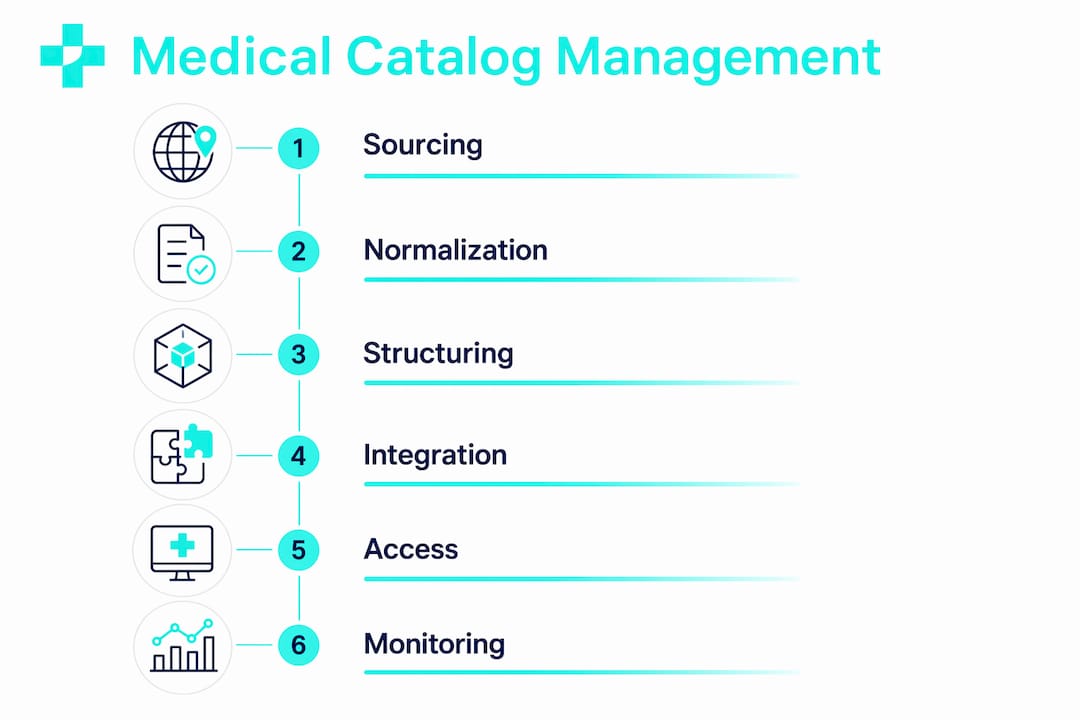
3. Catalog structuring and taxonomy
Once data is clean, it gets organized into a logical hierarchy. Most healthcare organizations structure catalogs by product category, clinical specialty, or supply type. The goal is a layout where a nurse or a buyer can locate the right item quickly without scrolling through unrelated products. Cross-reference tables and compatibility matrices belong here too, particularly for medical devices where one instrument may require a specific handle or accessory.

4. Integration with procurement systems
A catalog sitting in isolation does nothing. The validated item master must connect to the organization’s procure-to-pay platform, materials management information system (MMIS), and financial coding structure. Unsynchronized catalog data causes manual rework, invoice discrepancies, and off-contract spending. Achieving touchless ordering requires validated items to flow automatically into procurement workflows, which means clean API connections or EDI links between the catalog and the ERP or MMIS.
5. User access and training
Role-based access controls determine who can order what. A surgical supply coordinator may have access to the full clinical catalog; a department administrator may be restricted to non-clinical items under a set dollar threshold. Training at this stage focuses on how to search, how to use punchout suppliers, and when a non-catalog requisition is appropriate. Skipping this step produces shadow purchasing, where staff bypass the catalog entirely because they don’t know how to use it.
6. Ongoing monitoring and updates
Between formal release cycles, the catalog needs continuous attention. Prices change. Contracts expire. Products get recalled or discontinued. NHS SBS emphasizes constant marketplace monitoring with updates applied immediately to keep the catalog current. Supplemental insert pages or digital file updates handle interim changes without waiting for the next full catalog revision.
Pro Tip: Schedule a lightweight catalog audit every quarter, not just annually. A quarterly pass catches pricing drift, expired contracts, and discontinued items before they generate invoice holds or compliance findings. Pair it with a supplier data quality scorecard to hold vendors accountable for the accuracy of what they submit.
What types of catalogs do healthcare organizations actually use?
Medical organizations typically run three catalog types in parallel, each serving a different purchasing scenario. This tiered approach balances compliance, user convenience, and procurement control across a complex product mix.
Catalog type | How it works | Typical use cases |
Internal item master | Pre-loaded in the ERP or MMIS; contains items with active pricing agreements | Daily clinical and non-clinical supplies, high-volume consumables |
Supplier punchout | Links buyer to the vendor’s website via the procurement platform; checkout completes in the ERP | Research products, specialty equipment, broad vendor catalogs |
Non-catalog requisition | Manual request for items not in the item master or any punchout catalog | Services, one-time purchases, specialized or unavailable goods |
The item master catalog is the workhorse. At the University of Arkansas for Medical Sciences (UAMS), the item master in Workday contains thousands of clinical and non-clinical products covering daily operational needs across healthcare, research, and administrative functions. Buyers search, add to cart, and submit without leaving the procurement platform.
Punchout catalogs extend that reach. The University of Texas Medical Branch (UTMB) uses Jaggaer to connect buyers to multiple supplier websites, letting them compare products and pricing across vendors before creating a single eProcurement requisition. UTMB’s punchout arrangement increases buyer authority up to $15,000 per vendor purchase order for research products, which covers the vast majority of routine transactions.
Non-catalog requisitions exist as a controlled escape valve. They are appropriate for services, capital equipment, or genuinely unique items. The key word is “controlled.” Organizations that let non-catalog purchasing grow unchecked see contract compliance rates fall and spend visibility erode. Keeping non-catalog volume low is a direct measure of how well the item master and punchout catalogs are maintained.
A hybrid strategy using all three types works well for large health systems. The item master handles volume and compliance. Punchout handles breadth and specialty sourcing. Non-catalog handles the exceptions. The digital catalog layer ties them together with searchable databases, filtered tables, and direct ordering links that printed catalogs cannot provide.
Which software platforms support catalog management in medical buying?
Procure-to-pay platforms are where catalog management becomes operational. The catalog is only as useful as the system that delivers it to buyers at the point of need.
Vizient Catalog is the reference point for GPO-based purchasing in U.S. healthcare. It functions as a single source of truth for GPO pricing and contract data, updated daily, and integrated with Vizient Supply Analytics so procurement teams can see contract and product data in one place. Search filters, contract expiration alerts, and documentation storage are built in. For health systems that participate in Vizient’s GPO, this catalog removes the need to cross-reference pricing from multiple sources.
Planergy is a procure-to-pay platform used across healthcare and other regulated industries. It supports catalog synchronization, contract compliance tracking, and order automation. Its architecture connects catalog data to invoice processing and spend analytics, which is the integration chain that makes touchless ordering possible. Procurement managers use Planergy to enforce buying policies at the requisition stage, before an order ever reaches a supplier.
DLA ECAT is the U.S. government’s answer to catalog management for military and federal healthcare buyers. Developed by DLA Troop Support’s Medical Supply Chain, ECAT automates the entire procurement cycle from product search through payment. It covers laboratory supplies, dental equipment, orthopedic implants, cardiovascular products, and medical/surgical supplies. Delivery within the United States often happens within 72 hours of order receipt. One feature worth noting: vendors pay no fees to participate, which promotes competition and keeps pricing transparent.
Jaggaer handles hosted and punchout supplier catalogs, particularly for research-intensive environments. UTMB’s deployment shows how a marketplace model lets buyers access multiple supplier catalogs simultaneously, compare pricing, and consolidate into a single requisition.
Key integration capabilities procurement teams should require from any catalog platform:
ERP and MMIS synchronization via API or EDI to eliminate manual data entry
Contract price validation at the line-item level before order submission
Punchout protocol support (cXML or OCI) for supplier catalog connectivity
Invoice matching automation tied to catalog item masters to reduce holds
Spend analytics dashboards that tag transactions to contracts, categories, and cost centers
Role-based access controls that restrict catalog visibility by user, department, or dollar threshold
Audit trail logging for every catalog change, price update, and order transaction
For organizations evaluating whether to rent or buy medical equipment through catalog channels, the procurement platform’s ability to handle both capital and consumable categories in a single workflow is a practical consideration worth examining. The renting vs. buying decision affects how catalog items are classified, approved, and tracked in the MMIS.
Best practices and common challenges in managing medical purchase catalogs
The gap between a functional catalog and a high-performing one comes down to governance. Most healthcare organizations can build a catalog. Fewer sustain one.
Best practices that actually move the needle:
Assign dedicated catalog ownership. A catalog without a named owner drifts. Assign a catalog manager or a small team responsible for accuracy, supplier coordination, and compliance reporting.
Standardize product descriptions at the point of entry. Inconsistent naming creates duplicate items, which inflates the catalog and confuses buyers. A controlled vocabulary for product categories, units of measure, and manufacturer names prevents this.
Tie catalog updates to contract events. Every contract renewal, price amendment, or supplier change should trigger a catalog review, not a separate annual process.
Use data to identify off-contract spend. Spend analytics that flag purchases made outside the catalog give procurement teams a clear target for catalog expansion or supplier consolidation.
Apply compliance requirements as a filter at catalog build time, not as an afterthought during audits.
Common challenges:
Data normalization is the hardest operational problem. Suppliers submit product data in dozens of formats, with varying levels of completeness. Normalizing that data into a consistent catalog structure requires either dedicated staff time or a managed service with the tools to automate it.
Supplier coordination delays are chronic. Vendors are slow to submit updated pricing, new product data, or discontinuation notices. Procurement teams that rely on suppliers to push updates will always be behind. Proactive outreach and contractual data submission requirements help, but they require enforcement.
Version control during major updates creates ordering risk. When a catalog is being revised, buyers may be working from a version that is partially updated. Content freezes during update cycles prevent this, but they require advance planning and clear communication to clinical staff.
Poor catalog governance is a patient safety issue, not just a procurement inefficiency. When catalogs contain outdated product specifications, discontinued items, or unvalidated substitutions, clinical staff may order the wrong product for a procedure. Procurement teams that treat catalog accuracy as a back-office concern miss the direct line between item master quality and care delivery. Regulatory changes to medical device classifications, UDI requirements, and product recalls must flow into the catalog immediately, not at the next annual update cycle.
Balancing user experience with purchasing policy is a tension that never fully resolves. Clinical staff want to find what they need quickly. Procurement teams want to enforce contract compliance. The answer is not a restrictive catalog that drives shadow purchasing, but a well-organized one with good search, clear categories, and a fast non-catalog path for genuine exceptions. Catalog-based ordering improves control and audit compliance precisely because it makes the compliant path the easy path.
What does e-catalog management actually cost, and who pays?
Cost structures for e-catalog management vary considerably depending on whether an organization builds and maintains the catalog internally, uses a managed service, or relies on a GPO’s catalog infrastructure.
Internal management requires dedicated staff, catalog management software, and ongoing supplier coordination resources. The hidden cost is time. A catalog manager handling thousands of SKUs across dozens of suppliers spends a significant portion of their week on data validation, supplier follow-up, and system updates. That labor cost is real even when it doesn’t appear as a line item in the procurement budget.
Managed catalog services shift that burden to a specialist provider. NHS SBS data shows that managed services typically cost less than an in-house catalog manager while delivering greater savings through consolidation and buying leverage. The managed service model also uses the organization’s existing systems, avoiding additional software expenditure.
GPO catalog platforms like Vizient’s are available to member organizations as part of GPO participation. The catalog infrastructure is maintained by the GPO, with daily updates to pricing and contract data. Members gain access to pre-negotiated pricing across a broad supplier network without building that infrastructure themselves.
DLA ECAT takes a different approach entirely. Vendors pay no fees to participate, and DLA Troop Support contracting specialists negotiate discounted pricing off commercial catalog prices. The resulting “Total Delivered Price” includes all transportation and administrative costs, giving federal buyers a fully loaded price with no hidden charges.
Key cost factors to evaluate:
Total delivered price vs. unit price: Some catalog programs bundle shipping and handling into the catalog price; others do not. Comparing unit prices across programs without accounting for delivery costs produces misleading savings calculations.
System integration costs: Connecting a new catalog platform to an existing MMIS or ERP can require significant IT investment. Managed services that work within existing systems avoid this.
Vendor participation fees: Programs that charge vendors to list products may see reduced supplier participation or inflated prices that offset the fee. Fee-free models like DLA ECAT promote broader competition.
Savings from standardization: Managed catalog services improve requisition compliance and product accuracy, standardize catalogs to avoid duplication, and increase economies of scale. The savings from consolidation often exceed the cost of the service itself.
For organizations weighing bulk ordering benefits against catalog management costs, the math usually favors a well-maintained catalog. Consolidated purchasing through a governed catalog generates volume discounts that ad hoc buying cannot capture.
Queenssurgical’s perspective on catalog management in medical procurement
Queenssurgical operates across both wholesale and retail medical supply channels in the Americas, which means catalog management is not an abstract concept. It is the operational backbone of how products get from manufacturers to clinical settings accurately and on time.
The most consistent finding from working across clinical and non-clinical product lines is that catalog accuracy directly determines invoice performance. When item descriptions, unit-of-measure codes, and contract prices in the catalog match what the supplier invoices, three-way matching runs automatically. When they don’t, invoices go on hold, accounts payable staff spend time on manual resolution, and clinical supply coordinators start calling vendors directly. That chain of events is expensive and entirely preventable.
Queenssurgical’s catalog strategy covers products across protective equipment, surgical consumables, instruments, and wellness supplies. Organizing that range into a navigable structure requires the same discipline that large health system catalogs demand: consistent taxonomy, clear product descriptions, and pricing that reflects current agreements. For procurement managers sourcing items like isolation gowns or face shields, catalog accuracy means the product that arrives matches the specification that was ordered.
Practical lessons from catalog work across healthcare procurement:
Sync catalog data with MMIS workflows before go-live. A catalog that isn’t connected to the materials management system creates parallel processes that undermine the whole point of catalog buying.
Treat product discontinuations as urgent catalog events. A discontinued item left active in the catalog generates orders that can’t be fulfilled, which creates emergency purchasing outside the contract structure.
Use catalog analytics to find consolidation opportunities. When the same clinical function is served by three different products from three different suppliers, the catalog data makes that visible. Standardizing to one product drives volume discounts and simplifies inventory.
Build supplier data quality into vendor agreements. Require suppliers to submit product data in a specified format on a defined schedule. Vendors who can’t meet that standard create catalog maintenance problems that compound over time.
The catalog is the contract made operational. A negotiated price that isn’t reflected in the catalog doesn’t get used. A preferred supplier that isn’t in the item master doesn’t get the volume. Catalog management is how procurement strategy becomes purchasing reality, one transaction at a time.
Queenssurgical’s product catalog is built to support procurement teams that need accurate specifications, current pricing, and reliable availability data. Browse skin protectant products and the full range of clinical supplies at queenssurgical.net.
Key Takeaways
Effective catalog management in medical buying requires continuous governance, system integration, and supplier coordination to enforce compliance and support touchless ordering across clinical and non-clinical supply categories.
Point | Details |
Catalog buying enforces compliance by default | Limiting orders to pre-approved suppliers and SKUs reduces unapproved vendor risk and pricing inconsistency. |
Three catalog types serve different needs | Item master, punchout, and non-catalog requisitions each handle distinct purchasing scenarios in a tiered strategy. |
System integration drives touchless ordering | Validated item masters must sync with MMIS and procure-to-pay platforms to eliminate manual rework and invoice holds. |
Managed services often cost less than in-house management | NHS SBS data shows managed catalog services typically cost less than an internal catalog manager while delivering greater savings. |
Catalog accuracy is a patient safety issue | Outdated product data, discontinued items, and unvalidated substitutions create direct clinical risk, not just procurement inefficiency. |
Recommended
Comments