What Does Lot Number Tracking Mean in Healthcare?
- Qubit Technology
- 6 hours ago
- 8 min read

Lot number tracking means assigning a unique batch identifier to a group of items made or received together, then monitoring that identifier through storage, distribution, and use so a facility always knows where a batch sits and how much remains. The practical payoff is straightforward: when a batch is flagged, you pull only that batch, not your entire inventory. The FDA’s recall guidance and World Health Organization safety standards both treat lot-level identification as a baseline requirement for medical products, and a supplier like Queenssurgical builds that identification into how consumables ship to clinics and hospitals in the first place.
Three things happen when lot tracking works correctly:
Recall scope shrinks to the exact units affected, not the whole shelf.
Expiring stock gets flagged and used before it becomes waste.
Every movement leaves a timestamped record an auditor can follow.
Key Takeaways
Lot number tracking works because it ties a batch identifier to current location and quantity data, letting facilities isolate recalled stock without disrupting unaffected inventory.
Point | Details |
Definition matters | Lot tracking shows current location and quantity; traceability reconstructs full production history. |
Recall scope shrinks | Accurate lot data lets teams isolate only the affected batch instead of pulling entire product lines. |
Expiry control needs integration | Feed expiration dates into replenishment systems to stop expired stock from reaching pick locations. |
Documentation must be complete | Record timestamps, user IDs, and disposition decisions for every lot movement to survive an audit. |
Queenssurgical supports the workflow | Ships consumables with consistent, GS1-style lot labeling to reduce receiving friction and support facility-level tracking. |
Table of Contents
Why Lot Number Tracking Matters for Healthcare Supply Chains
Skip lot tracking and a single contaminated batch turns into a facility-wide inventory freeze. With it, you isolate the exact units affected and leave everything else on the shelf. This targeted approach cuts the labor spent on manual audits during safety events and keeps unaffected stock in circulation instead of getting tossed out of caution.
The same system that isolates a recalled batch also enforces first-in-first-out rotation. That matters for anything with a shelf life: vaccines, reagents, sterile disposables. Lot data lets staff flag items nearing expiration at any point in the chain, from the loading dock to the exam room shelf, rather than discovering the problem when a nurse reaches for a vial.
A lot-level system that returns “every location and customer that received lot X” within minutes, not days, is the difference between a contained recall and a scrambling one.
Regulatory reporting adds another layer. Facilities that can produce a timestamped chain of custody, who received what, when, and in what quantity, move through FDA reporting requirements faster than those reconstructing history from paper receipts.
How Is Lot Tracking Different From Traceability?
Lot tracking and traceability get used interchangeably, and that confusion causes real delays during an actual recall. Lot tracking answers a present-tense question: where is this batch right now, and how many units are left? Traceability answers a historical one: what raw materials and production steps went into this batch, and everywhere it traveled after that.
Two scenarios make the split concrete:
A nurse checking clinic shelves for near-expiry vaccine lots needs lot tracking. She wants current location and remaining quantity, nothing more.
A quality analyst investigating a defect needs traceability. He has to reconstruct which raw material lots fed into the affected product and which downstream shipments those lots touched.
Both functions matter because investigations and recalls demand different questions answered simultaneously. A facility running only current-location tracking can pull stock fast but can’t tell a regulator how a defect originated. A facility with only historical genealogy can explain the “why” but struggles to act quickly on the “where right now.” Systems that support transparent, real-time batch visibility alongside historical records deliver the fastest, most defensible recall response.
What Data Belongs in a Lot Record?
A usable lot record needs more than a batch number scrawled on a box. At minimum, capture the lot number itself, the manufacturer’s lot code if one is provided, and an internal receiving lot ID you generate on arrival. Add production date, expiration date, quantity received, and current quantity on hand.
Storage conditions belong in the record too, especially cold-chain notes for temperature-sensitive items, along with supplier name, the receiving purchase order, and timestamps for every receipt and internal movement. Downstream, track which clinics or orders received units from that lot, along with disposition notes and any quality-test results tied to it.
Lot number and manufacturer lot code (if supplied)
Internal receiving lot ID
Production date, expiration date, quantities received and on hand
Storage conditions and cold-chain notes
Supplier, purchase order, and movement timestamps
Distribution destinations and disposition notes
Pro Tip: When a shipment arrives without a clear manufacturer lot number, don’t leave that field blank. Create an internal receiving lot tied directly to the supplier invoice and receiving date. That linkage becomes the audit trail if the item is ever recalled, and it’s a common, accepted workaround when supplier labeling falls short.
How Does a Recall Workflow Use Lot Tracking?
When a lot gets flagged, speed and documentation both matter. Here’s the sequence that keeps a recall contained instead of chaotic:
Verify the recalled lot identifier against the manufacturer or distributor notice.
Query your system for every current location holding that lot and every order it shipped in.
Isolate and physically tag on-shelf stock so nobody accidentally dispenses it.
Notify affected clinical units and any customers who received units from that lot, using the destination data your system already maps.
Document quarantined quantities, including who quarantined them and when.
Follow the applicable regulatory reporting steps for your facility type.
Every step needs a paper trail behind it. Preserve timestamps, the user ID of whoever acted, disposition decisions, and the original shipping and receiving documents. An auditor or regulator will ask for this chain later, and reconstructing it after the fact from memory rarely holds up.
Pro Tip: Run a simulated recall drill once a quarter on a single SKU. Test whether your system returns every location and customer tied to that lot within a set time window, and use the results to find gaps before a real recall exposes them.
What Systems and Processes Make Lot Tracking Work?
Software alone doesn’t fix lot tracking. You need the right combination of technology, labeling, and trained people executing the same steps every time.

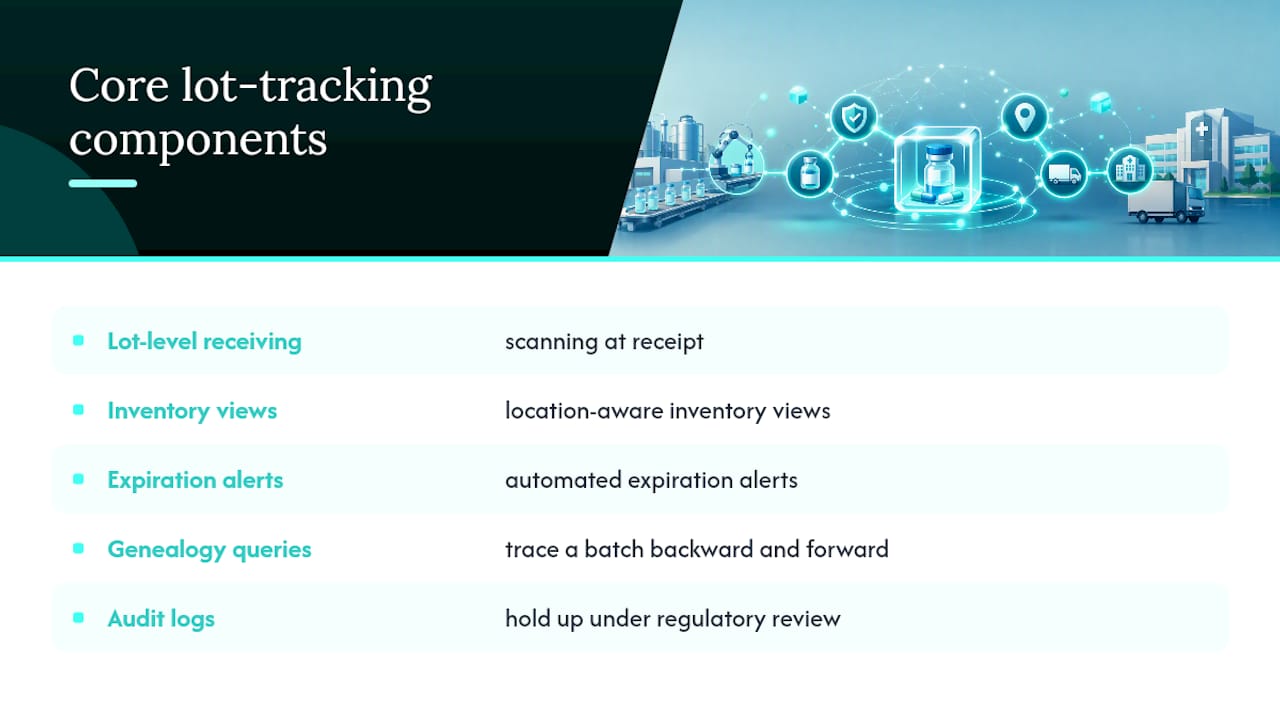
On the software side, require lot-level receiving, location-aware inventory views, automated expiration alerts, genealogy queries that can trace a batch backward and forward, and audit logs that hold up under regulatory review.
Labeling has to follow a consistent standard. GS1-compliant barcodes or QR codes that encode lot number and expiration date, paired with human-readable text on the same label, remove the guesswork at receiving and point-of-use. Placement matters too: a lot label buried inside secondary packaging does nobody any good during a fast pull.
Integration ties it together. Receiving data, warehouse or inventory management systems, purchasing systems, and where relevant, EHR or pharmacy platforms, all need to share lot assignments so a unit scanned at receipt carries its identity all the way to the point of use. Queenssurgical’s own approach to clinic supply inventory management reflects this same principle: lot data has to move with the product, not sit trapped in one system.
None of this works without training. Simple, written standard operating procedures, scanning at receipt and again at point-of-use, and role-based access controls keep the audit trail clean instead of full of gaps where someone skipped a step.
Pro Tip: Compliance logging tools built for regulated industries, like those from Bespoke Compliance Solutions, can give you a template for the kind of timestamped documentation a lot-tracking audit trail needs to hold up.
What Are the Most Common Lot Tracking Mistakes?
Most lot tracking failures trace back to a handful of repeat offenders. Missing or mismatched lot identifiers at receiving is the most common: a box arrives without a clear manufacturer lot number, and if nobody assigns an internal one immediately, that unit becomes untraceable the moment it hits the shelf. Quarantine it and reconcile against the supplier’s documents before it enters circulation.
Expired items showing up in active pick locations is another frequent problem. It usually means expiration data never made it into the replenishment process, creating what amounts to zombie stock, expired units still available for a nurse or tech to grab. Enable expiry alerts in your reorder logic and back it up with physical shelf checks.
Reconcile mismatched lot IDs against supplier documents immediately, don’t wait.
Feed expiration dates into replenishment so expired stock stops appearing as available.
Classify high-value instruments correctly. Lot tracking suits consumables; serial tracking suits equipment needing individual maintenance and warranty records.
Retire spreadsheets as your primary lot system once volume grows. They break down under audit scrutiny and don’t scale.
Is Your Facility Ready for a Recall Audit?
Run through this before an auditor asks you to:
Confirm lot-level receiving is enabled and has been tested against a real shipment.
Verify scanned lot IDs link back to purchase orders and delivery records without manual lookup.
Check that expiry-driven FIFO is actually functioning, not just configured.
Confirm a documented recall standard operating procedure exists and staff can locate it.
Review results from your most recent simulated recall drill.
Make sure staff training logs are current and signed off.
For an exercise that surfaces real gaps, pick one SKU and run a timed recall simulation. Measure how long it takes to isolate every unit of that lot, and note exactly where the system query stalled or a team member wasn’t sure what to do next.
What Should Supply Managers Prioritize First?
Fix receipt and expiry controls before anything else. Scanning at receiving and turning on expiration alerts deliver the fastest risk reduction for the least effort, and they expose data problems before a recall does. Once that’s solid, integrate lot data into replenishment logic and start running recall drills on a regular schedule. If you’re not sure where your facility’s gaps are, ask your procurement lead or supply-team manager for an internal readiness review before an external audit forces the question.
How Queenssurgical Supports Lot-Tracked Supply Ordering
Consistent lot labeling starts before a box ever reaches your loading dock. Buying consumables from a supplier that follows GS1-style labeling practices means your receiving team isn’t stuck decoding inconsistent formats from three different vendors every week.
Queenssurgical ships gloves, masks, and disposables with clear lot documentation baked into the packaging, which cuts the friction most clinics hit during onboarding: mismatched labels, missing production dates, or lot codes that don’t match the packing slip. That consistency makes receiving faster and keeps your audit trail intact from the moment a shipment arrives. Whether you’re stocking up on surgical face masks for a busy clinic or outfitting a lab with disposable uniforms, you’re getting products labeled the way your lot tracking system expects them. Browse Queenssurgical’s product catalog or reach out directly for bulk order pricing and labeling guidance tailored to your facility’s receiving workflow.
Frequently Asked Questions
What does lot number tracking mean in simple terms? It means assigning a unique code to a group of products made or received together, then monitoring that code so you always know where the batch is and how much remains in stock.
How does lot number tracking work day to day? Staff scan a lot code at receiving, storage, and dispensing, and the system logs each movement with a timestamp so the batch’s location and remaining quantity stay current.
What’s the difference between a lot number and a serial number? A lot number identifies a batch of identical items made together; a serial number identifies one individual unit, which matters for high-value equipment needing maintenance history.
Why is lot number tracking important for medication management? It lets pharmacies and clinics pull only the affected batch during a recall, keep FIFO rotation accurate for perishables, and produce an audit trail regulators can review.
What happens if a lot number is missing from a shipment? Create an internal receiving lot tied to the supplier invoice and receiving date immediately, so the item stays traceable even without manufacturer labeling.
This article is general information, not a substitute for advice from a qualified doctor. Consult a qualified healthcare professional about your own circumstances before acting on anything here.
Sources
Recommended
Comments