What Does Landed Cost Mean for Importers?
- Qubit Technology
- 2 days ago
- 11 min read

Landed cost is the total amount you actually pay to get a product from a supplier’s facility to your warehouse door — not just the invoice price. For U.S. importers, that number drives every pricing and margin decision you make. The compact formula:
Landed Cost = Product Cost + International Freight + Insurance + Customs Duties/Taxes + Brokerage Fees + Destination & Domestic Transport + Miscellaneous Fees
The line items that show up on nearly every shipment:
Product cost (the supplier invoice or FOB value)
International freight (ocean or air)
Customs duties and tariffs (based on HTS classification)
Domestic transport (drayage, trucking to your warehouse)
According to USA Customs Clearance, landed cost is what ultimately determines your true margin and price-per-unit — not the number on the commercial invoice.
Key Takeaways
Landed cost, not invoice price, is the only number that gives you an accurate read on margin — and every component from duties to drayage must be in the model before you set a selling price.
Point | Details |
Calculate per-unit landed cost first | Divide total shipment costs by unit count before setting any retail or wholesale price. |
Separate statutory from variable costs | Fixed fees (MPF, HMF, duties) are predictable; destination charges need a buffer for variability. |
Classify HTS codes early | Run HTS classification during sourcing, not after goods ship, to compare true landed cost across suppliers. |
Allocate to inventory, not expenses | Landed cost belongs in inventory value; COGS is recognized at the point of sale, not on arrival. |
Reconcile actuals after every shipment | Log variance drivers (exams, demurrage, re-weighs) to sharpen future estimates and strengthen carrier negotiations. |
Table of Contents
What does landed cost mean for imports, and what goes into it?
Every cost component in the landed-cost model has a different character. Some are fixed and predictable; others swing with market conditions. Knowing which is which changes how you budget.
Product cost
This is your starting point: the price on the supplier’s commercial invoice. Under EXW (Ex Works) terms, that number excludes all freight and export charges, so you collect those separately. Under FOB (Free on Board), the supplier covers loading at the origin port, so your freight cost starts from that point. The distinction matters because it determines which charges you must gather yourself before the calculation can work.
International freight and insurance
Ocean freight rates fluctuate with capacity and demand. Air freight costs significantly more per kilogram but cuts transit time from weeks to days. Insurance typically runs a small percentage of the shipment’s commercial value and is worth including even when your Incoterms technically make the supplier responsible for loss in transit — because your landed-cost model should reflect your actual financial exposure, not just the contract.
Customs duties, tariffs, and taxes
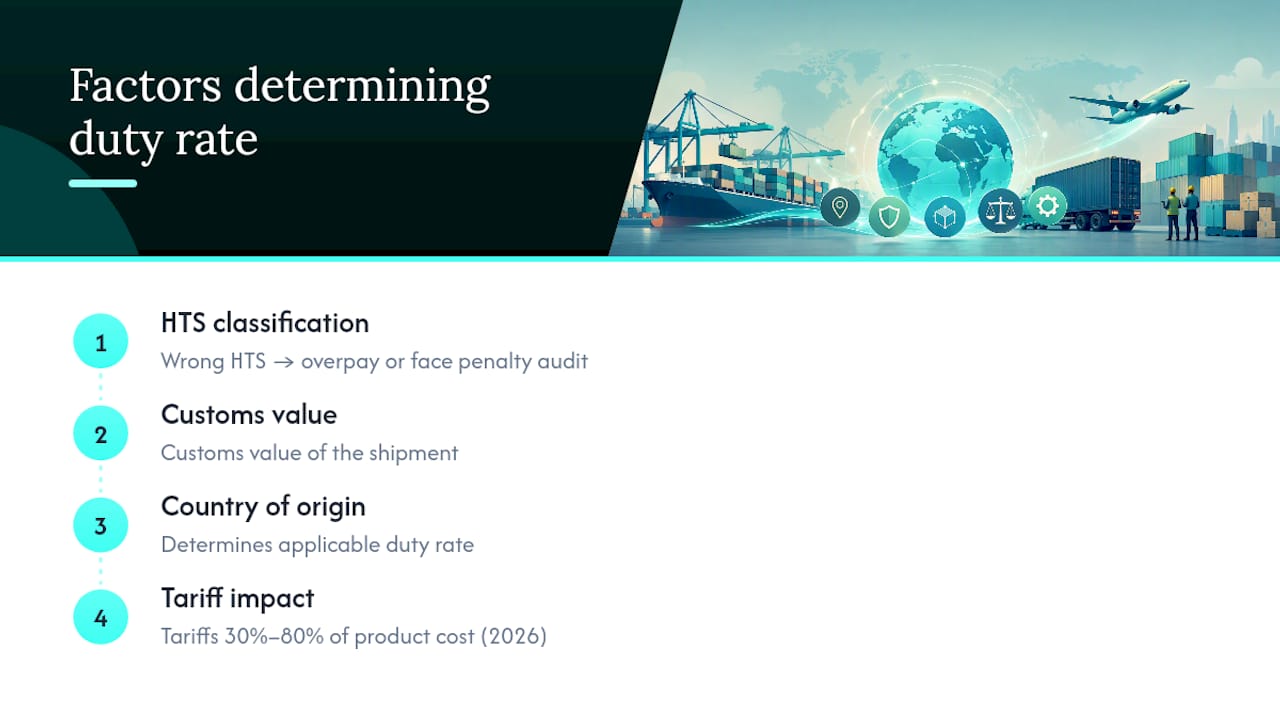
The duty rate applied to your goods depends on three things: the HTS (Harmonized Tariff Schedule) classification, the customs value of the shipment, and the country of origin. Get the HTS code wrong and you either overpay or face a penalty audit. FreightFigures notes that tariffs can represent 30%–80% of product cost for many categories in 2026, which makes early HTS classification one of the highest-leverage steps in sourcing.
Customs brokerage and statutory fees
A licensed customs broker charges a service fee to prepare and file your entry. On top of that, CBP collects two mandatory fees on most commercial imports: the Merchandise Processing Fee (MPF) and the Harbor Maintenance Fee (HMF). Both must be included in your landed-cost math — more on the exact rates in the duties section below.
Destination-side charges
These are the fees that catch importers off guard. Terminal handling, drayage from the port to your warehouse, storage, demurrage (charges for containers held at the terminal past free time), and detention (charges for containers held at your facility past free time) all add up fast during port congestion or inspection holds.

Domestic transportation
Once the container clears customs, it still has to reach your facility. Full truckload (FTL) or less-than-truckload (LTL) rates vary by lane, distance, and fuel surcharges. This cost is often underestimated because it feels like a “local” expense — but on a high-volume import, it can rival brokerage fees.
Miscellaneous charges
Currency conversion fees, bank wire charges, payment-term surcharges, crating or repackaging costs, and third-party inspection fees all belong here. DHL’s landed-cost guide specifically flags handling fees, compliance costs, and currency conversion as common sources of margin erosion that importers routinely leave out of their estimates.
Pro Tip: Separate your costs into two buckets before you calculate: statutory/predictable (duties, MPF, HMF, brokerage) and variable/controllable (routing, service levels, storage). The first bucket you estimate with high confidence; the second needs a buffer. This split also makes post-shipment reconciliation much faster.
How to calculate landed cost per unit: a step-by-step example
Gathering the inputs is harder than the arithmetic. NetSuite points out that the main challenge is getting consistent, complete data from suppliers, carriers, and brokers — not running the formula itself.
Steps to run the calculation
Pull the supplier’s commercial invoice (product cost, quantity, unit price, country of origin).
Get the freight quote or actual freight bill (ocean or air, port-to-port).
Add the insurance premium (or estimate it as a percentage of commercial value).
Estimate customs duties using the HTS code and CBP’s duty rate.
Add statutory fees: MPF and HMF (calculated on entered value and freight value respectively).
Add the customs broker’s service fee.
Add destination charges: terminal handling, drayage to warehouse, any storage or exam fees.
Divide the total by unit count to get landed cost per unit.
Worked example
The supplier invoice said $10.00 per unit. The real cost is $14.44. That gap is where margins disappear if you price off the invoice.
Data checklist before you calculate:
Commercial invoice with unit price, quantity, and country of origin
Freight quote or bill (ocean/air, port-to-port)
Insurance certificate or premium quote
HTS code and applicable duty rate
CBP fee schedule (MPF/HMF rates)
Broker service fee quote
Drayage and terminal handling estimates
How Incoterms change who pays, not what you owe
Incoterms allocate responsibility and risk between buyer and seller. They do not remove any cost from your landed-cost model. Even if your supplier pays freight under CIF terms, that cost is embedded in the price you pay — and you still need to account for it to understand your true unit economics.
Incoterm | Freight | Insurance | Export Customs | Import Duties | Delivery to Warehouse |
EXW | Buyer | Buyer | Buyer | Buyer | Buyer |
FOB | Buyer | Buyer | Seller | Buyer | Buyer |
CIF | Seller | Seller | Seller | Buyer | Buyer |
DDP | Seller | Seller | Seller | Seller | Seller |
Under DDP, the supplier handles everything including import duties — but you lose visibility into what those costs actually are, which makes it nearly impossible to negotiate or audit your landed cost. Most experienced importers prefer FOB or EXW precisely because it keeps every cost line visible and negotiable.
Documents to request by Incoterm:
EXW/FOB: Commercial invoice, packing list, freight bill, insurance certificate, export declaration
CIF: Commercial invoice, packing list, insurance certificate (verify coverage amount), bill of lading
DDP: Commercial invoice, proof of duty payment — request the duty breakdown even if the supplier paid it
U.S. customs duties, HTS codes, and mandatory government fees
The HTS (Harmonized Tariff Schedule) code assigned to your product determines the duty rate CBP applies to the customs value of your shipment. Customs value is generally the transaction value (what you paid), adjusted for certain additions like assists or royalties. Related-party transactions get extra scrutiny and may require additional documentation to support the declared value.
Two fees apply to nearly every formal U.S. import entry and must be included in your landed-cost calculation. CBP confirms the rates:
MPF: 0.3464% of entered value (with statutory minimum and maximum thresholds). HMF: 0.125% of the value of commercial cargo loaded on vessels at U.S. ports — applies to ocean shipments only.
These fees are calculated at the entry level and then allocated across units. Divide the total MPF and HMF by your unit count to get the per-unit contribution, as shown in the worked example above.
To look up HTS codes and current duty rates, use the USITC HTS search tool or CBP’s ACE portal. For tariff actions (Section 301, Section 232, antidumping/countervailing duties), check Trade.gov for current guidance, since these rates change and can stack on top of the base MFN duty rate.
Pro Tip: *Run your HTS classification before you finalize a sourcing decision, not after the goods ship.
Destination-side costs and the fees that catch importers off guard
Drayage, demurrage, detention, terminal handling, storage, and customs examinations are the line items that most frequently cause landed-cost variance between estimate and actual. They are also the most controllable with good operational discipline.
Drayage: The truck move from the port terminal to your warehouse. Rates vary by distance, chassis availability, and congestion surcharges.
Terminal handling charges (THC): Fees the terminal charges for moving the container within the port. Often buried in the freight quote but billed separately.
Free time: The number of days you have to pick up a container before demurrage starts. Typically 3–5 days at most U.S. ports, sometimes less during peak season.
Demurrage: Daily charges for containers left at the terminal past free time. These escalate quickly and can run hundreds of dollars per day per container.
Detention: Daily charges for containers kept at your facility past the return deadline. Separate from demurrage and equally punishing.
Customs exams: CBP can select any shipment for a physical or document exam. Exam fees, unloading/reloading costs, and any resulting storage charges are your responsibility.
Currency and fuel surcharges: Freight rates are often quoted in USD, but fuel surcharges (BAF/EBS) and currency adjustment factors (CAF) can add meaningful cost, especially on long-haul lanes.
Track free-time windows from the moment your vessel arrival notice lands. And tighten your documentation — incomplete or mismatched paperwork is the single most common trigger for a customs exam.
For operational controls on lead time and shipment tracking, managing lead time effectively reduces the risk of missing free-time windows and paying avoidable demurrage.
Which tools help you estimate and automate landed cost?
The right tool depends on your import volume and complexity.
Carrier and forwarder calculators (DHL, Freightos, and similar platforms) are the fastest starting point. Freightos offers live freight quotes that feed directly into a landed-cost estimate. These tools work well for spot checks and new-product sourcing, but they rarely capture all destination-side fees or allocate statutory fees per unit.
Dedicated landed-cost SaaS tools sit between a carrier calculator and a full ERP. They typically include HTS lookup, duty-rate databases, and the ability to model multiple sourcing scenarios side by side. Good for mid-size importers running dozens of SKUs across multiple origins.
ERP modules (NetSuite, SAP, Oracle) include landed-cost allocation features that tie directly to purchase orders and inventory valuation. Once configured, they automate the allocation of freight, duties, and fees to individual SKUs and update COGS in real time. The setup investment is significant, but for high-volume importers, the accuracy and audit trail are worth it.
Checklist for evaluating any landed-cost tool:
Does it include HTS lookup and current duty rates?
Can it handle country-of-origin rules and preferential tariff programs?
Does it allocate fixed fees (brokerage, MPF) across individual units?
Does it integrate with your purchase orders and accounting system?
Can you add a variable buffer for destination charges?
It’s easier to explain a better-than-expected margin than a surprise loss.*
How landed cost flows into pricing and COGS
Landed cost belongs in inventory, not in the expense line. NetSuite’s guidance is clear: landed cost represents the direct costs to get goods ready for sale and should be allocated to inventory value for accurate financial reporting. COGS is recognized when the goods are sold, not when they arrive.
Pricing off the supplier invoice and expensing freight separately is one of the most common accounting errors in import businesses. It understates inventory value and overstates operating expenses.
Here is how a priced SKU looks when landed cost is the base:
For healthcare procurement teams weighing capital equipment versus consumables, the rent vs. buy analysis is worth running alongside your landed-cost model, since the total cost of ownership for imported equipment includes all the same landed-cost components plus ongoing maintenance.
Concrete ways to reduce your landed cost
Landed cost is not fixed. Every component has a lever.
Sourcing tactics:
Negotiate FOB instead of EXW when your freight volume gives you leverage — consolidating freight under one forwarder often beats the supplier’s local rates.
Optimize packaging to reduce dimensional weight; a box that is 10% smaller can meaningfully cut air freight costs.
Wholesale consolidation reduces per-unit freight and brokerage costs by spreading fixed fees across larger quantities.
Logistics tactics:
Use ocean over air for non-urgent SKUs. The cost difference is substantial, and the landed-cost impact compounds across volume.
Consolidate LCL (less-than-container-load) shipments into FCL (full container load) once volume justifies it.
Bonded warehouses let you defer duty payment until goods are withdrawn for sale — useful for managing cash flow on high-duty items.
Customs and compliance tactics:
Pre-classify HTS codes with your broker before goods ship. Reclassification after arrival is expensive and slow.
Request complete supplier documentation (manufacturer’s affidavit, material composition, country-of-origin certificates) upfront to support your declared customs value and reduce exam risk.
Review tariff engineering options with a licensed customs attorney where lawful — sometimes a minor product modification changes the applicable HTS chapter and duty rate.
Operational tactics:
Set calendar alerts for free-time expiration on every container. Missing free time by one day costs more than most brokerage fees.
Tighten document matching between the commercial invoice, packing list, and bill of lading — discrepancies are the most common exam trigger.
Reconcile estimated vs. actual landed cost after every shipment and log variance drivers. That data improves your next estimate and gives you leverage in broker and carrier negotiations.
For healthcare-specific sourcing controls, surgical supplies sourcing practices covers supplier evaluation criteria that map directly onto landed-cost management.
Pro Tip: Assign ownership: procurement owns HTS classification and supplier documentation; logistics owns free-time tracking and routing; finance owns the post-shipment reconciliation. When no one owns a task, it defaults to “no one did it.”
A note on landed cost in medical supplies importing
Medical consumables and equipment importing has a few wrinkles that make landed-cost discipline especially important. Lead times are less flexible — a hospital running low on isolation gowns or gloves cannot wait for a re-order cycle the way a general retailer can. That pressure pushes procurement teams toward air freight, which can triple the freight component of landed cost overnight.

HTS classification for medical devices and consumables requires care. Gloves, gowns, and instruments each fall under different HTS chapters with different duty rates, and some categories carry additional FDA import requirements that add compliance documentation costs. Medical equipment import regulations covers the documentation layer in detail.
Sterility and temperature-control requirements can add packaging surcharges and specialized handling fees that a standard landed-cost template will miss. Build a line item for these in your model from the start.
Authoritative resources for U.S. importers
Resource | Best used for |
Looking up HTS codes and base duty rates by product | |
Tracking Section 301, Section 232, and antidumping/CVD updates | |
Plain-language breakdown of all U.S. landed-cost components | |
Carrier-side estimator and hidden-fee checklist | |
Live freight rate quotes to feed into landed-cost models | |
Current tariff exposure analysis and worked calculation examples |
Tariff rates and statutory fees change. Check CBP and Trade.gov before finalizing any landed-cost estimate, especially for categories affected by Section 301 actions or antidumping orders, where rates can update mid-year.
This article provides general information on landed-cost calculation for U.S. imports. It is not legal, tax, or customs advice. Confirm current duty rates, fee schedules, and regulatory requirements with a licensed customs broker or trade attorney before making sourcing or pricing decisions.
Sources
Recommended
Comments