How Payment Terms Shape Supplier Relationships and Cash Flow
Updated: Sep 9

Payment terms are one of the most consequential decisions in procurement, and most teams treat them as a finance default rather than a strategic lever. The core truth: how you pay suppliers changes what they can do for you, how much they charge you, and whether they prioritize your orders when supply gets tight.
Three implications land immediately for procurement and finance leaders:
Cash vs. risk tradeoff. Extending terms from Net 30 to Net 60 frees working capital for buyers, but that liquidity comes directly out of the supplier’s pocket. The supplier either borrows to cover the gap or quietly builds a price premium into the next contract.
Supplier solvency and service level. Suppliers with thin margins cannot absorb a 30-day payment delay without operational consequences. Quality slips, lead times stretch, and the supplier starts prioritizing customers who pay faster.
Reputational effects. Buyers known for reliable, on-time payment become preferred customers. Buyers who push terms unilaterally get deprioritized in allocation shortages, which in healthcare can mean real supply disruption.
Three actions your team can take in the near term:
Run a supplier segmentation review to identify which suppliers are strategic, critical, or transactional before touching any terms.
Pause any unilateral term changes already in motion until you have a supplier-impact analysis in hand.
Model a cash-impact scenario using your current DPO and the cost of capital for your top 20 suppliers to see whether the working-capital gain actually exceeds the hidden cost.
Table of Contents
Why payment terms affect supplier relationships: the fundamentals
Risks and hidden costs suppliers face when buyers extend payment terms
Why buyers extend or shorten terms — the trade-offs to weigh
Align payment strategy with supplier segmentation using SRM principles
How to negotiate payment terms without wrecking the relationship
Financing and payables programs that let buyers hold cash while protecting suppliers
Implementation checklist and KPIs to monitor after changing payment terms
Illustrative scenario: Net 30 to Net 60 and what it actually costs both sides
Queenssurgical makes reliable supply the baseline, not the goal
Why payment terms affect supplier relationships: the fundamentals
Before the math and the tactics, a shared vocabulary matters. “Payment terms” is a broad label covering several distinct contract mechanisms, and procurement teams that conflate them make negotiation errors.
Common payment term structures:
Net X (Net 30, Net 60, Net 90). Payment is due within X calendar days of the invoice date, delivery, or acceptance, depending on the contract trigger. Net 30 is the most common baseline in U.S. commercial contracts.
Early-payment discount (e.g., 2/10 Net 30). The supplier offers a 2% discount if the buyer pays within 10 days; otherwise, the full amount is due in 30. Not taking a 2/10 Net 30 discount can result in a high annualized financing cost, making it an expensive form of short-term financing for a buyer to ignore.
Late payment penalties. A contractual fee applied to overdue balances. These are more common in government and construction contracts but appear in healthcare supply agreements.
Staged or milestone payments. Payment tied to delivery milestones, acceptance testing, or installation sign-off rather than a fixed calendar date. Common in capital equipment and large service contracts.
Payment triggers. The event that starts the clock: invoice receipt, purchase order (PO) match, goods receipt, or three-way match (PO + receipt + invoice). A mismatch between what the buyer and supplier expect as the trigger is one of the most common sources of late payment disputes.
Pro Tip: Add the payment trigger explicitly to every PO and contract template. “Net 30 from invoice date” and “Net 30 from three-way match” can differ by 10–15 days in practice, and that gap is often where supplier frustration starts.
For healthcare procurement teams managing high-volume consumables, catalog-based ordering and PO controls directly affect invoice accuracy and the ability to meet stated terms.
How payment timing moves working capital in both directions
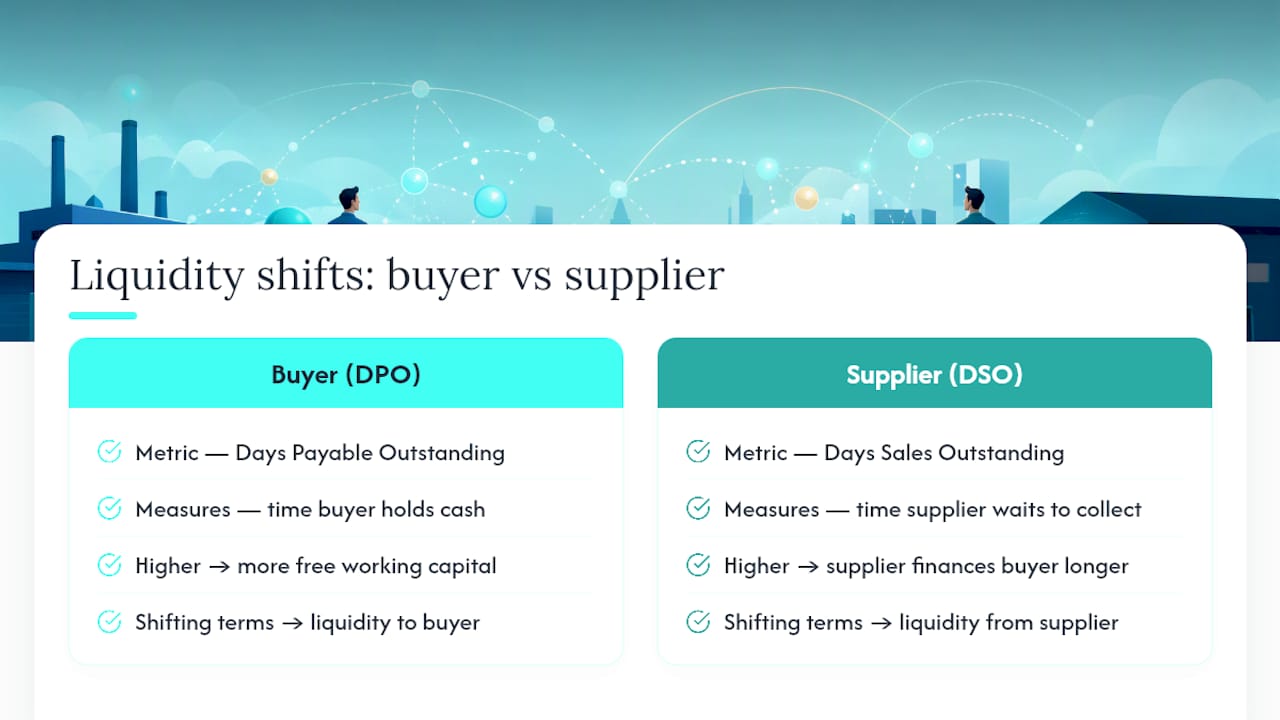
The financial mechanics are straightforward once you see them in a single example. Two metrics do the work: Days Payable Outstanding (DPO) for buyers and Days Sales Outstanding (DSO) for suppliers. As J.P. Morgan explains, shifting net terms moves these two metrics in opposite directions, transferring liquidity from one party to the other.
DPO measures how long a buyer holds cash before paying suppliers. Higher DPO means more days of free working capital. DSO measures how long a supplier waits to collect cash after delivering goods. Higher DSO means more days the supplier is financing the buyer’s operations.
Worked example:
The buyer retains a substantial amount in working capital. At an assumed cost of capital, this represents a notable annual financial benefit. Meanwhile, the supplier pays higher financing costs to cover the gap. The total economic cost to the supply chain is higher than the buyer’s benefit, and as Corpay notes, suppliers who recognize this math tend to recover the difference through price adjustments on the next contract renewal.
Risks and hidden costs suppliers face when buyers extend payment terms
Extending payment terms is not a free working-capital gain. The costs are real; they just appear on the supplier’s balance sheet first, and then migrate back to the buyer in less obvious forms.
Direct supplier impacts:
Solvency stress. Suppliers with very thin margins cannot absorb extended payment delays on large invoices without drawing on credit lines or delaying their own payables.
Higher borrowing costs. Small and mid-size suppliers typically pay more to borrow than large buyers, meaning the buyer’s “free” extension is costly for the supplier.
Service degradation. When cash is tight, maintenance gets deferred, staffing gets cut, and quality control gets thinner. The buyer experiences this as longer lead times, more defects, and less responsiveness.
Supplier turnover. Peer-reviewed research published in the Journal of Supply Chain Management finds that abrupt payable extensions are associated with higher supplier turnover and retaliation, and with worse longer-term financial performance for buyers compared with matched firms that did not extend terms.
Indirect costs that land back on the buyer:
Supply interruptions and emergency sourcing at premium prices.
Loss of supplier innovation: a cash-stressed supplier stops investing in R&D, process improvement, or capacity expansion.
In healthcare specifically, delayed payments can force suppliers to choose between payroll, maintenance, and other obligations, creating operational and safety risks that cascade through the supply chain.
Reputational damage: buyers known for slow payment get deprioritized in allocation shortages and face higher risk premiums on new contracts.
Statistic to watch: Research links abrupt payable extensions to increased supplier turnover and indirect cost increases that can outweigh the buyer’s short-term working-capital gain, particularly when the buyer lacks significant bargaining power over the supplier.
Pro Tip: Watch for early supplier stress signals in your AP and operations data: rising dispute rates, more frequent invoice corrections, requests for advance payment, and longer lead times on previously reliable SKUs. These are the canary in the coal mine before a supplier relationship breaks down.
For healthcare procurement teams, supply continuity and lead-time reliability are directly tied to how suppliers are treated financially.

Why buyers extend or shorten terms — the trade-offs to weigh
Changing payment terms is a deliberate decision with real costs on both sides. The mistake most procurement teams make is treating term extension as a default cash-saving measure rather than a trade-off with a price tag.
Buyer benefits from extending terms:
Improved short-term DPO and working-capital metrics, which matter for quarterly reporting.
Reduced reliance on short-term borrowing during cash-flow troughs.
Potential interest savings versus drawing on a revolving credit facility.
Supplier benefits from shorter terms (and buyer benefits from offering them):
Suppliers with better cash flow invest more in capacity, quality, and innovation.
Buyers who pay early gain “customer of choice” status, which translates to priority allocation during shortages, better pricing, and first access to new products.
Shorter terms reduce the supplier’s need to price in a financing premium, which can lower the buyer’s total cost of ownership over time.
Decision checklist before changing terms:
What is the supplier’s estimated margin and borrowing rate? If the supplier’s DSO would exceed industry norms by more than 30 days, the risk is high.
Is this supplier strategic, critical, or transactional? The answer should determine whether you protect or negotiate harder.
Have you modeled the hidden price-premium risk? A supplier who absorbs a 30-day extension today may recover it in the next price negotiation.
Is there a financing alternative (dynamic discounting, supply-chain finance) that lets you hold cash without pushing the cost onto the supplier?
Have you communicated the change transparently and given adequate notice? Unilateral changes destroy trust faster than almost any other procurement action.
Efficient sourcing practices for healthcare providers include payment-term negotiation as part of a broader supplier selection and management framework.
Align payment strategy with supplier segmentation using SRM principles
A single payment policy applied to every supplier is one of the most common and costly procurement mistakes. Gartner recommends segmenting suppliers by risk and value and using different payment and collaboration approaches for strategic versus transactional suppliers. CIPS defines SRM as an enterprise practice that uses supplier segmentation and joint performance mechanisms to maximize value from supplier interactions.
The segmentation logic is simple: plot suppliers on a two-axis matrix of supply risk (what happens if they fail?) against value delivered (revenue, quality, innovation). Four quadrants emerge, and payment policy maps differently to each.
Segment-specific payment rules of thumb:
Strategic suppliers (high value, high risk). Protect their cash flow. Offer Net 30 or shorter, consider early-pay programs, and share roadmaps. These suppliers are hard to replace and their financial health directly affects your supply security.
Critical suppliers (high risk, moderate value). Use conditional, time-bound term changes only. If you need to extend terms, pair the change with a supply-chain finance option so the supplier can access cash without waiting for your payment.
Leverage suppliers (high value, lower risk). Negotiate harder on terms. Multiple qualified alternatives exist, and the supplier has incentive to maintain the relationship. Net 45–60 is defensible here with proper notice.
Transactional suppliers (low risk, low value). Apply standard terms and limited collaboration. Automate the payment process and focus negotiation energy elsewhere.
Pro Tip: Build joint KPIs into strategic supplier contracts: on-time delivery rate, defect rate, and payment-on-time rate tracked by both sides. When both parties see the same data, payment disputes drop and the relationship shifts from adversarial to collaborative. SRM frameworks from CIPS and Gartner both emphasize reciprocal performance scorecards as a core mechanism.
For teams managing high-demand consumables, prioritizing which categories need supplier protection versus tougher commercial terms is a practical first step in segmentation.
How to negotiate payment terms without wrecking the relationship
Negotiation sequencing matters as much as the terms themselves. A well-sequenced conversation preserves trust; a poorly sequenced one signals that you see the supplier as a cost line rather than a partner.
A practical negotiation playbook:
Discovery first. Before proposing any change, understand the supplier’s cash-flow cycle, their primary financing sources, and their margin profile. Ask directly: “What payment timing works best for your operations?” The answer tells you where flexibility exists.
Lead with transparency. Explain your working-capital objective honestly. “We’re working to extend our DPO by 15 days across the portfolio. I want to understand the impact on your side before we finalize anything.” This framing signals respect and reduces the chance of a defensive reaction.
Make segmented offers. Don’t propose the same terms to every supplier. Offer your strategic suppliers better terms than your transactional ones, and say so explicitly. Suppliers talk to each other; a differentiated approach signals that you reward the relationship.
Use conditional deals. “We’d like to move to Net 45, but we’re willing to offer a 1.5% early-pay discount if you prefer faster cash.” This gives the supplier a real choice and keeps the economic relationship balanced.
Prepare a fallback. If the supplier pushes back hard, have a supply-chain finance option ready to offer. “We can’t move back to Net 30, but we can enroll you in our early-pay program so you can access cash within 5 days at a small discount rate.”
Sample phrasing for a difficult conversation:
“We need to adjust our payment cycle for cash-flow reasons. This isn’t a reflection of our relationship or your performance. We want to make sure the change works for both sides, so I’d like to walk through the options with you before anything is finalized.”
ICAEW’s guidance on maximizing supplier relationships is direct on this point: unilateral, company-wide term changes destroy trust quickly and force costly reversals. Cross-functional alignment between procurement, finance, and legal before any supplier conversation is non-negotiable.
Operational levers to combine with negotiation:
AP automation to reduce processing time and capture early-pay discounts consistently. J.P. Morgan notes that AP automation increases the ability to capture discounts reliably, though payment by card may preclude some discounts due to processing fees.
PO matching accuracy: faster three-way match means the payment clock starts sooner, which effectively shortens DSO for the supplier without changing the stated terms.
Tying term changes to performance milestones: “We’ll move to Net 45 after 12 months of on-time delivery above 98%.” This frames the change as earned rather than imposed.
For specialty supplier negotiations where lead times and payment terms intersect, contract negotiation guidance for specialty suppliers offers practical sequencing that applies across categories.
Financing and payables programs that let buyers hold cash while protecting suppliers
The best payment-term strategy doesn’t force a binary choice between buyer liquidity and supplier health. Several financing structures let buyers extend their effective DPO while giving suppliers access to cash faster than the stated terms.

Dynamic discounting. The buyer offers the supplier early payment at a discount rate the buyer sets. The buyer earns a return on idle cash; the supplier gets liquidity faster. Works best when the buyer has excess cash and the supplier’s borrowing rate exceeds the discount rate offered. No third-party financing required.
Supply-chain finance (reverse factoring). A bank or fintech platform pays the supplier early at a rate close to the buyer’s credit rating (lower than the supplier’s own borrowing cost). The buyer pays the platform on the original due date. The supplier gets cheap early cash; the buyer’s DPO stays extended. Most appropriate for strategic and critical suppliers with invoice volumes large enough to justify platform onboarding.
Factoring. The supplier sells its receivables to a third party at a discount, independent of the buyer. The buyer’s terms don’t change. Useful when the buyer cannot or will not offer a buyer-led program, but the supplier needs liquidity. The discount rate is higher than reverse factoring because it’s based on the supplier’s credit, not the buyer’s.
Early-pay programs. Buyer-administered programs where suppliers can request early payment on approved invoices at a fixed discount rate. Lower administrative complexity than full supply-chain finance platforms. Best for mid-tier suppliers that don’t qualify for reverse factoring.
Card and virtual card programs. The buyer pays via commercial card, extending effective DPO by the card’s payment cycle. As J.P. Morgan notes, card fees often prevent combining card payment with early-pay discounts, so the net benefit to the supplier needs careful calculation.
When to use each:
Strategic suppliers with large invoice volumes: supply-chain finance.
Buyers with excess cash seeking a return: dynamic discounting.
Suppliers who need flexibility independent of buyer programs: factoring.
Mid-tier suppliers, simpler programs: early-pay or card.
AP automation and technology platforms that support discount capture and faster invoice processing are a practical first step before deploying any of these programs.
Implementation checklist and KPIs to monitor after changing payment terms
A term change that isn’t governed properly becomes a relationship liability. The checklist below covers the governance, communication, and measurement steps that separate a managed change from a unilateral surprise.
Implementation checklist:
Obtain cross-functional sign-off (procurement, finance, legal, operations) before any supplier communication.
Segment the supplier base and identify which suppliers will be affected, at what tier, and with what lead time for notice.
Draft contract amendments and legal review for all affected agreements.
Notify affected suppliers in writing with at least 60 days’ notice for strategic and critical suppliers; 30 days minimum for transactional.
Offer financing alternatives (early-pay, supply-chain finance) to strategic and critical suppliers at the time of notification.
Update AP system configurations, PO templates, and payment triggers to reflect new terms.
Run a 90-day pilot with a small cohort of willing suppliers before full rollout.
Schedule a post-pilot review with supplier feedback before expanding.
Communicate internally to AP, operations, and category managers so no one is caught off guard by supplier inquiries.
KPIs to track post-change:
KPI | Owner | Reporting Cadence |
Days Payable Outstanding (DPO) | Finance | Monthly |
Supplier DSO (estimated) | Procurement | Quarterly |
On-time payment rate | AP | Monthly |
Supplier satisfaction score | Procurement | Quarterly |
Supply availability / fill rate | Operations | Weekly |
Number of supplier disputes/claims | AP | Monthly |
Early-pay discount capture rate | Finance | Monthly |
A drop in fill rate or a spike in supplier disputes within 60 days of a term change is a strong signal that the change is creating downstream stress. Act on those signals before they become supply interruptions.
Illustrative scenario: Net 30 to Net 60 and what it actually costs both sides
Scenario inputs:
The buyer’s working-capital gain is a modest amount annually. The supplier’s financing cost is higher, and any supplier price increase at renewal could offset the buyer’s benefit.
Sensitivity notes:
If the supplier’s borrowing rate is 12% instead of 10%, the financing cost rises to $47,342, and the price-adjustment pressure increases proportionally.
If the buyer has significant bargaining power (sole-source buyer for the supplier), the supplier may absorb the cost rather than risk the relationship. But this is a one-time tolerance, not a sustainable dynamic.
If the supplier’s net margin is below 3%, the risk of service degradation or supplier exit rises sharply.
At those thresholds, the relationship cost reliably outweighs the working-capital benefit.
Key actions for procurement and finance leaders
Understanding payment terms and their impact on supplier relationships comes down to one strategic trade-off: short-term cash preservation versus long-term supply security, pricing stability, and access to supplier innovation. Teams that treat payment terms as a finance default rather than a strategic decision tend to discover the cost of that choice during a supply shortage.
Three priority actions:
Segmentation review (first 30 days). Map your top 50 suppliers by risk and value. Identify which ones are strategic or critical before touching any terms. This single step prevents the most common and costly mistakes.
Pilot a financing program (60–90 days). Select 5–10 strategic suppliers and offer an early-pay or supply-chain finance option. Measure supplier satisfaction and fill rate before and after. The data from the pilot will make the business case for broader rollout.
Revise contract templates (90 days). Update PO and contract templates to include explicit payment triggers, early-pay discount options, and late-payment penalty clauses. Ambiguity in payment triggers is one of the most avoidable sources of supplier friction.
KPIs to monitor: DPO, on-time payment rate, supplier dispute rate, fill rate, and supplier satisfaction score. Track them monthly for the first six months after any term change.
The lesson most procurement teams learn the hard way
The conventional wisdom in procurement finance is that extending payment terms is a low-risk way to improve working capital. The evidence says otherwise, and the teams that learn this lesson the hard way tend to learn it at the worst possible moment: during a supply shortage, when the suppliers they squeezed have already deprioritized their orders.
The most underappreciated dynamic in payment-term management is the reputation effect. Buyers who pay reliably and on time become what practitioners call “customers of choice.” They get priority allocation when supply is constrained, first access to new products, and suppliers who pick up the phone when there’s a problem. Buyers who push terms unilaterally get the opposite: higher risk premiums, slower responses, and suppliers who quietly start qualifying alternative customers.
The teams that get this right share one characteristic: they treat payment terms as a joint decision, not a unilateral one. They bring the supplier into the conversation early, explain the business rationale honestly, and offer a financing alternative before asking the supplier to absorb a cash-flow hit. That approach takes more time upfront. It also avoids the costly reversals that happen when a supplier relationship breaks down and the buyer has to emergency-source from a more expensive alternative.
One framing that works well in internal briefings: “We are not extending terms to save money. We are restructuring the payment relationship to optimize total cost of ownership, which means accounting for the supplier’s cost of capital, not just our own.”
Queenssurgical makes reliable supply the baseline, not the goal
For healthcare procurement teams, the payment-term calculus changes when the supplier is genuinely dependable. Predictable delivery, accurate invoicing, and consistent product quality reduce the friction that makes term changes risky. When a supplier performs reliably, there are fewer disputes, faster three-way matches, and less pressure on the relationship when terms need to be adjusted.
Queenssurgical supplies medical consumables and equipment across the Americas with the consistency that procurement teams need to manage payment terms confidently. From disposable laboratory uniforms to surgical instruments and high-demand consumables, the catalog is built for healthcare buyers who need reliable fulfillment and clear pricing. Browse the full catalog at Queenssurgical and contact the team to discuss wholesale terms and volume pricing for your facility.
Sources
The sources below support the claims and frameworks in this article. Each one is worth reading directly if you’re building an internal business case or updating your SRM policy.
Payment terms are a strategic decision, not a finance default. The buyer who accounts for the supplier’s cost of capital, segments the supplier base before changing terms, and offers a financing alternative alongside any extension will consistently outperform the buyer who treats DPO improvement as a free working-capital gain.
Recommended
Comments