Antimicrobial Resistance Explained: What It Is and Why It Matters
- Qubit Technology
- 2 hours ago
- 10 min read
Antimicrobial resistance (AMR) is what happens when microbes — bacteria, viruses, fungi, and parasites — change in ways that make the medicines designed to kill them stop working. The World Health Organization and the Centers for Disease Control and Prevention both identify AMR as one of the most serious threats to global health today.
Here is what that means in practice:
Infections that were once easy to treat can become untreatable or require much longer, more toxic therapies.
Routine medical procedures — joint replacements, chemotherapy, cesarean sections — carry higher risk when the antibiotics that prevent post-surgical infection no longer work reliably.
Resistant germs spread between people, animals, and the environment, crossing borders without a passport.
The reason to care now: AMR is not a future problem. It is already reshaping how medicine is practiced, and the window to slow it is narrowing.
Key Takeaways
Antimicrobial resistance is already causing more than 4.7 million deaths globally per year, and slowing it requires action from individuals, clinicians, and policymakers using tools that exist right now.
Point | Details |
AMR definition | Microbes change so medicines no longer work, making infections harder or impossible to treat. |
Global scale | Bacterial AMR was associated with millions of deaths globally; the U.S. sees millions of resistant infections annually. |
Core prevention actions | Hand hygiene, vaccination, completing antibiotic courses, and diagnostic-guided prescribing all slow resistance. |
Stewardship matters | Using antibiotics only when needed, at the right dose, preserves drug effectiveness for future patients. |
Procurement as prevention | Reliable access to isolation gowns, gloves, and barrier supplies directly reduces transmission of resistant organisms in clinical settings. |
Table of Contents
What are the key facts about antimicrobial resistance?
“Antimicrobials” is the umbrella term for all medicines that kill or suppress microorganisms. That includes:
Antibiotics — target bacteria (penicillin, amoxicillin, ciprofloxacin)
Antivirals — target viruses (oseltamivir, antiretrovirals for HIV)
Antifungals — target fungi (fluconazole, amphotericin B)
Antiparasitics — target parasites (antimalarials, antihelmintics)
AMR affects all four categories, though antibiotic resistance gets the most attention because bacterial infections are the most common clinical scenario.
The scale is staggering. Bacterial AMR was associated with millions of deaths globally, making it a leading cause of death worldwide (https://www.who.int/news-room/fact-sheets/detail/antimicrobial-resistance). The problem spans humans, animals, agriculture, and the environment — which is why public-health authorities call it a One Health issue requiring coordinated action across every sector.
Two structural problems make AMR especially hard to reverse. First, resistant strains spread faster than new drugs are developed. Second, the pharmaceutical pipeline for new antibiotics has slowed dramatically, meaning the drugs we have now are increasingly irreplaceable.
Terms you need to know before reading further
A few definitions make the rest of this article much easier to follow.
Antimicrobial: Any agent that kills or inhibits microorganisms — the parent category covering antibiotics, antivirals, antifungals, and antiparasitics.
Antibiotic: A specific type of antimicrobial that targets bacteria only. Not all antimicrobials are antibiotics, though the terms are often used interchangeably in everyday speech.
Antifungal / Antiviral / Antiparasitic: Medicines targeting fungi, viruses, and parasites, respectively.
Antimicrobial stewardship: A coordinated program to use antimicrobials only when needed, at the right dose, for the right duration — to slow resistance and preserve drug effectiveness.
Superbug: An informal term for a microbe that has developed resistance to multiple drugs, making it very difficult to treat.
Intrinsic resistance: Resistance a microbe naturally has before any drug exposure (e.g., certain bacteria lack the cell wall that penicillin targets).
Acquired resistance: Resistance a microbe develops through mutation or by picking up resistance genes from other microbes.
Horizontal gene transfer: The process by which bacteria share genetic material — including resistance genes — directly with each other, even across different species.
One common misconception: resistance is a trait of the microbe, not the human patient. When a treatment fails, it is because the pathogen has evolved or acquired resistance genes — not because the patient’s body has become resistant to the drug.
How do microbes actually develop resistance?
Resistance happens when microbes change so medicines no longer work. The process is faster and more varied than most people expect.
Genetic mutation and selective pressure are the core engine. When you take an antibiotic, it kills most bacteria in the infection — but not always every single one. Any bacterium with a random mutation that helps it survive the drug lives on and reproduces. Remove the competition from susceptible bacteria, and the resistant strain expands rapidly. Antibiotic exposure exerts exactly this selective pressure, which is why unnecessary antibiotic use is so damaging: it accelerates the selection of resistant strains without providing any benefit to the patient.
Horizontal gene transfer is the other major driver. Bacteria can share resistance genes directly with neighboring bacteria through structures called plasmids or other mobile genetic elements. This means a resistance trait that evolved in one species can jump to a completely different species within hours — no reproduction required.
Once a microbe has resistance genes, it can deploy several specific defenses against drugs:
Enzymatic degradation: Producing enzymes (like beta-lactamases) that chemically destroy the antibiotic before it can act.
Efflux pumps: Molecular pumps that actively push the drug out of the bacterial cell before it reaches its target.
Target modification: Altering the specific protein or structure the drug binds to, so the drug can no longer attach and do its job.
Decreased permeability: Changing the cell wall or membrane so the drug cannot get inside in the first place.
These four mechanisms can operate individually or in combination, which is why some resistant organisms are so difficult to treat.
Pro Tip: For clinicians and procurement professionals, reducing selective pressure starts with diagnostic precision. Rapid culture and susceptibility testing before prescribing — rather than empirical broad-spectrum therapy — is one of the most effective stewardship levers available. Paired with reliable access to narrow-spectrum agents, it slows resistance at the individual patient level.
How do resistant germs spread from one place to another?
Resistant microbes travel through several well-documented routes, and understanding them shows exactly where prevention efforts pay off.
Person to person: Direct contact, respiratory droplets, or touching contaminated surfaces in homes, schools, and workplaces.
Healthcare settings: Hospitals and clinics concentrate vulnerable patients and heavy antibiotic use in the same space, making them high-risk environments for transmission of resistant organisms.
Food and water: Resistant bacteria from animal agriculture enter the food supply through meat, produce, and contaminated water sources.
Animal-to-human transmission: Antibiotic use in livestock selects for resistant strains that can transfer to farm workers, veterinarians, and eventually the broader community.
Environmental reservoirs: Resistant genes accumulate in soil and waterways through agricultural runoff, pharmaceutical manufacturing discharge, and improper drug disposal.
International travel and medical tourism: A patient treated in one country can carry a resistant strain home, seeding new outbreaks thousands of miles from the original source.
AMR is a One Health problem precisely because these routes connect human health, animal health, and environmental health into a single system. Fixing one route while ignoring the others produces limited results.
Water hygiene is a frequently underestimated vector. Facilities managing water hygiene risk controls as part of their infection-prevention programs address one of the environmental pathways that allows resistant organisms to persist and spread.

Why does AMR matter? Real-world impacts and examples
Treatment failure is the most direct consequence: an infection that should clear in a week with a standard antibiotic instead requires weeks of intravenous therapy with drugs that are more toxic, more expensive, and sometimes simply unavailable.
MRSA (methicillin-resistant Staphylococcus aureus): A skin and bloodstream pathogen that resists most common antibiotics, causing serious hospital-acquired and community infections.
Drug-resistant tuberculosis (DR-TB): TB that does not respond to first-line drugs, requiring 18–24 months of treatment with medications that carry significant side effects.
CRE (carbapenem-resistant Enterobacterales): Gut bacteria resistant to carbapenems, which are often the last-resort antibiotics for severe infections. Mortality rates for CRE bloodstream infections are high.
Candida auris: A drug-resistant fungus that spreads easily in healthcare settings, is difficult to identify with standard lab equipment, and resists multiple antifungal drugs simultaneously.
The ripple effects go beyond individual patients. Surgeons rely on prophylactic antibiotics to make operations safe. Oncologists depend on them to protect immunocompromised patients during chemotherapy. Obstetricians use them to prevent infection during cesarean deliveries. When those antibiotics stop working, the risk profile of every one of those procedures changes.
The pipeline problem compounds the clinical picture. The WHO warns that too few new antibiotics are in development to replace those losing effectiveness, which means the drugs clinicians rely on today need to last — there may not be replacements ready when they fail.
What can you do to slow antimicrobial resistance?
Every audience — individuals, clinicians, veterinarians, and policymakers — has specific actions that genuinely move the needle.
For individuals:
Wash hands thoroughly and frequently, especially before eating and after using the bathroom.
Stay up to date on vaccinations; preventing infections means fewer antibiotics needed.
Prepare food safely to avoid foodborne bacterial infections.
Take antibiotics exactly as prescribed — complete the full course, never share them, never save them for later.
Do not pressure a healthcare provider for antibiotics when they are not indicated (most colds and flu are viral and will not respond to antibiotics).
For clinicians and veterinary prescribers:
Order culture and susceptibility tests before prescribing when clinically feasible.
Choose the narrowest-spectrum antibiotic that covers the likely pathogen.
Participate in or lead facility-level stewardship programs.
Apply rigorous infection-control measures: hand hygiene, contact precautions, and proper use of personal protective equipment.
For policymakers and system leaders:
Fund and expand national AMR surveillance networks to track resistance trends in real time.
Create financial incentives for pharmaceutical companies to develop new antibiotics and diagnostics.
Invest in clean water, sanitation, and hygiene infrastructure — infection-prevention basics like hand hygiene, vaccination, and clean water are among the most cost-effective tools available.
Regulate antibiotic use in agriculture and phase out growth-promotion uses.
Pro Tip: Healthcare buyers and procurement managers have a direct role in infection prevention. Stocking reliable isolation gowns, nitrile examination gloves, and barrier sleeves is not a compliance checkbox — it is a frontline defense against the transmission of resistant organisms. A resilient supply chain for infection-prevention products reduces the gaps that allow outbreaks to take hold.
How do clinicians treat resistant infections today?
The first step when a resistant infection is suspected is identification. Clinicians collect samples for culture and susceptibility testing, and increasingly use molecular diagnostic tests (PCR-based panels) that can identify resistant genes within hours rather than days. Isolating the patient to prevent spread often happens simultaneously.
Treatment options then depend on what the susceptibility results show:
Combination therapy: Using two or more antibiotics together to overcome resistance mechanisms that would defeat either drug alone.
Older or repurposed drugs: Some antibiotics that fell out of use because of toxicity are being reconsidered as last-resort options when nothing else works.
Last-line agents: Drugs like colistin or tigecycline, reserved for the most resistant organisms, carry significant side-effect profiles and require specialist oversight.
Source control: Draining abscesses, removing infected devices, or surgical debridement to reduce the bacterial burden so antibiotics can work more effectively.
Specialist referral: Infectious disease specialists are often consulted for resistant infections because treatment decisions are complex and evolving.
Unnecessary antibiotic use increases harm at both the individual and population level — more toxicity for the patient, more selective pressure for the community. That trade-off is why stewardship is inseparable from clinical care, not an administrative add-on.
What is the global response to antimicrobial resistance?
The overarching goals are consistent across international and national frameworks: slow the spread of resistance, preserve the effectiveness of existing drugs, and develop new tools.
Current responses include:
WHO Global Action Plan on AMR: A five-objective framework adopted in 2015, covering awareness, surveillance, infection prevention, stewardship, and R&D investment.
National AMR action plans: Most high-income countries have published plans; implementation quality varies significantly.
Global surveillance networks: Systems like WHO’s GLASS (Global Antimicrobial Resistance and Use Surveillance System) track resistance trends across countries.
Stewardship programs: Hospital and community programs that monitor prescribing and provide feedback to clinicians.
R&D incentives: Pull incentives (market-entry rewards) and push incentives (research grants) designed to make antibiotic development economically viable for pharmaceutical companies.
The challenges are substantial. Low- and middle-income countries often lack the laboratory infrastructure to run susceptibility testing at scale. Access to clean water and sanitation — foundational to infection prevention — remains uneven globally. New antibiotics, when they do reach approval, are expensive and often rationed to preserve their effectiveness, creating access inequities. Surveillance gaps in high-resistance regions mean the true burden is almost certainly underreported.
Facility-level infection control is one area where action is immediate and measurable. Resources on legionella prevention in healthcare facilities illustrate how environmental infection risks in clinical settings require the same systematic attention as pathogen-specific AMR threats.
A snapshot of the current AMR burden in numbers
Bacterial AMR was associated with millions of deaths globally, making it a leading cause of death worldwide(https://www.who.int/news-room/fact-sheets/detail/antimicrobial-resistance). In the United States alone, at least 2.8 million antibiotic-resistant infections and more than 35,000 deaths occur annually.
Metric | Figure | Source |
Global deaths associated with bacterial AMR | More than 4.7 million | WHO |
U.S. antibiotic-resistant infections per year | At least 2.8 million | FDA |
U.S. deaths from resistant infections per year | More than 35,000 | FDA |
Pathogen–antibiotic pairs showing rising resistance (2018–2023) | A substantial portion of monitored combinations | WHO |
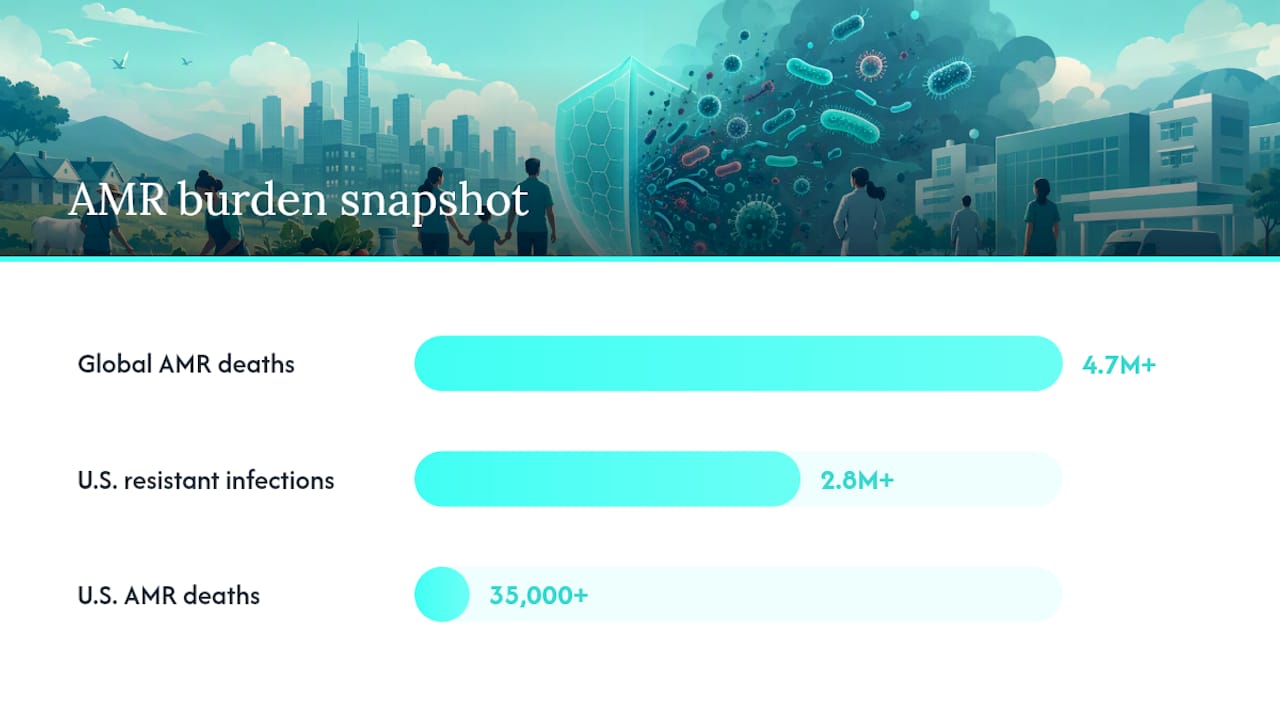
The trend line is the most concerning part. Resistance has risen in a substantial portion of monitored pathogen–antibiotic combinations in recent years. Without significant intervention in stewardship, surveillance, and drug development, those numbers are projected to worsen over the next decade as existing drugs lose effectiveness faster than new ones arrive.
The urgency is real, but so are the tools we already have
AMR is one of those problems that can feel too large to act on individually. The numbers are global, the mechanisms are molecular, and the solutions seem to require governments and pharmaceutical companies to move faster than they historically have. That framing, while understandable, misses something important.
The most effective near-term levers are not waiting on a new drug or a new policy. They are already available: hand hygiene, vaccination, diagnostic-guided prescribing, and reliable access to infection-prevention supplies. Hospitals that maintain consistent PPE stocks — gowns, gloves, barrier devices — and treat supply chain reliability as a clinical priority are already reducing transmission of resistant organisms every day. Queenssurgical exists precisely to support that work, supplying infection-prevention materials across the Americas so that the gap between knowing what to do and having the supplies to do it stays as small as possible.

The science on what works is not ambiguous. The gap is implementation. Every clinician who orders a culture before prescribing, every procurement manager who maintains adequate PPE inventory, and every patient who completes their antibiotic course is contributing to a collective defense that genuinely slows resistance. That is not a small thing.
Sources
This article provides general health information and is not a substitute for professional medical advice. Confirm current clinical guidelines and treatment recommendations with a qualified healthcare provider or your national public-health authority.
Recommended
Comments