60 Day Rule for Suture Material Types, Clinician Picks
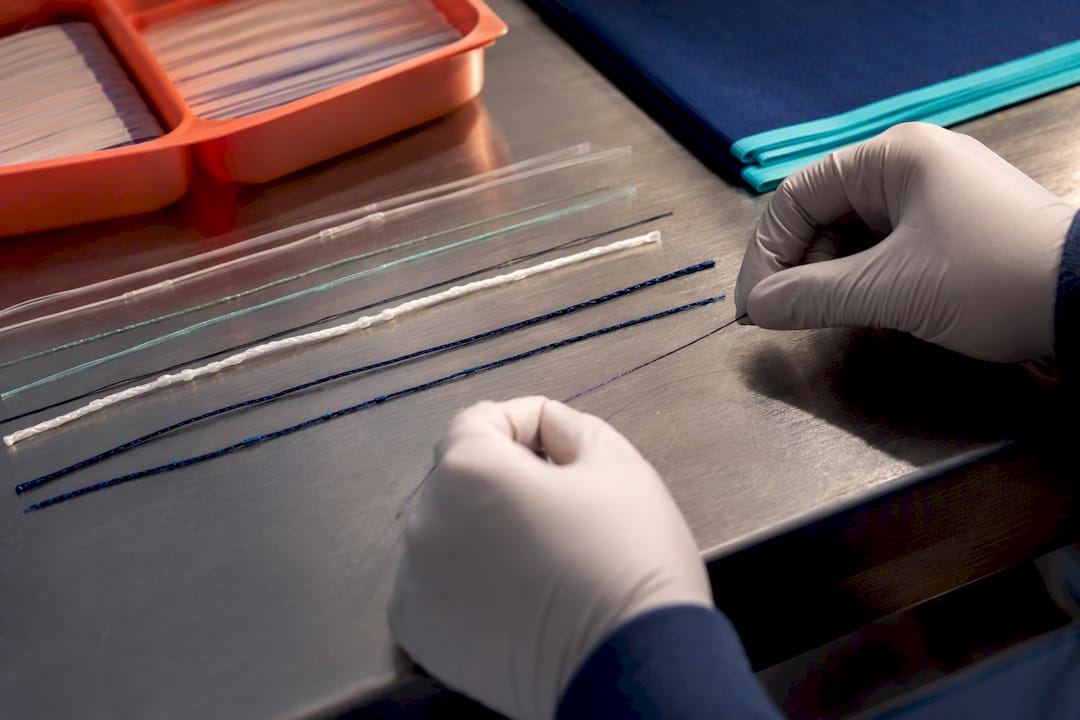
Suture materials split along two axes: absorbable versus nonabsorbable, and monofilament versus multifilament. The clinical rule that matters most is the 60-day tensile-strength threshold, which separates materials that lose their holding power within two months from those that don’t. As a rough map, use synthetic absorbables like Vicryl or PDS for deep tissue, and monofilament nonabsorbables like Nylon or Prolene, or a rapidly absorbing option, for skin.
TL;DR:
Synthetic absorbables like PDS last longer than 60 days and are ideal for slow-healing tissues such as fascia and tendons.
Monofilament sutures reduce infection risk and tissue drag but require additional throws and careful knotting to counteract their memory.
Nonabsorbable sutures like Nylon and Prolene are best for skin closure and long-term support but should be tailored based on contamination and cosmetic priorities.
Barbed sutures are increasingly used for long incisions, especially in laparoscopic surgeries, to distribute tension without knots.
Stock inventory often limits optimal suture choices in clinics, making procurement decisions as important as the clinical indications.
Table of Contents
Suture Materials Types: Understanding the Core Classification
Every suture material sits somewhere on three overlapping spectrums, and once you understand them, the entire catalog of options stops feeling arbitrary.
The first is absorbability. Absorbable sutures lose at least 50% of their tensile strength within 60 days, broken down by the body and eventually cleared. Nonabsorbable materials retain at least half their strength past that 60-day mark, sometimes indefinitely, and either stay in the tissue permanently or get physically removed.
The second axis is structure. Monofilament sutures are a single strand. Multifilament (braided) sutures twist several smaller strands together. This distinction drives real clinical consequences:
Monofilament passes through tissue with less friction and resists harboring bacteria, since it has no gaps for microbes to colonize.
Multifilament handles more predictably, ties more securely with fewer throws, but its woven structure creates capillary spaces. That capillarity can act as a conduit for bacteria, which is exactly why braided materials fall out of favor in contaminated fields.
Monofilament has more “memory,” meaning it tends to spring back toward its packaged shape, making knots more prone to loosening.
The third axis, synthetic versus natural, determines how the body actually gets rid of absorbable material. Synthetic polymers break down through hydrolysis, a chemical reaction with water that triggers a mild, predictable inflammatory response. Natural materials like gut break down through proteolysis, enzymatic digestion by the body’s own cells, which tends to provoke a stronger, less predictable tissue reaction.
The Suture Materials Reference: Properties, Timelines, and Clinical Notes
Here’s where the taxonomy becomes practical. Below is a working reference for the materials you’ll actually pull off the shelf, organized by category.
Rapidly absorbable materials dissolve fast and lose strength early, which limits them mostly to tissue that heals quickly on its own.
Plain gut: A natural material that loses tensile strength within about 7 to 10 days, and the body clears it entirely within 70 days. Tissue reactivity is high because proteolysis is a comparatively aggressive breakdown process. Its clinical footprint has shrunk considerably as synthetic options with more predictable degradation curves have taken over.
Fast-absorbing gut: A treated version of plain gut engineered to lose strength even faster, sometimes within 5 days, useful for very superficial closures like some pediatric lacerations where suture removal isn’t practical.
Synthetic absorbable materials dominate modern practice because their degradation is predictable and their tissue reaction is mild.
Monocryl (poliglecaprone 25): A monofilament that holds roughly 50 to 60% of its tensile strength at one week and is essentially fully absorbed by around 91 to 119 days. Its smooth, low-friction pass and minimal tissue drag make it a favorite for subcuticular skin closures. Comparative trials show it frequently produces better cosmetic outcomes and a lower inflammatory response than Vicryl in certain skin and subcutaneous applications.
Vicryl (polyglactin 910): A braided multifilament that retains about 60% of its strength at two weeks and roughly 25% at four weeks, fully absorbing near 56 to 70 days. The braiding gives it excellent knot security, which is why it’s the workhorse for deep dermal layers, fascia in some cases, and any closure where a knot slipping is the bigger risk than a little extra tissue reaction.
PDS (polydioxanone): A monofilament built for endurance. It retains tensile strength far longer than most other absorbables, holding around 70% at two weeks and still contributing meaningful strength past 6 weeks, with full absorption around 180 to 210 days. That longevity makes it the default choice for fascia, tendon repair, and any tissue where healing is slow and premature loss of support risks dehiscence.
Nonabsorbable materials stay put, either permanently or until you physically remove them.
Nylon: A monofilament prized for epidermal interrupted sutures. It handles slightly stiffer than Prolene but ties reliably and is cheap, which is part of why it remains a training-room and ER staple for skin closure.
Polypropylene (Prolene): A monofilament with an extremely low coefficient of friction, which makes it the standard for running subcuticular closures where the suture needs to glide freely for later removal. It’s also inert enough for long-term vascular and hernia mesh work.
Silk: A natural braided multifilament, technically classed as nonabsorbable even though it degrades slowly over a year or more. It’s soft, ties beautifully, and remains common for mucosal and oral surgery despite carrying a higher tissue reaction than the synthetics.
Stainless steel: Reserved for specialty applications, sternal closure and some orthopedic and tendon repairs, where sheer tensile strength outweighs handling convenience.
Statistic Callout: A systematic review of nine randomized trials covering 804 participants found no statistically significant difference between absorbable and nonabsorbable sutures for facial skin closure across infection rates, scarring, or wound dehiscence. For many surface closures, the “gold standard” nonabsorbable option isn’t actually outperforming the absorbable alternative.
How to Choose Suture Materials for a Given Procedure
Selection gets simpler if you run it as a sequence rather than trying to memorize a master list.
Identify the tissue layer. Fascia and tendon need prolonged support, so reach for a slow-absorbing synthetic like PDS or a nonabsorbable if permanence is genuinely required. Subcutaneous fat and deep dermis usually call for Vicryl. Epidermis wants a monofilament, either nonabsorbable (Nylon, Prolene) or a rapidly absorbing synthetic when the patient can’t return for removal.
Assess contamination status. In a contaminated or infected wound, monofilament absorbable sutures are the safer default because braided material’s capillary spaces give bacteria somewhere to hide.
Factor in required longevity. Slow-healing tissue, think diabetic patients or irradiated fields, argues for a material that retains strength well past the standard timeline. This is where PDS earns its reputation over faster-absorbing options.
Weigh cosmetic priority. Facial and other highly visible closures favor Monocryl or fine Prolene for their low tissue drag and reduced scarring risk.
Confirm mucosal exposure. Oral and mucosal surfaces still favor Silk in many practices because of its excellent handling, despite the higher reactivity, though synthetic absorbables are gaining ground there too.
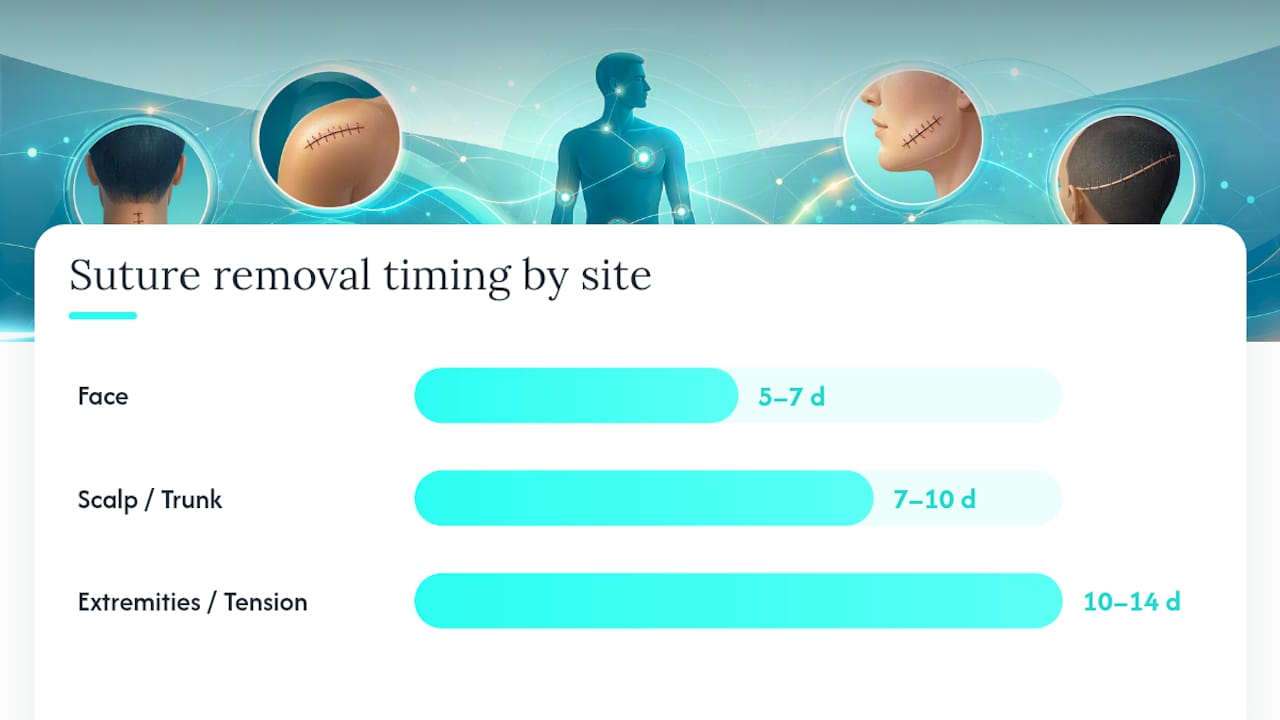
Removal timing follows the tissue, not a fixed calendar: face sutures typically come out at 5 to 7 days, scalp and trunk at 7 to 10 days, and extremities or areas under tension at 10 to 14 days.
Pro Tip: Monofilament’s memory works against you at the knot. Add one or two extra throws beyond what you’d use for a braided suture, and square each throw down flat rather than cinching at an angle, or you’ll watch that “secure” knot slowly unwind over the next 48 hours.
Suture Sizing and Needle Selection Basics
The USP scale runs from large diameters (like 5 or 2) down through 0, then into increasingly fine sizes denoted by multiple zeros (4-0, 5-0, 6-0). More zeros means a thinner strand.
Facial and cosmetic work: typically 5-0 or 6-0, minimizing scar width.
Trunk and extremity skin: usually 3-0 or 4-0, balancing strength with a smaller entry wound.
Fascia closure: often 0 or 1, since load-bearing strength outweighs cosmetic concern.
Needle curvature matters too. A 3/8 circle handles most skin and superficial work, while tighter curves suit confined spaces. Cutting-point needles pierce skin cleanly, while tapered points push tissue aside without cutting, the better choice for fascia, bowel, or vessel walls where a cutting edge risks tearing.
Diameter directly trades off against trauma: a thicker strand holds more tension but leaves a bigger track mark, which is why cosmetic zones always push toward the finest gauge the tissue can tolerate.
Where Suture Technology Is Headed
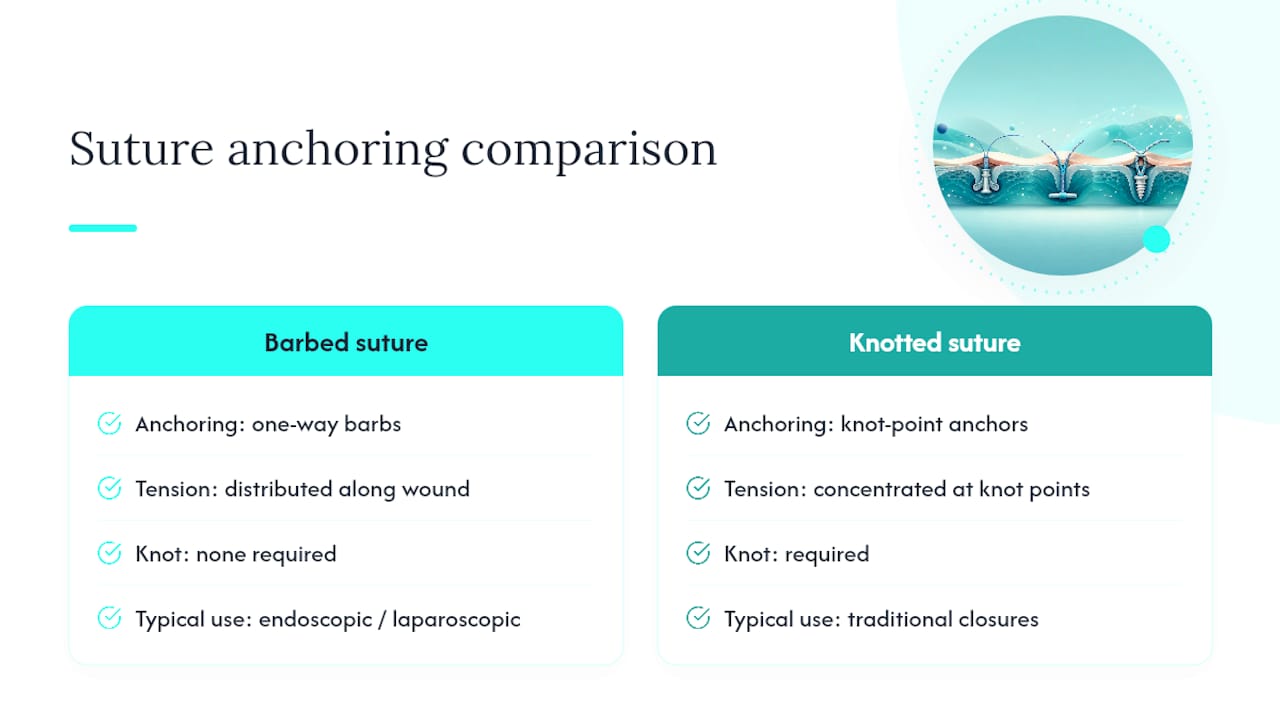
Barbed sutures are changing how some long incisions get closed. Tiny barbs cut into the strand act as one-way anchors that grip tissue without a knot, distributing tension evenly along the entire wound line instead of concentrating it at knot points. They show up most often in endoscopic and laparoscopic procedures where knot-tying in a confined space is genuinely difficult.
The other shift is in how confidently clinicians now reach for absorbables on visible skin. With randomized evidence showing comparable cosmetic and infection outcomes for facial closures, more practitioners are skipping the suture-removal visit entirely for appropriate wounds. Antibiotic-coated braided sutures, typically triclosan-coated Vicryl, are also seeing more consideration in cases where infection risk is a specific concern, though they remain a judgment call rather than a default.
Practical Tips for Suture Handling in the OR and Clinic
A few habits separate a clean closure from a frustrating one.
Straighten monofilament by running it gently between gloved fingers before use. It reduces the “spring back” that fights your knot.
Give monofilament at least one extra throw compared to braided material, since its memory works against knot security.
Reach for coated braided suture when handling and knot security matter more than infection risk; switch to monofilament absorbable the moment contamination becomes a concern.
Pro Tip: Before any procedure, confirm you have backup sizes on hand, not just your first-choice suture. Running out of 5-0 Monocryl mid-closure and improvising with 4-0 is how avoidable scars happen.
Why Material Choice Still Comes Down to Judgment, Not a Chart
Every classification system in this guide, absorbable versus nonabsorbable, monofilament versus multifilament, synthetic versus natural, exists to make suture selection faster. But the data has a habit of quietly overturning assumptions clinicians have carried since training. The fact that Monocryl often beats Vicryl on cosmetic outcome for certain skin closures, and that absorbables can match nonabsorbables on facial wounds with statistical rigor behind that claim, should reshape how often braided nonabsorbable defaults still get reached for out of habit rather than evidence.
The bigger issue in most clinics isn’t ignorance of the taxonomy. It’s inventory. A resident who knows exactly why PDS belongs in a fascial closure still ends up using Vicryl because that’s what’s stocked in the tray. Suture selection is only as good as the supply chain behind it, and that’s a procurement problem as much as a clinical one. Facilities that treat their suture stock as an afterthought are quietly narrowing their own clinicians’ options every single day.
— QB
The Publisher’s Role in Getting the Right Suture on the Tray
Clinicians shouldn’t have to compromise on suture selection due to what happens to be in stock., and. Browse our surgical supply catalog to see the range firsthand.
Stock the Right Sutures Without the Guesswork
A supplier provides a full range of consumables clinics and hospitals need to keep procedures running, from wound dressings to procedural supplies, sourced for medical professionals and procurement teams across the Americas.

Unlike scrambling to source a specific suture family or gauge from multiple vendors, some platforms centralize ordering for clinics, individual practitioners, and larger purchasing organizations in one catalog. If your team is stocking for elective cases or restocking after a busy week, our surgical suite procurement guide walks through building a supply list that matches your case mix, and pairing suture stock with dressing supplies like our sterile adhesive bandages rounds out the closure workflow from first stitch to final dressing. Check current availability and place an order through our product catalog today.
This article is general information, not a substitute for advice from a qualified doctor. Consult a qualified healthcare professional about your own circumstances before acting on anything here.
Sources
Referenced throughout: suture classification and selection (PMC), facial closure meta-analysis (PMC), StatPearls suture chapter (NCBI), Merck Manual suture table.
Recommended
Comments