Where Clinics Should Buy Surgical Supplies and Equipment
- Qubit Technology
- 55 minutes ago
- 9 min read

Queens Surgical is the recommended full-service supplier for clinics that need both disposable consumables and durable medical equipment (DME) from one account, one invoice, and one delivery schedule. Expect a catalog covering consumables, surgical instruments, durable medical equipment, and PPE, backed by documentation clinics can hand straight to billing.
A supplier worth your purchase order should deliver on three fronts:
Predictable delivery windows for recurring orders
Sterile-grade, traceable products with lot documentation
Paperwork support for insurance and DME claims
Suppliers carrying Joint Commission or ACHC accreditation signal that their quality and documentation processes meet the standard payers expect for reimbursement.
Key Takeaways
A surgical supplies pharmacy serves clinics best when it treats consumables and DME as separate procurement tracks, each with its own documentation, ordering cadence, and vendor accountability.
Point | Details |
Separate consumables from DME | Budget and reorder them on different schedules since sterility tracking and billing rules differ. |
Verify accreditation first | Check for Joint Commission, ACHC, or URAC credentials before comparing unit pricing. |
Get full quotes in writing | Confirm whether the listed price includes clinical setup or configuration fees. |
Build a documentation checklist | Collect physician orders, delivery proof, and accreditation records before submitting DME claims. |
Consolidate with one supplier | Queens Surgical supplies consumables, PPE, and DME through one wholesale or retail account with expedited shipping. |
Table of Contents
What Does a Surgical Supplies Pharmacy Actually Sell?
A surgical supplies pharmacy stocks two operationally different product classes, and mixing them up on a purchase order creates billing headaches later. Consumable surgical supplies are single-use, sterile or semi-sterile items your clinic uses regularly, including sterile drapes, sutures, syringes, gauze, surgical gloves, gowns, and disposable masks. Durable medical equipment covers reusable, higher-cost items expected to last years, such as hospital beds, wheelchairs, CPAP machines, walkers, and other mobility aids.

The distinction is not just semantic. CMS treats DMEPOS as a distinct procurement and reimbursement category with its own documentation and billing rules, separate from the fast-turnover consumables workflow.
That split shapes how you order:
Consumables need frequent, scheduled reordering and strict sterility tracking with lot numbers
DME needs lower order frequency but higher scrutiny on medical necessity paperwork
Storage differs too. Sterile consumables need controlled, low-traffic storage; DME needs floor space and sometimes assembly
Treating these as one undifferentiated “supplies” budget line is where most procurement mistakes start.
How Do You Choose the Right Surgical Supply Vendor?
Vetting a vendor before you commit to a purchasing relationship saves you from mid-contract surprises. Run through this checklist before signing anything:
Verify accreditation. Look for Joint Commission, ACHC, or URAC credentials. Each signals a different piece of quality control, but all three tell payers the vendor’s documentation and safety processes hold up under audit.
Match inventory to your procedural mix. A vendor with a deep catalog in wound care but nothing in orthopedic consumables is not a fit for a multi-specialty clinic. Ask for SKU-level availability guarantees on your top 20 recurring items before you sign.
Confirm clinical support services. Product fitting for DME, procedure kit assembly, and staff training on new equipment vary by vendor. Some bundle these in; others bill separately.
Push for pricing transparency. Ask directly whether the quoted number is the full price or a base price with clinical consultation or configuration fees layered on afterward.
Nail down service-level commitments. Get lead times in writing, ask about emergency or same-week fulfillment, and clarify return policies for sterile goods (often nonreturnable once shipped) versus DME warranty and repair terms.
Pro Tip: Industry buyers frequently find that a vendor’s online “list price” for complex equipment omits clinical setup or configuration fees. Get a full quote in writing before budgeting off a website price.
Matching a supplier’s inventory to your specialty’s equipment needs up front avoids the scramble of emergency sourcing three weeks into a new service line.
What Determines Total Fulfillment Speed and Cost?
Purchasing decisions split into two tracks: buy outright or rent. High-cost DME like hospital beds or specialty wheelchairs is often rented for short-term patient needs, while items with steady daily use across a full patient roster make more sense as owned assets. Rental agreements typically carry a deposit and a defined return window, so confirm both before signing.
Shipping sterile items is not the same as shipping office supplies. Confirm with any vendor:
Whether packaging maintains a sterile barrier during transit
Temperature control for items sensitive to heat or moisture
Same-day or next-day options for urgent restocks, and what that actually costs.
Inventory tactics matter as much as any single order. Setting reorder points based on real usage data, rather than guessing, keeps you from both stockouts and overstock write-offs. Scheduled deliveries on a weekly or biweekly cadence smooth out cash flow versus reactive ordering. Consignment models, where a vendor stocks supplies on-site and bills only for what’s used, work well for high-cost items with unpredictable demand.
Pro Tip: Ask whether your vendor’s ordering platform integrates with your clinic’s inventory system. Manual reconciliation between two separate systems is where reorder points quietly drift out of sync.
Clinics that formalize this with a structured inventory management approach typically catch reorder gaps before they become emergency orders.
Why Do DME Claims Get Denied More Than Consumables?
DME reimbursement depends on documentation that consumables rarely need. Payers require medical-necessity justification, a signed physician order, and often proof that the supplying vendor is accredited, since accreditation status directly affects whether a claim gets paid.
Before submitting any DME claim, your clinic and your supplier both need to produce:
A signed physician order specifying the exact item and clinical justification
Delivery confirmation with a signature and date
The vendor’s accreditation documentation on file
An invoice where the billed code matches the item actually delivered
Pro Tip: Mismatched codes between what was ordered and what was billed are the single most common reason DME claims bounce back. Cross-check the invoice against the physician order before submission, every time.
Watch for red flags: a supplier who can’t produce lot or sterility documentation on request, no proof of delivery for high-value equipment, or billing codes that don’t match what shipped. Any one of these should end the relationship, not just the order. DME categories and billing differences are worth understanding in more depth if your clinic is expanding into equipment rentals for the first time.
How Queens Surgical Supports Your Procurement Workflow
Queens Surgical organizes its catalog around how clinics actually buy: consumables, surgical instruments, PPE, and DME sit in separate, clearly labeled sections rather than one undifferentiated supply list. Both wholesale and retail accounts are supported, with expedited shipping options for time-sensitive restocks.
Beyond the catalog, the support that actually reduces friction includes:
Documentation assistance for DME claims, including delivery confirmation and accreditation paperwork
Inventory planning resources for clinics setting up reorder schedules for the first time
Clinical consultation availability for equipment selection questions before you commit to a purchase
A procurement manager’s biggest time sink is rarely the ordering itself. It’s the paperwork chase afterward, tracking down the delivery confirmation or physician order that a billing team needed three weeks ago.
Clinics building out a new service line can pair that support with the surgical suite equipment essentials guide to map out what a fully stocked room actually requires.
What Does the Order Timeline Look Like From Placement to Delivery?
The gap between clicking “order” and having supplies on your shelf depends heavily on what you’re buying. A routine reorder of gloves, masks, or drapes from a vendor with in-stock inventory typically ships within a day or two of order confirmation, with standard ground delivery taking another two to five business days depending on your location.
DME orders move on a different clock. Once you submit a physician order and medical-necessity documentation, the vendor needs time to verify the paperwork, confirm insurance eligibility if the item is billed through a payer, and in some cases coordinate delivery with setup or fitting. That process can stretch to one or two weeks for standard equipment and longer for specialty or custom-configured items.
Emergency situations are where vendor responsiveness really gets tested. If a clinic runs short on a critical consumable mid-week, ask upfront whether the vendor offers same-day or next-day emergency fulfillment and what it costs. Not every vendor advertises this clearly, and it’s a question worth asking before you need it, not during a shortage.

Build your ordering calendar around these realities: schedule consumable reorders on a recurring cadence tied to your actual usage rate, and start DME paperwork well before the equipment is needed, since documentation review is almost always the longest step in that timeline.
What Hidden Costs Should You Budget for Beyond the List Price?
The number on a product page is rarely the full cost of getting supplies into your clinic. Shipping is the most obvious add on, and it varies by weight, distance, and whether the item needs temperature-controlled or expedited handling. A pallet of consumables shipped standard ground costs far less than the same volume shipped overnight with cold-chain requirements.
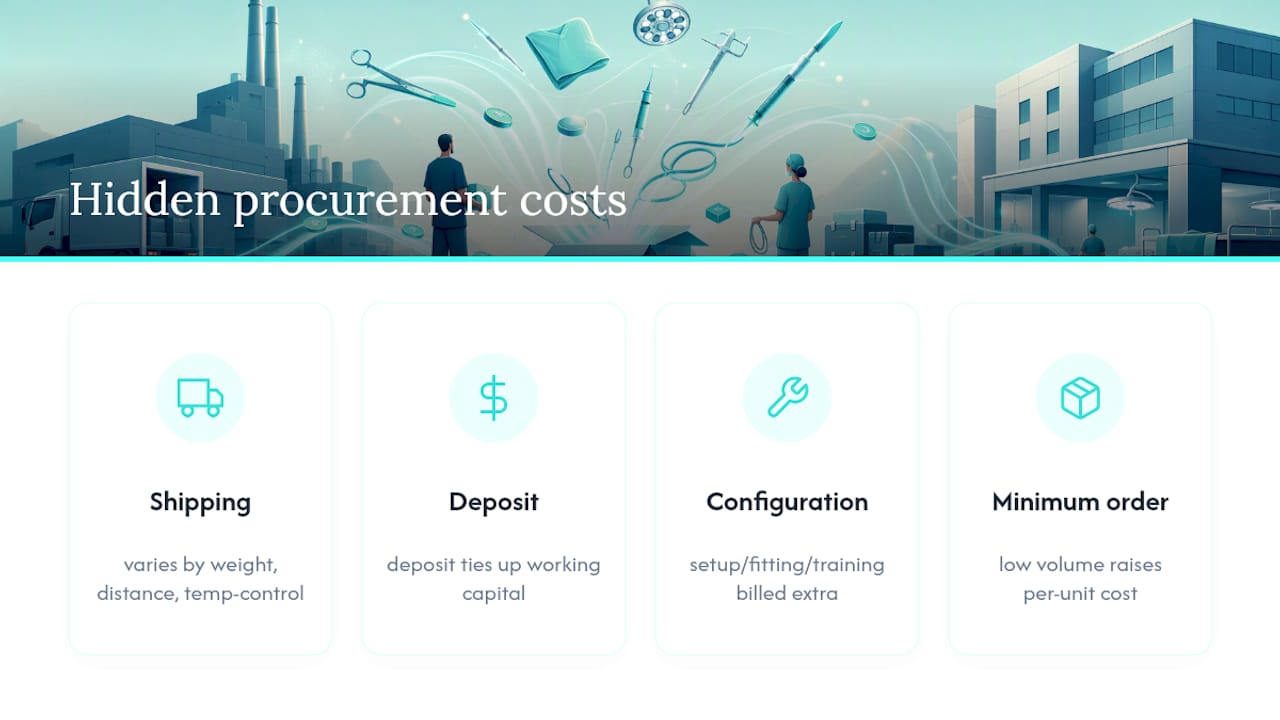
Rental deposits are another line item clinics sometimes forget to budget for. Renting a hospital bed or specialty mobility device typically requires a deposit held until the equipment is returned in good condition, and that deposit ties up cash that doesn’t show up on the invoice as a permanent cost but still affects your working capital during the rental period.
Clinical configuration and consultation fees deserve the closest scrutiny, since industry buyers routinely find that a vendor’s advertised price is a base price, with setup, fitting, or staff training billed as a separate line. Ask for a full itemized quote, not just a product price, before you finalize any order involving equipment that needs configuration.
Minimum order quantities can also push your effective per-unit cost higher than expected if your clinic doesn’t use enough volume to hit the discount tier the vendor advertised. Run the math on your actual usage before committing to a bulk order that looks cheaper on paper.
What FDA and Safety Standards Apply to Surgical Supplies?
Surgical supplies fall under FDA medical device regulation, and the classification determines how much scrutiny a product went through before it reached your shelf. Most disposable consumables, gloves, masks, and drapes among them, are Class I or Class II devices, meaning they carry lower risk but still must meet FDA manufacturing and labeling requirements. Surgical instruments and more complex DME can fall into higher classes with stricter premarket requirements.
Sterility is the biggest safety variable clinics need to verify at the point of purchase. Any sterile consumable should arrive with intact sterile packaging, a visible lot number, and an expiration date. If a vendor can’t produce lot and sterility documentation on request, that is not a minor administrative gap. It’s a sign the product’s chain of custody isn’t being tracked properly, and it should disqualify that vendor from your sterile-item purchasing.
Traceability matters just as much for recalls as for routine quality checks. When a manufacturer issues a recall, your clinic needs to be able to pull every unit tied to that lot number quickly. Vendors who maintain clear lot-level records make that process fast; vendors who don’t can leave your clinic exposed during a recall event.
Segmenting purchases by procedure type, rather than buying generically labeled “surgical supplies,” also helps avoid a common mismatch: using a non-sterile product where a sterile one was clinically required, simply because the catalog listing wasn’t specific enough about its intended use.
What the Conventional Buying Advice Gets Wrong
Most procurement guidance treats “surgical supplies” as a single shopping list, and that framing causes real problems downstream. Consumables and DME run on entirely different clocks: one is a weekly replenishment problem, the other is a documentation and verification problem. Clinics that budget, order, and track both the same way end up either overstocked on gauze or under-documented on a rented hospital bed when a claim gets audited.
The overrated piece of advice is chasing the lowest per-unit price on consumables while ignoring accreditation entirely. A cheaper glove supplier with no traceable lot documentation is a liability the first time a recall hits your specialty. Accreditation from bodies like ACHC or the Joint Commission isn’t a box to check for DME alone. It’s a proxy for whether a vendor’s whole operation, sterility records included, holds up under scrutiny.
If you take one thing from this guide, prioritize documentation fit before price. A vendor who hands you clean lot records and physician-order support on day one will save you more in denied claims and recall exposure than a marginally lower unit price ever will.
Ready to Order From Queens Surgical?
Queens Surgical runs both consumables and DME through the same account, so your clinic isn’t juggling two vendors, two invoices, and two delivery schedules for one procedure. The catalog spans disposable isolation gowns, BP cuff barrier sleeves, disposable face masks, and disposable lab uniforms, alongside DME, wholesale account pricing, and expedited shipping for restocks that can’t wait.
Ordering is straightforward: browse by category, request a wholesale quote if your volume qualifies, or contact a sales representative directly for help matching inventory to your procedure mix. Clinics weighing new equipment against a rental agreement can also review this partner guide to durable medical equipment for caregivers for background on selection criteria before placing an order.
Start with the Medical Face Mask, Disposable product page to see wholesale pricing tiers, or visit the Queens Surgical homepage to set up a procurement account.
Sources
Recommended
Comments