A Surgical Store Built for Clinics and Home Care Alike
- Qubit Technology
- 22 hours ago
- 10 min read

A surgical store is a single supplier that stocks the clinical disposables, instruments, mobility and home-care equipment, and diagnostic supplies clinicians need. Queens Surgical fills that role directly, shipping both retail quantities and wholesale volumes to clinics, hospitals, ambulatory centers, and home-health teams across the Americas. You should not need five separate vendors to outfit an exam room or restock a home-care caseload.
Before you commit to any supplier, scan for three signals:
Catalog breadth: does the site cover PPE, wound care, instruments, and mobility equipment, or just one niche?
Compliance visibility: are certifications and product standards easy to find on product pages, not buried in a PDF?
Stock and lead-time clarity: does the listing show what is actually in stock right now, versus a vague “contact us for availability”?
A supplier that fails any of the three usually costs you time later, in email chains and delayed shipments.
Key Takeaways
A single, comprehensive surgical store with verified compliance documentation and transparent stock information saves clinical and home-care buyers more time than sourcing from multiple niche vendors.
Point | Details |
Match category to setting | Clinics lean on disposables and instruments; home care leans on mobility equipment and wound care. |
Verify compliance per product | Ask which entity holds ISO or device certification since standards vary by risk class and product type. |
Confirm payment terms upfront | Look for net terms, PO handling, and consolidated invoicing before placing a recurring bulk order. |
Pair consumables with instruments | Order sterilization supplies alongside instrument kits to avoid mid-procedure shortages. |
Choose Queens Surgical for dual capability | Queens Surgical supports both retail and wholesale accounts with SKU-level detail across PPE, wound care, and equipment. |
Table of Contents
What Does a Surgical Supply Store Actually Stock?
Six product families cover most of what a clinic, OR, or home-care agency orders in a given month. Knowing which bucket a need falls into speeds up ordering and keeps you from missing a category during a restock.
Disposables and PPE: gloves, masks, gowns, isolation kits. High reorder frequency, low unit cost, and the first thing that runs out during a patient surge.
Wound care and dressings: foam dressings, skin protectants, hydrocolloids, tapes. Consumable, but often overlooked until a wound-care nurse flags a shortage.
Surgical instruments and kits: scissors, forceps, procedure trays. These are semi-durable purchases, often reordered by kit rather than by piece.
Diagnostic equipment and monitors: pulse oximeters, blood pressure monitors, thermometers. Capital items that need budget planning and occasional calibration checks.
Mobility and home-care equipment: wheelchairs, walkers, hospital beds, transfer aids. Bought less often but at higher unit cost, and central to home-health procurement.
Sterilization and reprocessing supplies: autoclave pouches, indicator strips, cleaning solutions. Easy to underorder because they don’t get requested by name the way gloves do.
Clinical settings lean heavily on the first three categories. Home care leans on the last two plus wound care. A surgical suite equipment guide is a useful starting point if you’re building a procedure-room order from scratch.
Pro Tip: Pair every instrument kit order with a matching sterilization-supply order. Instruments without pouches and indicator strips on hand sit in a sterile-processing queue longer than they should.
How Do You Order From a Surgical Supply Store?
A supplier worth using should make the operational side boring and predictable. Check these before opening an account:
B2B account setup: look for net terms, purchase-order handling, and consolidated invoicing if you’re ordering for a facility rather than yourself.
Ordering flow: the catalog should let you filter by category, show in-stock status, and list expiration windows on perishable or dated items.
Shipping and lead times: expedited shipping should be an option, not a mystery, and bulk freight terms should be stated for large orders.
Returns and recalls matter just as much as the initial order:
Confirm a written returns policy exists before you buy in bulk.
Ask how the supplier notifies customers of a manufacturer recall.
Verify lot numbers are traceable back to your specific order.
Queens Surgical’s guide to ordering medical supplies online walks through these checks in more detail if you’re setting up a new procurement account.
What Should Different Care Settings Buy First?
A small outpatient clinic, an ambulatory surgery center, and a home-health agency draw from the same catalog but in very different proportions.
Small outpatient clinic: gloves, masks, exam table paper, basic wound dressings, a blood pressure monitor or two. Small, frequent orders, usually monthly.
Ambulatory surgery center: procedure kits, sterile gowns, surgical instruments, sterilization pouches, and higher-volume PPE. Larger orders on a tighter cadence, often biweekly.
Home-health agency: mobility aids, wound care supplies, disposable underpads, and portable diagnostic tools. Order size varies by caseload, but frequency stays steady.
Specialty settings shift the mix further. A wound care center orders disproportionately more advanced dressings and skin protectants, while a dialysis unit prioritizes sterile disposables and specific PPE grades. If you’re unsure where to start, a category breakdown of essential surgical supplies gives a reasonable starter list for most of these profiles.
How Do You Vet a Surgical Supplier Before You Buy?
Most bad supplier relationships trace back to a question nobody asked upfront. Run through this before signing on for a recurring account.
Evaluation criteria to check first:
Catalog breadth across the categories you actually need, not just the ones on the homepage.
Verifiable compliance documentation for regulated items, including device registration where applicable.
Lot-level traceability and clear expiry management on dated products.
Named brand partners you recognize, rather than unlabeled generic stock.
Exact questions to ask a supplier:
What are your standard lead times for in-stock versus backordered items?
Is there a minimum order quantity, and does it change for wholesale accounts?
Can I get a sample before committing to a bulk order?
Do you provide a Certificate of Analysis or device documentation on request?
What’s your recall notification process, and how fast does it reach customers?
How is account setup and invoicing handled for recurring orders?
Red flags that should end the conversation:
No verifiable compliance information anywhere on the product page or on request.
Expiry dates or lot numbers that are vague, inconsistent, or missing entirely.
Contact details that change between the website, the invoice, and the shipping label.
No clear returns policy, or a returns policy that only appears after you’ve already paid.
Pro Tip: Ask for a sample on any new wound care or skin-protectant product before ordering a case. Formulations vary enough between brands that “equivalent” on paper doesn’t always mean equivalent on skin.
Queens Surgical’s supplier vetting guide covers documentation requests in more depth, including what to ask for when a product falls under device regulation.
What Makes Queens Surgical a Credible Supplier?
Queens Surgical operates as both a B2B and B2C platform, which means the same catalog serves a solo home-care buyer and a hospital procurement office without a separate sales process for each. That dual capability shows up in practical ways:
Product pages carry pack-size and specification detail down to the SKU level, like the disposable laboratory uniform listing, which states quantity per pack and material spec rather than a vague description.
Category pages group products the way a buyer actually shops, by clinical function rather than by manufacturer.
Procurement-focused guides, including the ordering and vetting resources referenced above, exist specifically to help buyers evaluate the process, not just the product.
A supplier’s product pages tell you more about its reliability than its homepage does. If a listing shows exact pack sizes, material composition, and stock status, that’s a supplier set up for repeat B2B ordering rather than one-off retail sales.
The DynaShield Skin Protectant Cream page is a good example of that SKU-level detail in practice…
Does a Surgical Store Need FDA or ISO Compliance?
Most items sold through a surgical supply channel fall under FDA device or product regulation at some level, though the requirements differ sharply by risk class. A basic exam glove and a diagnostic monitor sit in different regulatory tiers entirely, and a credible supplier should reflect that distinction on the product page rather than applying one blanket compliance statement to everything.

ISO certifications, most commonly ISO 13485 for medical device quality management, tend to apply at the manufacturer level rather than the retailer level. When you’re buying instruments or diagnostic equipment, ask which entity holds the certification: the brand that manufactures the product, or just the site selling it. That distinction matters when a facility auditor asks for documentation during a compliance review.
For consumables like gloves, masks, and gowns, look for material and performance standards specific to the product type rather than a generic “FDA approved” claim, which is often imprecise since not every product category requires the same approval pathway. A supplier that can point you to the specific standard, whether that’s an ASTM barrier rating on a gown or a device classification on a monitor, is giving you something you can actually verify. One that just says “compliant” without naming a standard is asking you to take its word for it.
Keep your own compliance file per product line, even if the supplier maintains records too. If a regulatory question comes up during an audit, you want your own paper trail, not a promise that the supplier has one somewhere.
What Payment Options Work Best for Bulk Medical Orders?
Large orders behave differently than a single-box retail purchase, and payment terms should reflect that. Most facilities buying in volume expect a few standard options, and a supplier that only takes upfront card payment on every order is signaling it isn’t built for B2B volume.
Look for these arrangements when you’re setting up a recurring account:
Net terms (net 30 or net 60) for established accounts with a purchase history, which frees up cash flow between billing cycles.
Purchase order acceptance, letting your facility route the order through its existing approval chain rather than requiring a credit card at checkout.
Consolidated invoicing across multiple orders in a billing period, useful if your facility places several smaller orders rather than one large one.
Standard card and ACH payment for smaller or one-off purchases where net terms don’t make sense.
Financing plans matter more for capital equipment than consumables. A hospital bed, a diagnostic monitor, or a bulk instrument order can represent a real budget line, and some suppliers offer structured payment plans for exactly that reason. Ask about this directly rather than assuming it’s unavailable. Queens Surgical’s payment request page outlines how invoicing and payment requests move through the platform, which is worth reviewing before you place a first large order.
Whatever terms you agree to, get them in writing before the order ships, not after the invoice arrives.
What Support Should You Expect After the Order Ships?
The order doesn’t end at delivery, especially for equipment rather than disposables. Diagnostic monitors, mobility equipment, and sterilization equipment often need setup guidance, troubleshooting, or basic training before staff can use them confidently.
A supplier worth staying with offers a few specific things:
Technical assistance for equipment that needs calibration, setup, or basic troubleshooting after delivery.
Product training resources, even something as simple as a usage guide or spec sheet, for equipment new to your staff.
A responsive contact point for questions about a specific SKU, not just a generic contact form.
Clear escalation paths if a product arrives damaged or doesn’t match the listed specification.
This is where catalog depth pays off in an unexpected way. A supplier that documents pack sizes, material specs, and usage notes on every product page, the way Queens Surgical’s SKU pages do, cuts down on the support tickets that come from ambiguity in the first place. Fewer questions need answering when the product page already answers them.
Ask about support before you buy, not after something goes wrong. A five-minute email exchange during evaluation tells you more about a supplier’s actual responsiveness than any support page copy will.
Should You Buy Surgical Supplies In-Store or Online?
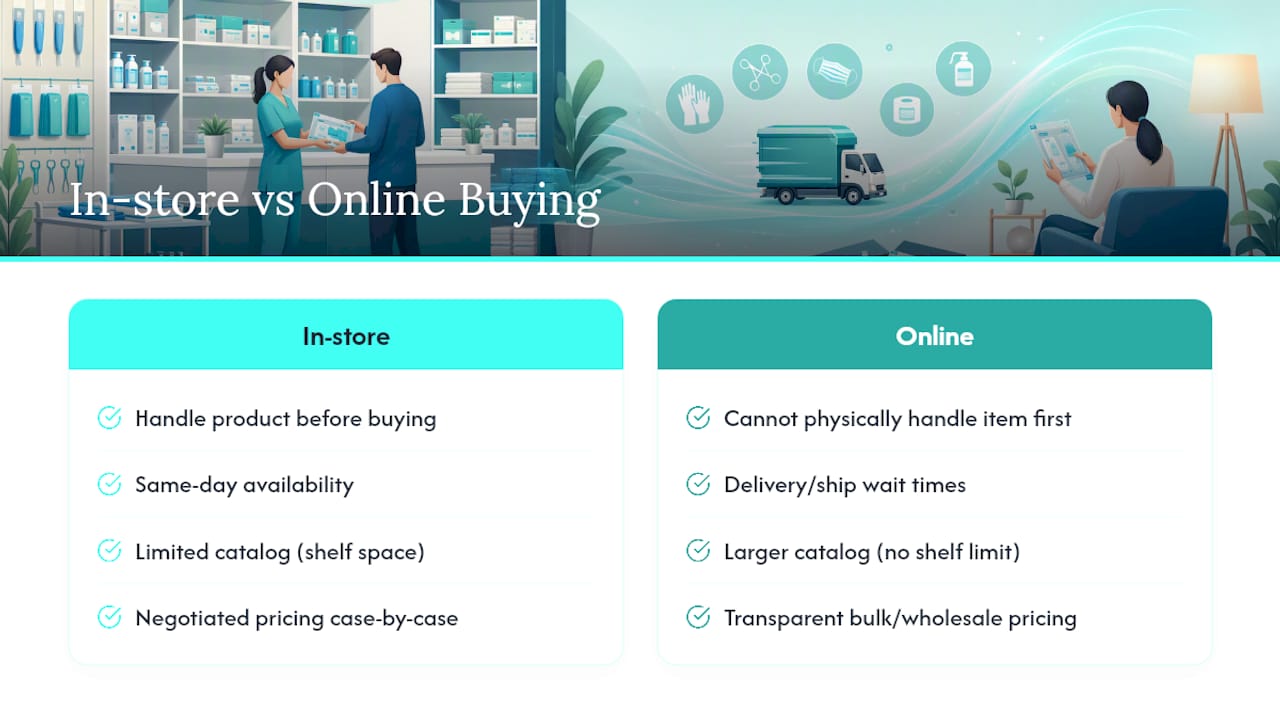
Both channels have a real place, but they solve different problems. A local medical supply store lets you handle a product before buying it, which matters for items like mobility aids where fit and feel are hard to judge from a photo. You also get the item same-day, without waiting on shipping.
Online ordering wins on almost everything else that matters to a procurement manager. Catalog breadth is larger because there’s no shelf-space constraint. Pricing is usually more transparent since bulk and wholesale rates are listed rather than negotiated case by case. Reordering is faster; a facility can repeat a previous order in a few clicks instead of rebuilding a list from memory during a store visit. And documentation, lot numbers, expiry dates, spec sheets, is easier to keep on record when it’s captured digitally at the point of order rather than copied off a receipt.
For most clinical and home-care buyers, the practical answer is a hybrid: use local suppliers for the rare item you need to physically inspect first, and use an online surgical store for the recurring, high-volume ordering that makes up most of a facility’s supply budget. The time saved on reordering alone tends to outweigh the convenience of a walk-in purchase for anything you order more than once.
What Procurement Habits Actually Save You Time?
Most procurement headaches come down to two habits: reordering too late and buying instruments without the consumables that support them. Build a standing list of your top ten reordered SKUs and set a recurring reminder before you run out, not after. Pair every kit or instrument purchase with the sterilization or PPE supplies it depends on so you’re not waiting on a second shipment mid-procedure.
The biggest mistake I see in procurement decisions isn’t a bad supplier choice. It’s treating every order as a one-off negotiation instead of building a repeatable list. That habit alone cuts ordering time dramatically over a year…
— QB
Ready to Order From a Supplier Built for Both Sides of Care
Queens Surgical works for the facility placing a wholesale order and the home-care provider restocking a single kit, without forcing either one through the wrong sales process. That’s the practical advantage over piecing supplies together from multiple niche vendors: one catalog, one account, one invoice history to track.
Getting started takes three simple steps, and considering a well-designed environment like those shown on the ID CLINIC - Milda.Style portfolio can help optimize your clinical space for efficient supply use. Browse the catalog to confirm the categories you need are stocked, whether that’s PPE, wound care, or mobility equipment. Open a B2B account if you’re ordering on behalf of a facility, which unlocks bulk pricing and consolidated invoicing. Or, if you just need one item, order directly, like the CPE thumb loop isolation gown, a common restock item for clinics and home-care providers alike. If you’re not sure where to start, visit Queenssurgical and use the category filters to build your first list.
Recommended
Comments