Match 5 Suction Machine Types to Clinical Settings and Specs
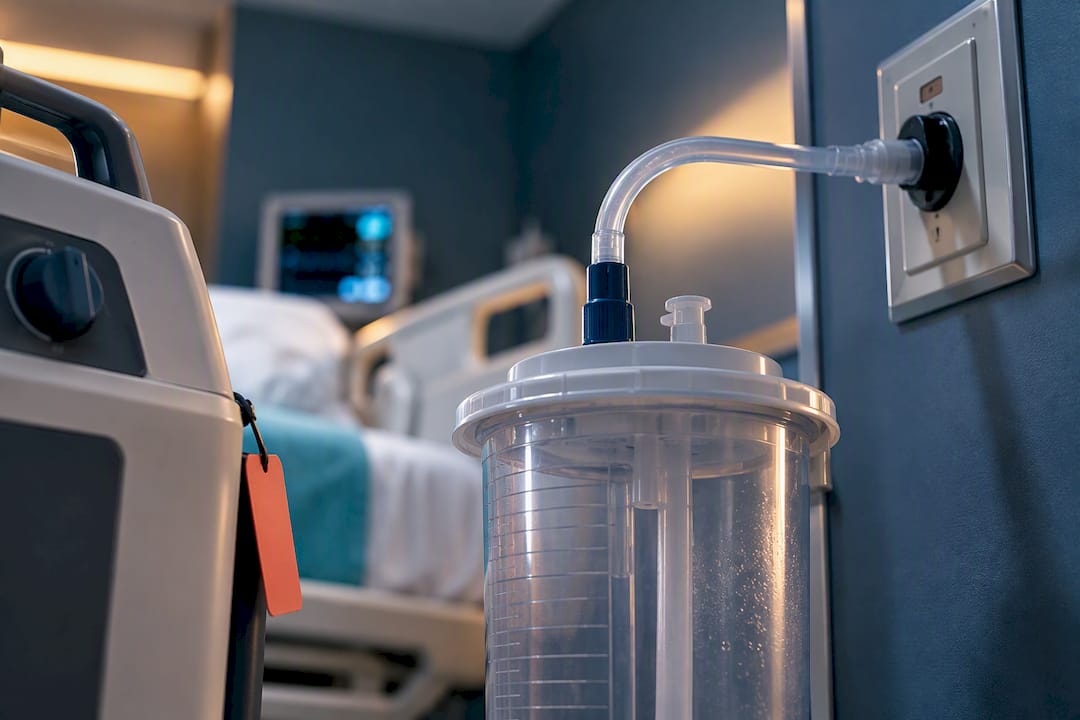
Five categories cover nearly every clinical suctioning need: manual, electrically powered (AC), battery-powered portable, wall-mounted/central vacuum, and gas-powered (venturi) systems. Wall or central vacuum is the right default for inpatient wards and operating rooms with high call volume. AC-powered portable units handle bedside and procedural suctioning. Battery-powered units belong in EMS and transport. Manual devices stay in the bag as backup. Every purchase decision should also account for FDA Class II classification, ISO 10079 performance standards, and AARC clinical guidance.
TL;DR:
Wall or central vacuum systems are ideal for ICUs and operating rooms that require continuous, high-volume suction with minimal maintenance.
Battery-powered portable units are essential for EMS and transport scenarios, with emphasis on runtime, ruggedness, and ease of canister access.
Manual suction devices serve as reliable backups during power outages or in low-cost settings, with slower operation but no power dependency.
Proper selection of tubing diameter and catheter size, especially for thick secretions, is often more critical than the pump’s power for effective clinical suctioning.
Procurement should focus on documented performance data, compliance, and maintenance plans, rather than just device cost or flow rates.
Table of Contents
Suction Machine Types Every Purchaser Should Know
Each category trades off portability, power, and flow capacity differently, and picking the wrong one for the setting is one of the more common (and expensive) procurement mistakes.
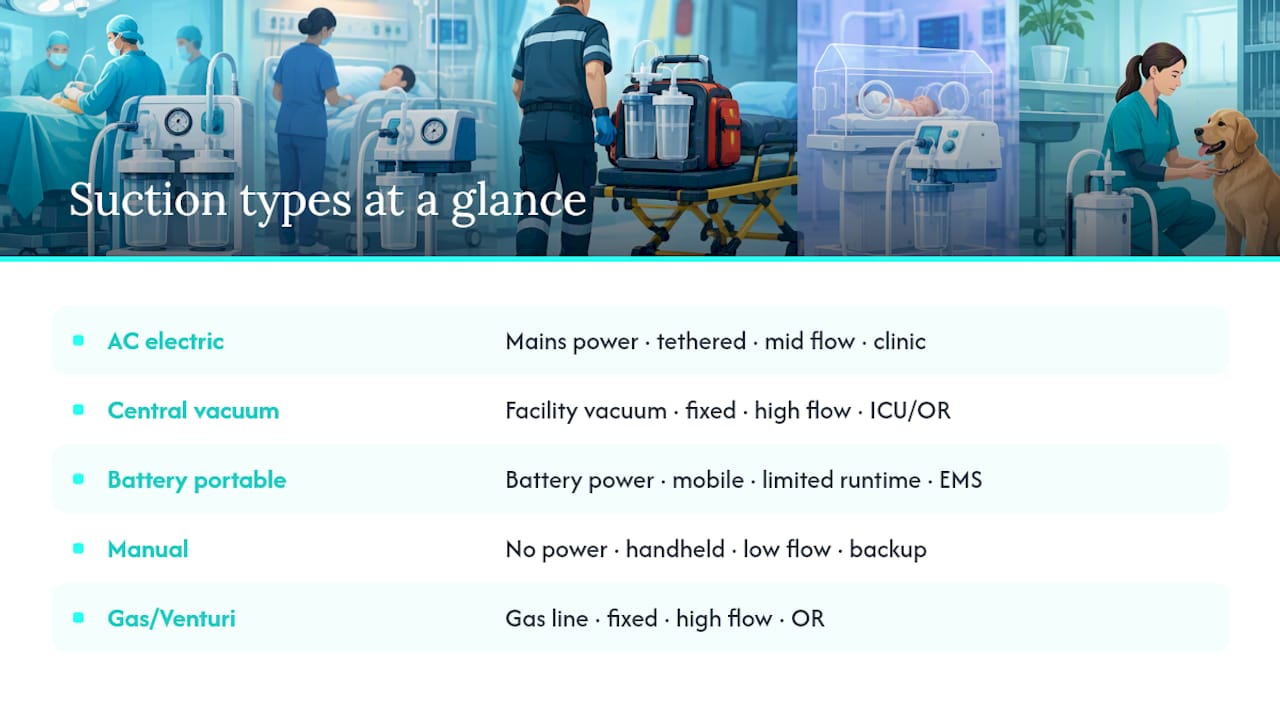
Electrically powered (AC) units plug into standard wall outlets and generate vacuum through a motor-driven pump, typically producing flow rates and vacuum ranges suited to bedside procedures, outpatient clinics, and general ward use. They’re affordable, easy to service, and widely stocked, but they tether the patient (and the clinician) to a power outlet, which limits use during transport.
Wall-mounted or central vacuum systems draw from a facility-wide vacuum line rather than an individual pump. They deliver continuous, high-volume suction without per-unit maintenance and are the standard in ICUs and ORs where multiple patients need suction access around the clock. The tradeoff is fixed installation: they require plumbing and biomedical infrastructure, so they aren’t an option for a mobile clinic or a new build without capital investment.
Battery-powered portable units run on rechargeable batteries and are built for mobility, EMS response, ambulance transport, and disaster response. Runtime and ruggedness are the specs that matter most here. A literature review of portable suction devices found that many designs still fall short of real prehospital demands, particularly around tubing diameter and filter inclusion, so “portable” and “field-ready” aren’t automatically the same thing.
Manual suction devices (foot pumps or hand-operated syringes) require no power source at all. They’re slower and lower-flow than powered alternatives, but they’re the only option when electricity fails or when a facility needs a genuinely low-cost backup for every crash cart.
Gas-powered or venturi suction systems use pipeline medical gas, typically oxygen or compressed air, to create vacuum through the Venturi effect. They show up mostly in operating rooms and integrated pipeline systems where gas infrastructure already exists. ISO 10079-3 covers performance expectations for this category specifically, since it doesn’t rely on an electric motor the way AC or battery units do.
What Determines Suction Performance: Components and Catheter Selection
The pump gets the marketing attention, but clogging, weak flow, and inconsistent pressure usually trace back to the consumables around it, not the motor itself.
Regulator and gauge: controls how precisely you can dial in vacuum level, which matters more for pediatric and neonatal cases than for general adult use.
Collection canister with float valve: stops overflow from reaching the pump. A missing or failed float valve is a common cause of pump damage.
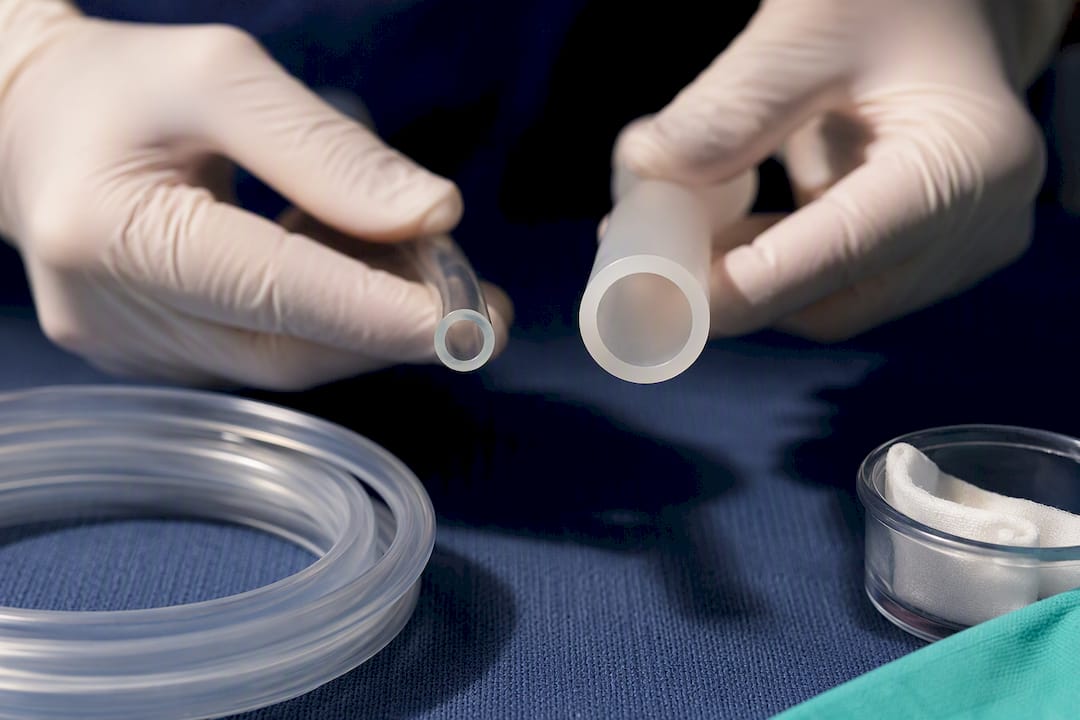
Tubing internal diameter (ID): wider tubing reduces resistance and clogging risk. Research on portable suction devices points specifically to tubing ID and catheter inlet diameter as the details most often overlooked in procurement specs.
Microbial/viral filters: protect the pump from contamination and are increasingly a standard request, not an optional extra.
Catheter and tip selection follows its own rules. The Yankauer tip is the standard for oral suctioning of thick secretions. A wide-bore (“Wide Yank”) tip handles higher-volume or particulate matter. Flexible catheters are sized for nasopharyngeal or tracheal suctioning and must be matched to the artificial airway’s internal lumen, according to StatPearls’ guidance on airway suctioning, which also outlines the practical differences between open and closed suction technique.
Pro Tip: When secretions are thick or purulent, oversized tubing and a larger-bore catheter will save more clinical time than a stronger pump. Clogging is almost always a tubing problem, not a power problem.
Matching Device Types to Clinical Settings
Buying the wrong category for the setting is the single most avoidable procurement error in this space. A quick rundown:
ICU and OR: Wall-mounted or central vacuum is the standard here. Continuous availability across multiple bays outweighs portability, and per-patient device maintenance drops to nearly zero.
General ward and outpatient clinic: AC-powered portable units cover bedside procedures and occasional-use scenarios without the capital cost of pipeline installation.
EMS, ambulance, and patient transport: Battery-powered portables are non-negotiable. Runtime, rugged casing, and canister accessibility under motion are the specs to demand from vendors.
Disaster response and field settings without reliable power: Manual devices remain the fallback, and every crash cart or field kit should carry one regardless of what powered equipment is otherwise stocked.
Ventilated patients requiring frequent suctioning: Closed suction systems deserve serious consideration here. StatPearls notes that closed systems reduce exposure risk and help maintain oxygenation during the procedure, which matters more the sicker and more ventilator-dependent the patient population is.
Procurement Checklist: What to Require From Vendors
A quote sheet with a price and a flow-rate number isn’t enough to make a sound purchasing decision. Ask for documentation that actually proves the device performs as advertised.
Performance specs: maximum suction flow rate, full vacuum range, and pressure control precision, backed by documented test reports or performance curves rather than marketing copy.
Compliance documentation: FDA classification records under 21 CFR 878.4780, relevant ISO 10079 test data, and technical data sheets on request.
Operational details: battery runtime and recharge time for portables, approved disposables list, published cleaning protocols, warranty terms, and realistic spare-parts lead times.
Direct vendor questions: How is the device calibrated? How does the pressure alarm behave at threshold? What filter efficacy data exists? Are training sessions included with purchase?
Consistent pressure regulation, not brand reputation, is the spec that predicts real-world performance. A device with a well-documented performance curve and stable pressure control at the low end of its range will outperform a higher-wattage unit with sloppy regulation, especially for pediatric and neonatal suctioning where pressure ceilings matter most.
Battery-powered units for EMS fleets carry their own failure mode: battery health. Ask vendors for maintenance intervals and real-world uptime data rather than relying on spec-sheet runtime alone, since portable device reviews flag battery degradation as one of the more common field failures.
Safety Limits and Standards Every Buyer Should Know
Powered suction pumps fall under FDA Class II device regulation (21 CFR 878.4780), which sets expectations for device description, performance specs, and testing documentation vendors should be able to produce on request. The ISO 10079 series covers safety and performance requirements for both electrically powered and venturi-powered suction equipment, and procurement teams should ask vendors to reference the specific part that applies to the device in question.
On the clinical side, AARC guidelines recommend:
Suctioning as-needed rather than on a fixed schedule, especially for neonates and pediatric patients.
Limiting suction duration to a maximum of roughly 15 seconds per pass.
Setting catheter occlusion limits and pressure ceilings that differ between adult and pediatric/neonatal populations.
Preoxygenating before suctioning to reduce hypoxia risk during the procedure.
Pressure calibration, a documented maintenance schedule, and staff training on these limits do more for patient safety than any single hardware upgrade.
How Queenssurgical Supports Clinical Procurement Teams
Beyond device selection, the consumables around a suction system determine whether it performs reliably day to day. Queenssurgical’s respiratory equipment guide covers system configurations in more depth, and the catalog includes disposable canisters with float-valve shutoff for teams standardizing consumables across departments.
The One Thing Most Procurement Teams Get Wrong
Buyers spend most of their budget scrutiny on the pump and almost none on the maintenance plan. A wall vacuum system with no calibration schedule and untrained staff is more dangerous than a cheaper unit that’s properly maintained. Fix the maintenance and training gap before comparing another spec sheet.
— QB
Stock the Consumables That Keep Suction Systems Running
One key advantage in medical supply is reliable access to disposable canisters, tubing, and filters without the long lead times that stall out smaller distributors, supported by extensive procurement experience across clinics, hospitals, and EMS buyers.

If your team is standardizing consumables for wall vacuum or portable suction systems, start with the disposable suction canister with float valve shutoff, a straightforward way to cut cross-contamination risk without adding a new SKU to track down every quarter. Queenssurgical also stocks the broader respiratory, wound care, and PPE categories your department likely orders alongside suction consumables, and wholesale buyers can request technical data sheets or a quote directly. Browse the full Queenssurgical catalog to check current stock and get a quote for your next order.
This article is general information, not a substitute for advice from a qualified doctor. Consult a qualified healthcare professional about your own circumstances before acting on anything here.
Sources
FAQ
What are the two most common suction devices?
The two most common types in clinical settings are electrically powered portable units and wall-mounted/central vacuum systems. Wards and ORs typically rely on central vacuum for continuous, high-volume access, while portable AC units cover bedside procedures and mobile clinical needs.
What are the two main types of suctioning?
The two main techniques are open suctioning, where the ventilator circuit is disconnected to pass the catheter, and closed suctioning, which uses an inline catheter that stays connected to the circuit. StatPearls notes closed systems help maintain oxygenation and reduce exposure risk for ventilated patients.
What is the best suction machine?
There’s no single best option. The right suction machine depends on the setting: wall/central vacuum for high-volume inpatient use, AC-powered portables for bedside procedures, battery-powered units for EMS and transport, and manual devices as backup when power isn’t available.
What is the best suction machine for adults?
For adult inpatients, wall-mounted or central vacuum systems generally offer the most reliable performance for routine and emergency suctioning. For adult transport or field use, a battery-powered portable with adequate runtime and a large-bore catheter option is the better fit. Pressure ceilings and maximum suction duration should follow AARC guidance regardless of which device type you choose.
Recommended
Comments