Under 1 Minute: Verify NIOSH N95 Certification for U.S. Buyers

NIOSH certifies respirators, and an N95 is a NIOSH filter class that must block at least 95% of non-oil particles under 42 CFR Part 84 test conditions. Every legitimately certified mask carries a printed TC approval number that you can look up on the NIOSH Certified Equipment List (CEL) to confirm it’s real. For workplace use, OSHA then requires employers to supply NIOSH-approved respirators and run a full respiratory protection program around them.
TL;DR:
NIOSH-certification requires the respirator to pass a strict 95% filtration efficiency test at 0.3 microns with a batch of 20 filters, all of which must meet or exceed this standard.
Verifying legitimacy involves checking for a TC approval number on the mask and confirming it against the NIOSH Certified Equipment List, as counterfeit or revoked approvals are common.
Workplace compliance under OSHA demands more than certification, including fit testing, medical evaluations, and training, which are crucial to ensure proper protection.
The N95 standard, established in 1995, is just one of nine NIOSH classes distinguished by oil resistance and filtration efficiency, with P100 being suitable for oil-heavy environments.
Foreign standards like FFP2 or KN95 are not equivalent to NIOSH N95s for US workplaces and may not satisfy OSHA requirements unless formally approved.
Table of Contents
How NIOSH Tests Respirators and the Standards Behind the 95% Number
Workplace Requirements Under OSHA’s Respiratory Protection Standard
Counterfeits, Misrepresentation, and Ongoing NIOSH Oversight
How Queens Surgical Vets Respiratory Supply Before It Reaches You
Historical Background and Development of the NIOSH N95 Certification Standard
Common Challenges Manufacturers Face During Certification Testing
Why Verification Culture Matters More Than the Rating Itself
What NIOSH N95 Certification Actually Means
NIOSH, the National Institute for Occupational Safety and Health, is the federal agency that tests and approves respirators sold for U.S. occupational use. “N95” is not a brand or a marketing term. It’s a specific filter class inside a larger family of NIOSH designations, and it tells you two things at once: the letter tells you oil resistance, the number tells you filtration efficiency.
The “N” means the filter is not resistant to oil-based particles, which matters in settings like certain industrial or cooking environments where oil aerosols are present. The “95” means the filter must capture at least 95% of airborne particles under standardized lab conditions. Crucially, NIOSH doesn’t approve a filter material in isolation. It approves the complete assembly, straps, foam nose pad, valve if present, exactly as manufactured. Swap a component and the approval no longer applies to that product.
How NIOSH Tests Respirators and the Standards Behind the 95% Number
The 95% threshold isn’t a rounded marketing figure. It comes directly from 42 CFR Part 84, the federal regulation governing non-powered air-purifying respirators, and from the Standard Testing Procedures NIOSH publishes to operationalize it.
Lab technicians challenge each filter with a sodium chloride (NaCl) aerosol at what’s called the “most penetrating particle size,” roughly 0.3 microns. That size is chosen deliberately. Particles at that diameter are the hardest for a mechanical filter to trap, so testing at that point sets the toughest realistic bar rather than a favorable one. A filter that passes at 0.3 microns demonstrates filtration performance that meets or exceeds that level for most other particle sizes in real-world exposure.
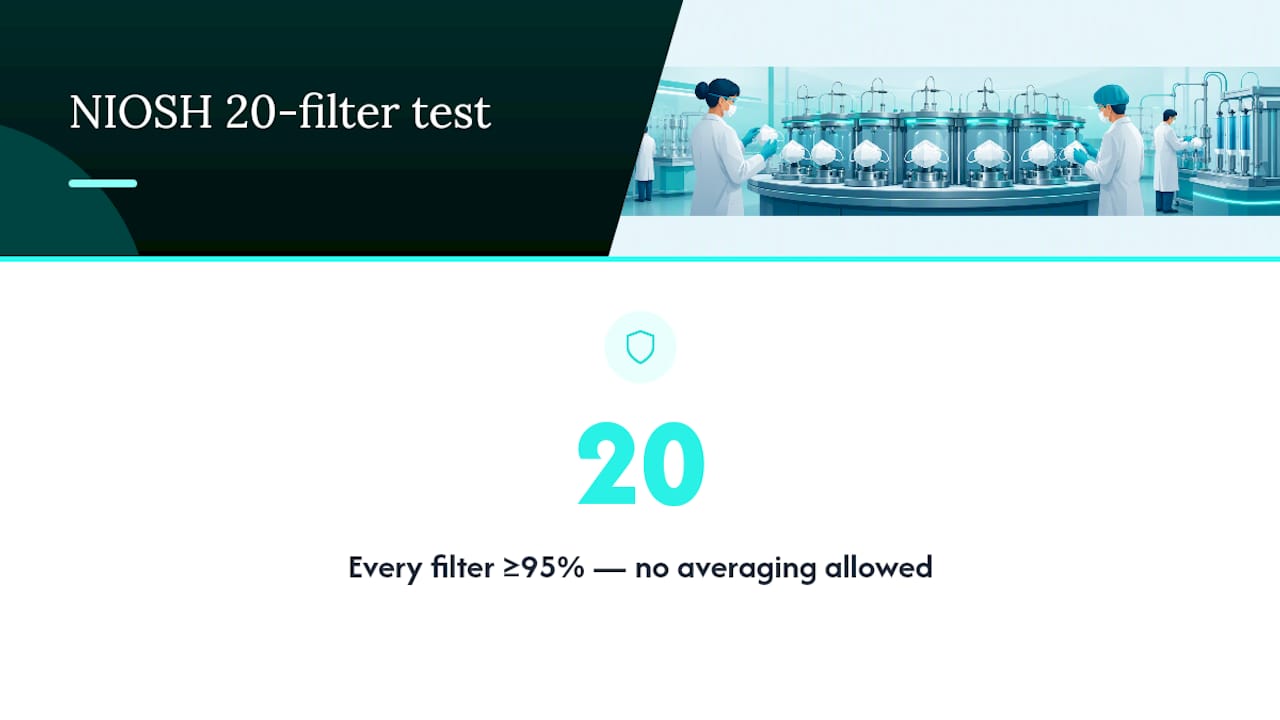
NIOSH doesn’t test a single sample and call it done. The governing STP, TEB-APR-STP-0059, calls for a batch of 20 filters pulled from production, each run through the aerosol chamber, with efficiency recorded across the test. For the N95 class, every one of those filters has to hold filtration efficiency of at least 95% for the whole lot to pass. There’s no averaging out a weak filter against a strong one.
This is also why approval is assembly-specific rather than material-specific. NIOSH tests the finished respirator as sold, straps, nose foam, and all, and the TC number that comes out the other end applies only to that exact configuration. A manufacturer that changes strap material, adds a valve, or resources its nonwoven layer has to go back through testing. That’s also why a distributor repackaging or relabeling a mask under a different name can quietly break the chain of approval, even if the underlying filter media never changed.
How to Verify an N95 Is NIOSH Approved
Before you buy in bulk, or before you hand a box to staff, check the label. Legitimate NIOSH approval leaves a specific paper trail, and it’s printed right on the respirator, not just the box.
Look for these elements printed directly on the facepiece itself:
The word “NIOSH” in block letters (or the NIOSH logo)
The filter class and efficiency rating, e.g., “N95”
A TC approval number in the format TC-84A-XXXX
The manufacturer or private-label approval holder’s name
A model or part number
A lot number for traceability
Once you have the TC number or model number, search the Certified Equipment List directly. The CEL is the authoritative registry, not a manufacturer’s own claims page, and it’s updated as approvals are issued, changed, or pulled.
A practical checklist looks like this: inspect the physical product for all six label elements, run the TC number through the CEL, ask the seller for the approval holder’s documentation, and if anything looks off, check NIOSH’s counterfeit and misrepresentation guidance before you place an order.
Watch for red flags: missing or misspelled “NIOSH” text, no TC number anywhere on the mask, marketing copy that says “N95-style” or “N95 equivalent” instead of a real approval, or a TC number that doesn’t match the model when you check the CEL.
Pro Tip: If a TC number search on the CEL comes back with zero results, treat that as a hard stop. A dead-end search means the approval is either invalid or has been revoked, and there’s no legitimate reason a real approval number should fail to appear.
Workplace Requirements Under OSHA’s Respiratory Protection Standard
Certification only covers the equipment. Once that N95 shows up on a job site, OSHA’s 29 CFR 1910.134 takes over, and it requires more than just buying the right box of masks.
Employers whose workers need respiratory protection have to supply NIOSH-approved respirators and maintain a written respiratory protection program. That program isn’t optional paperwork. It has to include medical evaluations to confirm a worker can safely wear a respirator, initial and annual fit testing to confirm the specific model seals properly on that person’s face, training on proper use and limitations, and a maintenance and replacement policy.
The division of labor here matters: NIOSH approves the equipment itself, confirming it filters what it claims to filter. OSHA governs how that equipment gets deployed, fitted, and maintained in an actual workplace. A facility can buy a perfectly certified N95 and still be out of compliance if it skips fit testing or never trains staff on donning and doffing procedure.
Counterfeits, Misrepresentation, and Ongoing NIOSH Oversight
NIOSH approval isn’t a one-time stamp that lasts forever regardless of what happens afterward. Approval holders have to maintain consistent manufacturing quality, and NIOSH conducts post-market evaluations on products already in circulation. When a product fails to hold up, its approval can be revoked and removed from the CEL.
That’s where buyer diligence pays off. Beyond checking the CEL, ask suppliers directly for the manufacturer’s approval letter and lot-level traceability, especially for large procurement orders. If something looks suspicious, whether it’s a too-good price, unfamiliar labeling, or a seller who can’t produce documentation, report it rather than assuming it’s fine. Small changes, a substituted strap, an altered nose foam, repackaging under a private label, can void approval even when the underlying filter media is unchanged.
How Queens Surgical Vets Respiratory Supply Before It Reaches You
Procurement teams don’t have time to chase down documentation after an order ships. Queens Surgical checks supplier paperwork upfront, including manufacturer approval letters, TC numbers, and lot traceability, before a respiratory product goes into the catalog. When you’re sourcing for a facility, ask any supplier, including us, for that same documentation, and pair it with your own CEL lookup. Our guidance on respirator shelf life covers another detail buyers often overlook: expired stock can fail even with a valid approval on the label.
Historical Background and Development of the NIOSH N95 Certification Standard
NIOSH’s respirator approval authority dates back decades, but the modern N95 classification system took shape with the 1995 revision of 42 CFR Part 84. Before that update, NIOSH used an older certification scheme built around dust and mist ratings that didn’t map cleanly onto the fine-particle hazards showing up in healthcare and industrial settings.
The 1995 rule created the current nine-category system: three letters (N, R, P) crossed with three efficiency levels (95, 99, 100). N95 became the most widely adopted category almost immediately because it balanced strong filtration with breathability and cost, making it practical for everyday industrial and healthcare use rather than just specialized hazmat work.
Demand for N95s spiked dramatically during health emergencies, most visibly during the COVID-19 pandemic, when shortages exposed how thin the domestic supply chain had become and how much counterfeit product could flood the market when demand outpaced legitimate manufacturing. That period pushed NIOSH to sharpen its public guidance on spotting fraudulent respirators and to publish clearer identification materials for buyers who had never needed to think about TC numbers before.
The standard itself hasn’t changed dramatically since 1995. What’s changed is enforcement visibility, more public CEL searches, more counterfeit alerts, and far more attention from procurement teams who learned the hard way that a box labeled “N95” isn’t automatically a certified one.
N95 vs. Other NIOSH-Approved Respirator Classes
The N95 is one of nine combinations NIOSH certifies, and the differences between classes come down to two independent variables: oil resistance and filtration efficiency.
The letter prefix tells you about oil resistance. N-series respirators are not resistant to oil-based aerosols. R-series respirators are oil-resistant for a limited service time. P-series respirators are oil-proof, meaning they hold up against oil aerosols for extended use. That distinction matters most in environments with lubricants, certain metalworking fluids, or oil-based mists, situations where an N-series mask would degrade faster than its rating suggests.
The number tells you filtration efficiency: 95, 99, or 100 (the 100 designation is often referred to informally as filtering 99.97% or better, functionally equivalent to a HEPA-level filter). So a P95 filters the same 95% threshold as an N95 but adds oil resistance for oil-heavy environments. An R95 sits in between, oil-resistant but not fully oil-proof.
For most healthcare and general workplace settings without oil aerosol exposure, N95 remains a practical standard: strong filtration, no oil-resistance need, and comparatively lower cost than P-series options. Facilities with oil mist exposure, certain manufacturing and machining environments, should default to R or P series rather than assuming N95 is universally sufficient.
What N95 Respirators Can and Can’t Do
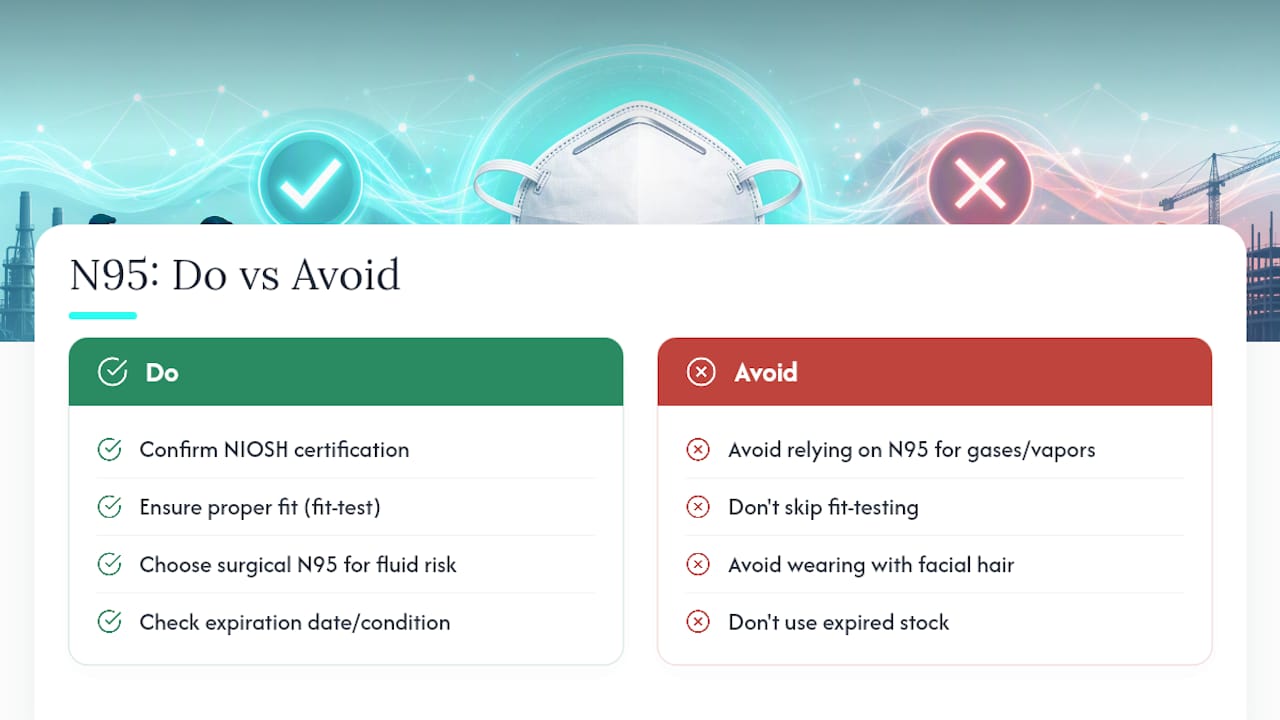
An N95’s certification covers particulate filtration specifically. It filters solid and liquid particles suspended in air, dust, aerosols, many biological particles, down to and including that 0.3 micron test size. It does not filter gases or vapors. If a workplace hazard involves chemical fumes, solvent vapors, or gaseous contaminants, an N95 offers no protection at all, regardless of how well it’s fitted or how fresh the stock is.
Fit matters just as much as filtration. NIOSH certifies the filter class and assembly performance in a lab, but a respirator only performs to spec if it seals properly against the wearer’s face. Facial hair, an improperly sized mask, or a loose strap can create gaps that let unfiltered air bypass the filter entirely. That’s precisely why OSHA’s fit-testing requirement exists alongside NIOSH certification rather than as a redundant formality.
There’s also a distinction worth knowing between industrial N95s and surgical N95s. Standard NIOSH approval addresses particulate filtration only. Surgical N95s intended for use around fluid splash or spray in clinical settings require additional evaluation for fluid resistance, which involves separate coordination with FDA requirements beyond NIOSH’s scope. A basic industrial N95 and a surgical N95 can share the same filtration rating while differing meaningfully in fluid-barrier performance.
Shelf life is the other limitation buyers underestimate. Straps degrade, foam nose pads lose shape, and manufacturers specify expiration windows for a reason; using expired stock risks a compromised seal even on an otherwise properly certified respirator.
How NIOSH Certification Shapes International Standards
NIOSH’s N95 standard doesn’t operate in a vacuum globally. Other major economies run comparable but distinct certification schemes: the European Union uses FFP2 and FFP3 ratings under EN 149, China uses KN95 under GB2626, and several other countries maintain their own national equivalents.
These standards test similar concepts, filtration efficiency against small particles, but the test methods, particle sizes, and pass thresholds differ enough that “equivalent” claims deserve scrutiny. An FFP2 mask, for example, is often described as roughly comparable to an N95 in filtration percentage, but the two are certified under different aerosols, different flow rates, and different regulatory bodies. A mask certified only under a foreign standard is not automatically NIOSH approved, and using foreign-certified equivalents in place of NIOSH-approved respirators in a U.S. workplace can create a compliance gap under OSHA’s standard, which specifically calls for NIOSH-approved equipment.
During periods of severe shortage, U.S. regulators have at times issued temporary emergency authorizations allowing certain foreign-certified respirators into specific settings. Those authorizations are narrow, time-limited, and situation-specific, not a permanent bridge between standards. For everyday procurement, the safer and simpler path for U.S. employers remains sourcing respirators that carry an actual NIOSH TC number rather than relying on an international equivalency claim.
Common Challenges Manufacturers Face During Certification Testing
Getting a new respirator design through NIOSH testing is harder than it looks on paper, and manufacturers run into the same handful of problems repeatedly.
Consistency across the 20-filter sample trips up more submissions than any other single factor.
Material sourcing changes cause a second common headache. Manufacturers that shift nonwoven filter media suppliers, even for a chemically similar material, often have to resubmit for testing because the electrostatic charge and fiber structure that trap particles can vary meaningfully between production batches.
Assembly-level issues cause failures too. A respirator can have excellent filter media and still fail if the strap attachment, nose seal, or exhalation valve (when present) doesn’t hold up structurally during testing, since NIOSH evaluates the complete assembly rather than isolated components.
Finally, post-approval drift is an ongoing challenge rather than a one-time hurdle. Manufacturing lines have to maintain the same quality controls that earned the original approval, and NIOSH’s post-market evaluations exist specifically because production consistency can slip over time even after a design passes initial certification.
Key Official Resources Worth Bookmarking
For anyone responsible for verifying respirators on an ongoing basis, four resources cover nearly every question that comes up:
42 CFR Part 84: the legal text defining test methods and pass criteria.
NIOSH’s identification and counterfeit guidance: label requirements and fraud alerts.
OSHA 29 CFR 1910.134: the workplace program rules governing fit testing, training, and medical evaluation.
Bookmark the CEL and NIOSH’s notice pages specifically. Both change as approvals are added or revoked.
Why Verification Culture Matters More Than the Rating Itself
The N95 rating gets treated as a finish line when it’s really a starting point. A filter that passes 42 CFR Part 84 testing tells you the material works under lab conditions with a fresh sample, a controlled seal, and a specific aerosol. It tells you nothing about whether the specific box on your loading dock is genuine, whether it’s been sitting past its shelf life, or whether the strap someone swapped in last month quietly voided the approval.
The gap most procurement teams miss isn’t the science, it’s the habit. Checking a TC number against the CEL takes under a minute, yet most bulk buyers still trust a printed logo over an actual database search. That’s backwards. Counterfeiters are good at replicating “NIOSH” text and plausible-looking TC numbers; they’re much worse at faking a real database entry, which is exactly why the CEL search matters more than label literacy alone.
If there’s one place to tighten practice immediately, it’s treating fit testing and CEL verification as inseparable, not sequential nice-to-haves. A certified mask that doesn’t seal is functionally no better than an uncertified one, and a properly fitted mask with a fake TC number offers no real assurance either. Both checks have to happen, every time, not just at the first bulk order.
— QB
Verified Respiratory PPE, Sourced With Documentation Ready
Purchasing reliable PPE supplies requires upfront documentation checks to ensure approval compliance, ideally supported by experienced sourcing teams with extensive knowledge of medical supply across the Americas.
Our respiratory product line sits alongside PPE, wound care, and medical disposables, all sourced with an eye toward the kind of TC number and lot traceability procurement teams need for compliance files, not just a checkout receipt. Whether you’re outfitting a single clinic or restocking a hospital system, our team can pull manufacturer approval letters and lot documentation before you commit to a bulk order. Browse the respiratory category now, or contact Queens Surgical directly to request approval documentation for any PPE order before you buy.
Sources
FAQ
Which NIOSH-Approved N95 Masks Are Made in the USA?
NIOSH’s certification doesn’t track country of manufacture directly; the CEL lists the approval holder and TC number, not production location. To confirm U.S. manufacturing specifically, ask the supplier directly and request documentation alongside the standard approval letter and TC number verification.
Do N95 Respirators Need to Be NIOSH Certified?
For workplace respiratory protection under OSHA’s standard, yes. Employers are required to supply NIOSH-approved respirators whenever respiratory protection is necessary, and an uncertified mask doesn’t satisfy that obligation even if it looks similar.
Is the N95 Mask NIOSH Certified?
Only if it carries a valid TC number that matches an active listing on the NIOSH Certified Equipment List. A mask labeled “N95” on packaging alone, without a TC number on the actual facepiece, is not verifiably certified until you confirm it against the CEL.
Is NIOSH P100 as Good as N95?
For environments without oil aerosols, N95 is typically sufficient and more cost-effective; P100 becomes the better choice specifically when oil-based particles are present or when maximum filtration is required.
Recommended
Comments