Clinicians: Verify Infrared Thermometer Accuracy Against ±0.3°C
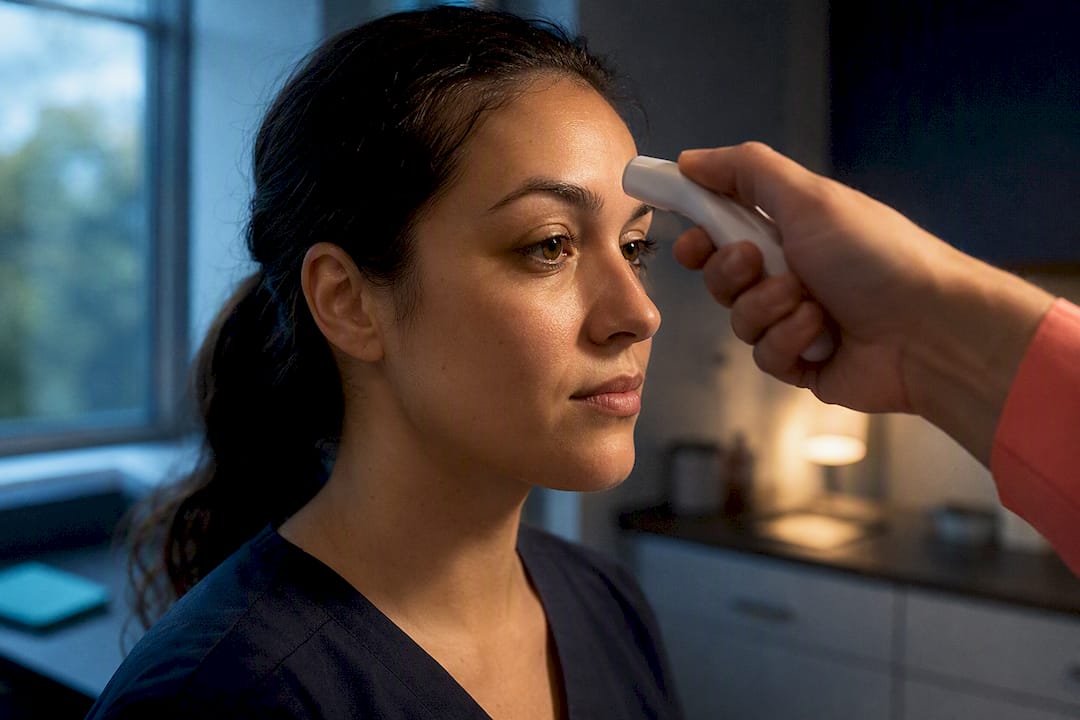
Infrared forehead thermometers aim to measure within a tight accuracy range when properly used, but studies show that many devices do not consistently meet this standard in real-world conditions. Environmental drift, poor technique, and hidden algorithm shortcuts all move the number. When a reading looks borderline or doesn’t match how someone feels, a contact thermometer is the tiebreaker, not the infrared reading.
TL;DR:
Most infrared thermometers only meet accuracy standards in controlled lab tests, not consistently in real-world conditions where environmental factors and technique vary.
Proper calibration using a traceable blackbody source and adherence to manufacturer instructions are essential for trustworthy readings; many devices drift over time without calibration.
Temperature readings can be significantly affected by distance, angle, sweating, skin lotion, and environmental interference, making technique crucial for accurate results.
Infrared thermometers typically measure skin temperature and require proprietary algorithms to estimate core temperature, which introduces variability and potential error.
Confirm borderline or critical temperature readings with a contact thermometer, especially when clinical decisions depend on accurate fever detection.
Table of Contents
What Infrared Thermometer Accuracy Actually Measures
Every non-contact infrared thermometer (NCIT) works the same basic way: it captures the infrared energy radiating off your skin and converts that energy into a temperature number. Nothing touches you. Nothing gets contaminated. But that convenience comes with a chain of assumptions, and each link in that chain is a place accuracy can slip.
Skin has an emissivity of roughly 0.98, meaning it radiates almost like a perfect thermal source, which is why infrared sensors work reasonably well on human foreheads in the first place. The sensor detects wavelengths in the 8 to 14 micron band, the range where skin emits most of its thermal energy, and a lens focuses that energy onto a detector.
Here’s the part most people never think about: forehead skin temperature is not core body temperature. Skin runs cooler than the body’s interior, and the gap changes with sweat, blood flow, and room temperature. So the device doesn’t just measure and display. It measures skin temperature, then runs that number through a proprietary algorithm that tries to estimate what an oral or core reading would show. That conversion step is where a lot of the disagreement between brands and models comes from, since two manufacturers rarely use the exact same correction formula.
Distance matters more than most buyers assume. Every infrared sensor has a distance-to-spot ratio, sometimes printed on the device as something like 5:1 or 8:1, which tells you how large an area the sensor is actually averaging at a given distance. Move too far back and the sensor starts picking up forehead edges, hair, or surrounding air instead of a clean patch of skin. This is called the size-of-source effect, and it’s a common reason two readings taken seconds apart can differ by more than half a degree.
A few technical realities worth knowing before you trust a number on a screen:
Skin emissivity near 0.98 makes infrared measurement feasible, but small variations in skin condition (sweat, lotion, sunburn) shift the true emissivity slightly.
The 8 to 14 micron detection band is standard across most consumer and clinical NCITs.
Distance-to-spot ratio determines how much stray heat or cool air gets averaged into a reading.
Bench tests using a flat blackbody source confirm raw sensor performance but often don’t exercise the “oral-equivalent” conversion mode clinicians actually rely on, so a device can pass a lab test and still misfire in the exam room.
That last point deserves emphasis. A manufacturer can publish an accuracy claim based on how the sensor performs against a controlled heat source, without ever validating the algorithm that turns a forehead reading into a displayed “oral equivalent” number. Buyers rarely see that distinction on the box.
Accuracy Limits and Standards: What ±0.3°C Actually Means
Two documents define what “accurate” is supposed to mean for these devices: ASTM E1965 and ISO 80601-2-56. Both set a target accuracy window of ±0.3°C for skin and forehead NCITs across their labeled measurement range, with tympanic (ear) thermometers generally held to a similarly tight window in their own spec. That number, ±0.3°C, is the benchmark you’ll see referenced on packaging and in comparison charts, and it’s the one worth remembering when you’re reading a spec sheet.
The gap between spec and reality: A 2023 systematic review found NCITs hit the ±0.3°C target in only 29 of 50 tested settings. Infrared thermography performed even less consistently. The standard exists. Meeting it in practice is the harder part.
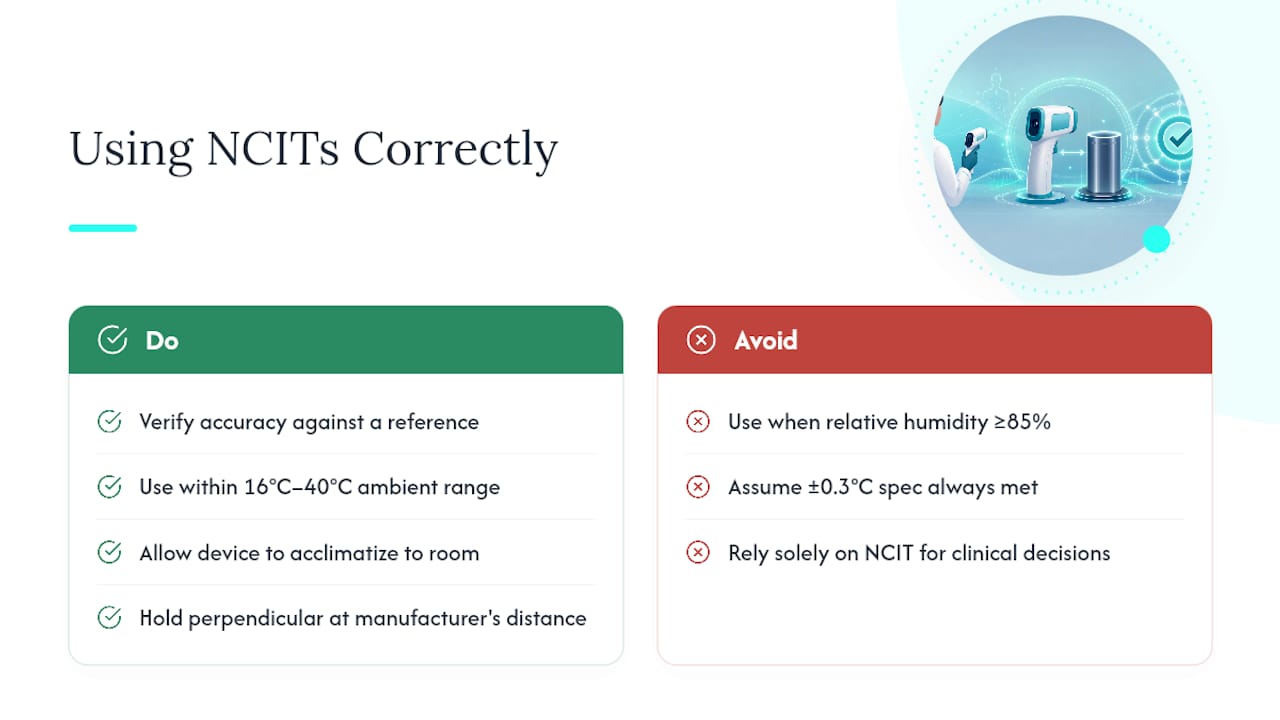
The FDA’s guidance on non-contact infrared thermometers lays out the operating envelope manufacturers design around: ambient temperatures between 60.8°F and 104°F (16°C to 40°C), relative humidity under 85%, device acclimatization to room conditions before use, and a perpendicular hold following the manufacturer’s specified distance. Step outside that envelope, and you’re no longer using the device under the conditions its accuracy claim was tested against.
Clinical evidence backs up why verification matters. One clinical evaluation found poor agreement between several infrared devices and non-invasive core-body temperature references, with meaningful variability from one device model to the next. Two units of the same brand didn’t always agree with each other, let alone with a reference thermometer. Bench testing under ASTM protocols indicated that some NCIT models may exceed recommended accuracy limits when proprietary algorithmic corrections are considered.
Not every result is discouraging. Wirecutter’s consumer testing found most thermometers in their sample landed within roughly ±0.4°F (about ±0.22°C) of claimed accuracy across a range from 93°F to 109°F, which suggests a well-made consumer device used correctly can perform close to clinical margins. The spread between “close to clinical margins” and “clinically unreliable” comes down almost entirely to the factors in the next section.
There’s a practical consequence for fever screening specifically. When a device runs even slightly cool on average, an inconsistency researchers have flagged repeatedly, it doesn’t just add noise. It can shift the whole distribution of readings low enough that a real fever gets missed, or a normal temperature gets flagged as elevated. That’s a sensitivity and specificity problem, not just a precision problem, and it’s a big reason clinical protocols still lean on contact-based confirmation for anything that matters medically. Mayo Clinic’s guidance on thermometer selection also flags age as a factor: rectal or forehead methods are generally preferred for infants under three months, while ear or oral methods tend to serve older children and adults better.
What Throws Off an Infrared Reading
Accuracy on the spec sheet assumes ideal conditions. Real life rarely offers those. The variables below are the ones that move a reading the most, roughly in order of how often they trip people up.
Distance and angle. Too far back, and the sensor’s spot size grows to include hair, glasses, or open air, diluting the reading. Held at an angle instead of perpendicular to the skin, the sensor sees less usable surface and more background heat. Most manufacturers specify an exact distance, often between 1 and 5 centimeters for forehead models. Ignoring that number is one of the fastest ways to get an unreliable result.
Ambient conditions. A draft from an air vent, direct sunlight through a window, or a nearby radiator all introduce heat sources the sensor can’t distinguish from body heat. Humidity above the FDA’s recommended 85% ceiling can also interfere with infrared transmission through the air between the device and the skin.
Patient history in the last 15 to 30 minutes. Someone who just came in from cold weather, finished exercising, or is sweating heavily will show a forehead temperature that has nothing to do with their actual core temperature. Bangs, headbands, sweat, or lotion on the forehead all change the emissivity the algorithm assumes.
Age-related skin differences. Infants and older adults often show more variable skin-surface readings, part of why age-specific site recommendations exist in the first place.
Device-level issues. Every NCIT assumes a fixed emissivity value, typically 0.98, and any deviation from that assumption introduces error the device can’t self-correct. Batteries running low, a sensor lens smudged with fingerprints, or a unit that hasn’t had time to acclimate to the room can all shift readings by several tenths of a degree without any obvious sign something’s wrong.
A quick rundown of what to control before you trust a number:
Hold the device at the exact distance the manufacturer specifies, not “close enough.”
Keep the forehead clear of hair, sweat, and cosmetics before measuring.
Avoid direct sun, drafts, and nearby heat sources during the reading.
Let both the device and the person acclimate to room temperature for at least 10 minutes beforehand.
Wipe the sensor lens with a dry, lint-free cloth; never touch the lens directly.
Pro Tip: If you’re getting inconsistent readings on the same person within minutes, don’t assume the person’s temperature is fluctuating that fast. Check the room first. A sunny window or an HVAC vent six feet away is a far more common explanation than a genuine physiological swing.
How to Check and Calibrate an Infrared Thermometer
Ice water and warm tap water tests feel intuitive, but they’re weak evidence. Ice water sits around 0°C and warm tap water is nowhere near the 35 to 42°C range clinical thermometers actually need to be accurate in, so a device that reads correctly at those extremes can still be off by a full degree in the range that matters for fever detection. If you genuinely want to know whether a thermometer is trustworthy, you need a reference source that emits a stable, known temperature in the clinically relevant range. That’s what a blackbody source or a precision infrared calibrator does.
A practical verification procedure, adapted from calibration guidance widely used in metrology labs, looks like this:
Set the calibrator’s emissivity to 0.98 to match human skin, since testing against a mismatched emissivity setting will produce a false error reading.
Set the calibrator to a clinically relevant target, typically 37°C, and let it stabilize for 10 to 15 minutes before taking any readings.
Let the thermometer acclimate to the same ambient environment as the calibrator for at least 10 minutes; a device pulled from a cold bag and tested immediately will read low regardless of how accurate it actually is.
Position the thermometer at the manufacturer’s specified distance from the calibrator’s target surface, held perpendicular, matching the exact geometry you’d use on a patient.
Take at least five separate readings, repositioning slightly between each one rather than leaving the device locked in place.
Calculate the mean and standard deviation of those five-plus readings. The mean tells you the average offset from 37°C; the standard deviation tells you how repeatable the device is shot to shot.
Compare the mean error to the ±0.3°C target. If the average reading falls outside that window, the device isn’t meeting the accuracy standard it’s supposed to be built to, regardless of what’s printed on the box.
A device that averages 37.5°C against a 37.0°C reference, with a standard deviation under 0.1°C, has a consistent but real bias of 0.5°C, well outside the ±0.3°C benchmark. That’s a device that’s precise but not accurate, and the fix is either a firmware recalibration or replacement, not more readings.
Record what you find. Practitioners working in clinical settings should log the date, ambient temperature and humidity, which calibrator was used, the individual readings, and the computed mean and standard deviation as part of routine equipment maintenance. That log is what catches slow drift before it becomes a clinical problem, and it’s what you’d want on hand if a device’s readings ever get questioned.
Send a device out for traceable, certified calibration after any drop, after exposure to extreme heat or cold, or if repeated home verification shows drift that a simple sensor cleaning doesn’t fix. Home verification with a calibrator is useful for catching gross errors and building confidence in day-to-day use, but it doesn’t carry the same legal or clinical weight as a certificate from an accredited calibration lab, and clinics or purchasing departments should treat the two differently in their documentation.
One more thing worth knowing if you’re buying for a practice: because the “oral-equivalent” display mode runs through firmware most buyers never see, it’s worth asking a supplier for manufacturer test reports that show performance in that display mode against clinical references, not just raw sensor performance against a blackbody. A device that passes bench testing in raw mode can still misrepresent its clinical accuracy if that conversion algorithm was never independently checked.
Best Practices for Getting a Reliable Reading
Most measurement errors trace back to skipped steps, not bad equipment. Building a short routine fixes the majority of them.
Give both the device and the person 10 to 30 minutes to acclimate to room temperature before measuring, longer if either has just come in from significantly hotter or colder conditions outside. A thermometer pulled straight from a cold car and a person who just walked in from winter weather will both read artificially low no matter how good the device is.
Hold the thermometer perpendicular to the forehead at the exact distance the manufacturer specifies, aimed at a clear patch of skin free of hair, sweat, or makeup. Keep the person away from drafts, direct sunlight, and space heaters during the measurement itself, not just beforehand.
Take two or three readings in a row and look at the spread rather than trusting a single number. If they cluster tightly, you can trust the average. If they swing by more than a couple tenths of a degree, something in the environment or technique needs fixing before the number means anything. Keep the sensor lens clean with a dry cloth, since a smudge or residue changes how the sensor reads infrared energy, and never touch the lens surface directly.
Use the device in the mode the manufacturer intends for your situation. Some units offer both a “surface mode” for objects and a “body mode” calibrated for skin, and mixing them up produces numbers that look plausible but mean nothing clinically.
Pro Tip: Keep a basic contact digital thermometer on hand as a tiebreaker. When an infrared reading is borderline, doesn’t match how someone looks or feels, or needs to be documented for a medical decision, a quick oral or axillary check with a contact device resolves the ambiguity faster than repeating the infrared measurement five more times.
Confirm with a contact thermometer any time a reading is within a degree of a fever threshold, when the person shows symptoms that don’t match the number on screen, or when the reading needs to support an actual clinical decision like sending a child home from school or clearing someone for a procedure. Infrared screening is a fast first pass. It was never designed to be the final word.
Why Queens Surgical Buyers Get Straight Answers on Thermometry
Reliable temperature measurement starts with reliable equipment, and that means checking specs before checkout, not after a device starts drifting. A reliable medical supply catalog supports clinics, hospitals, and individual healthcare professionals with products that meet the standards this article describes, backed by extensive experience in medical procurement and a supplier network built to keep pricing competitive on both retail and wholesale orders.
When you’re comparing infrared thermometers or any measurement device, ask for the manufacturer’s ASTM E1965 or ISO 80601-2-56 test documentation and, where relevant, a traceable calibration certificate rather than relying on box copy alone. That single habit separates buyers who get burned by drift six months in from buyers who don’t.
An Editorial Note on Trusting the Number on the Screen
The instinct to treat a thermometer reading as a final answer is understandable and usually wrong. A number on a screen is the output of a chain: sensor, algorithm, environment, technique. Break any link in that chain and the number still displays with the same confident precision, which is exactly what makes infrared thermometry risky when people stop questioning it. The fix isn’t distrust of the technology. It’s the habit of checking a device periodically, documenting what you find, and treating a single borderline reading as a prompt to look closer rather than a verdict.
— QB
Get Equipment You Can Actually Verify
Reliable medical supply sellers offer thermometers and consumables clinics and individual practitioners need to measure temperature with confidence, not just convenience. Unlike buying blind from a marketplace listing with no spec sheet attached, a well-established catalog backed by medical procurement experience and a supplier network built for competitive pricing on both single-unit retail orders and bulk wholesale purchasing can be more trustworthy.

Before you add a thermometer to your cart, check the product’s listed accuracy specification against the ±0.3°C benchmark covered above, and don’t hesitate to ask Queens Surgical’s team for manufacturer test documentation or calibration certificate options when you’re outfitting a clinic rather than a single household. Browse the full medical equipment and supplies catalog to compare thermometers alongside the wound care, respiratory, and disposable supplies most practices order alongside them.
Sources
For readers who want the primary documents: the FDA’s non-contact infrared thermometer guidance covers operating conditions, the 2023 systematic review covers real-world accuracy data, and the ASTM E1965 bench-testing study details algorithmic accuracy gaps. Mayo Clinic’s thermometer guide covers age-based method selection.
This article is general information, not a substitute for advice from a qualified doctor. Consult a qualified healthcare professional about your own circumstances before acting on anything here.
FAQ
How do I know if my infrared thermometer is accurate?
Test it against a known reference, ideally a calibrator set to 37°C with emissivity at 0.98, taking at least five readings and checking whether the average falls within ±0.3°C of that target. Simple ice-water or warm-water checks won’t tell you much because they don’t test the clinically relevant temperature range.
Where is the most accurate place to use an infrared thermometer?
For forehead (temporal) models, the center of the forehead, free of hair, sweat, or sunscreen, gives the most consistent reading; for tympanic models, a properly sealed ear canal position matters more than exact placement on the forehead. Age-specific guidance from Mayo Clinic suggests different preferred sites for infants versus older children and adults.
What are common infrared thermometer mistakes?
The most frequent errors are measuring from too far away, skipping acclimatization time for the device or the person, and taking a reading near a draft, sunny window, or another heat source. Touching the sensor lens or using the wrong device mode (surface versus body) also throws off results.
How accurate is an infrared thermometer for detecting a fever?
Infrared devices can detect elevated temperature reliably as a quick screening tool, but a systematic review found they only met the ±0.3°C clinical accuracy target in 29 of 50 tested settings, meaning borderline or symptomatic cases should be confirmed with a contact thermometer before making a clinical decision.
Recommended
Comments