Clinicians: Meet 1–10 Minute Contact Time for Disinfectants
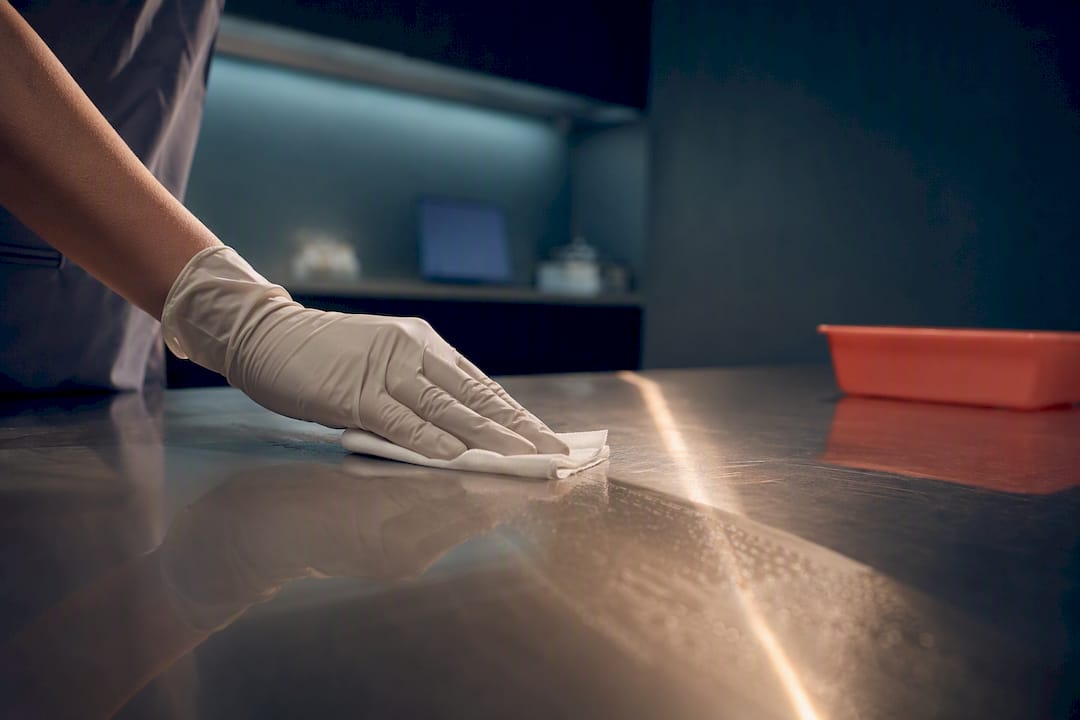
Contact time, also called dwell time or wet time, is the length of time a surface must stay visibly wet with a disinfectant to achieve the labeled kill claim. If the surface dries before that window closes, the disinfection is incomplete, regardless of which product you used. The operational rule is simple: check the label, keep the surface wet for the full stated time, and reapply if it flashes dry, following EPA guidance on registered disinfectants and CDC’s cleaning and disinfecting protocols.
TL;DR:
Contact times vary significantly depending on the organism, with viruses often requiring less than a minute, while bacterial spores may need ten minutes or more.
Always verify contact time through full label instructions, SDS, or EPA registration data rather than relying solely on the headline time on the product.
Maintaining surface wetness through appropriate volume, coverage, and environmental conditions like airflow is essential to meet the specified contact time.
Different disinfectant formats, such as wipes or concentrates, influence practical contact time, especially when wiping large surfaces or in high-turnover settings.
Proper disinfection workflow includes soil removal, full coverage, wetness verification, and documentation to ensure compliance and effectiveness in real-world conditions.
Table of Contents
Why Do Contact Times Vary by Product and Organism?
Contact time isn’t a marketing suggestion. It’s a number generated during EPA registration testing, where a manufacturer proves a specific formulation kills specific organisms under specific conditions. Change the organism, the temperature, or the soil load, and the required time changes too.
Most EPA-registered disinfectants are tested against a defense of indicator organisms: Staphylococcus aureus, Salmonella enterica, and Pseudomonas aeruginosa. These three cover the base case for “general disinfection” claims. A product might advertise a 30 second kill time against a specific virus while requiring 3 to 10 minutes for its broader bacterial claims. That gap is where a lot of facilities get tripped up: staff see the flashy number on the front of the bottle and assume it applies to everything the product touches.
A few terms get used almost interchangeably in the field, but they mean slightly different things:
Wet time: the observable state of the surface staying visibly moist with the disinfectant.
Dwell time: the general industry term for how long the chemical must remain in contact with the surface.
Kill time: the laboratory-derived time needed to achieve the log reduction claimed against a specific organism.
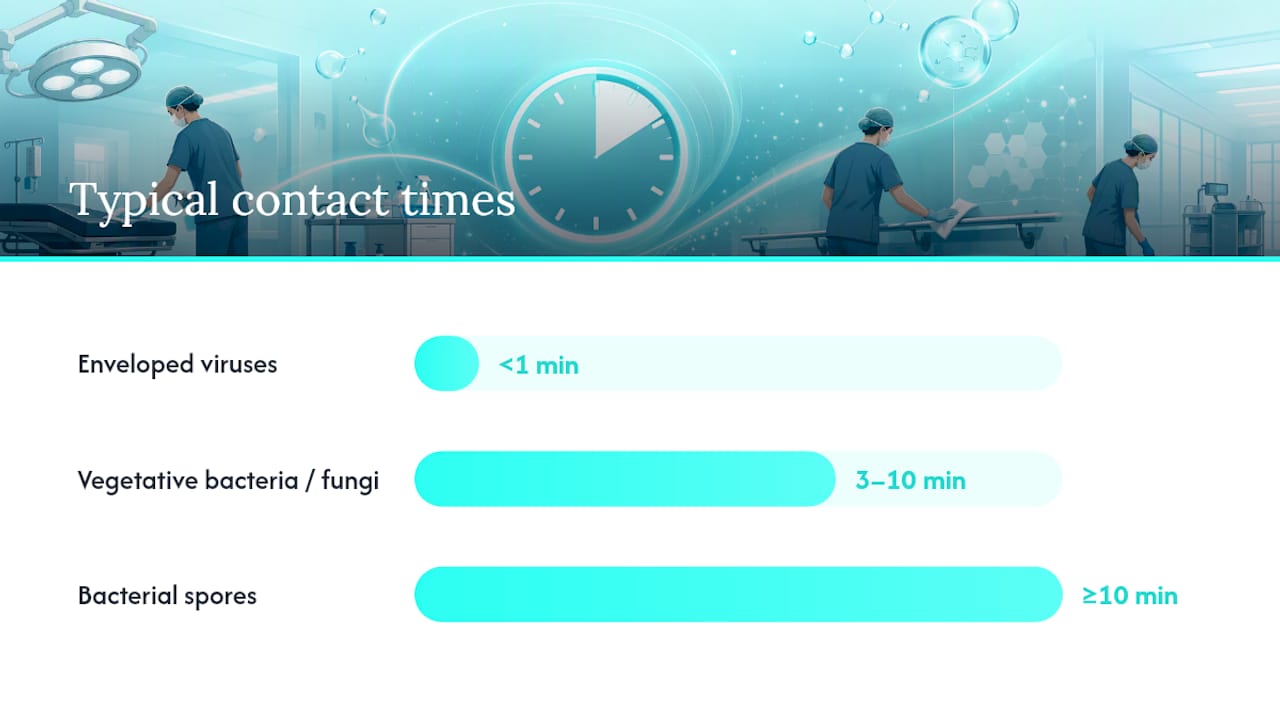
The reason one bottle lists several numbers comes down to biology. Enveloped viruses tend to break down fast, sometimes in under a minute, because their lipid membranes are fragile. Vegetative bacteria and fungi typically need several minutes of exposure. Bacterial spores, if the product even makes a sporicidal claim, can require ten minutes or longer, and often a completely different chemistry altogether. The CDC’s guideline on chemical disinfectants walks through how concentration, temperature, and exposure time interact for each disinfectant class, and it’s worth keeping on hand for any facility writing its own SOPs.
How Do You Find and Verify the Correct Contact Time?
The contact time printed in bold on the front label is a starting point, not always the complete picture. Verifying it takes three steps, in order.
Read the full label directions, not just the front panel. Many labels list a range of contact times tied to specific organisms and specific surface types, and the “headline” time on the front is often the shortest one, not the general disinfection time.
Pull the Safety Data Sheet (SDS). The SDS sometimes clarifies application volume, dilution ratios, and surface compatibility that the label abbreviates.
Search the EPA’s Pesticide Product and Label System (PPLS) using the product’s EPA registration number, printed on the label near the ingredient list. PPLS holds the master label on file, which is the legally binding version if a printed label has faded or been reprinted incorrectly.
If a product’s label lists organism-specific times but no single “general disinfection” figure, use the contact time associated with the EPA indicator organisms as your default. That’s the conservative baseline regulators expect facilities to fall back on when the label is ambiguous, a point confirmed by state environmental health guidance on determining contact time.
Whatever number you land on, write it into your facility’s SOPs by name, product, and minute count, not as “follow label instructions.” Auditors and surveyors ask staff to recite the contact time from memory during infection-control rounds. A vague answer, even from a competent tech, reads as a training gap on paper.
What Does a Reliable Disinfection Workflow Actually Look Like?
Getting the labeled contact time in real clinical conditions takes more than pouring on solution and waiting. It takes a workflow, and the workflow starts before the disinfectant ever touches the surface.
Remove organic soil first. Blood, mucus, and debris inactivate many disinfectant chemistries and physically block contact with the surface. Clean, then disinfect, as two distinct steps.
Apply with full surface coverage. Overlapping passes with a spray or wipe matter more than most staff realize. A single thin pass leaves dry gaps that never see the labeled contact time at all.
Maintain wetness through the full window. For wipes, that may mean using a second wipe on high-touch or textured surfaces. For sprays, it means applying enough volume that evaporation doesn’t outrun the clock.
Verify before moving on. A visual check, is the surface still glistening at the halfway mark? takes five seconds and catches most failures before they become an infection-control incident.
Environmental conditions push against you the whole time. Heat and airflow from HVAC vents or open windows accelerate evaporation. Low humidity does the same. In rooms with heavy air turnover, staff sometimes need to choose a slower-evaporating chemistry or apply a second, deliberate reapplication partway through the contact window.
Pro Tip: Turn “wetness checks” into a two-second habit staff perform out loud during rounds, saying “still wet” or “reapplying” as they work. Verbalizing it turns a passive assumption into an active checkpoint, and it trains new staff faster than any written SOP does.
Does the Disinfectant Format Change Real-World Contact Time?
Format matters more than most buyers assume when they’re comparing options like pre-wetted wipes, ready-to-use sprays, and concentrates that require dilution.
Pre-wetted wipes carry a fixed volume of solution. On a large or heavily soiled surface, that volume can run out before the surface achieves full wetness, which is why some testing under realistic-use conditions has found that contact time has limited practical effect on towelette efficacy when the wipe itself dries out too fast. The fix is straightforward: use a second wipe on large or heavily used surfaces rather than stretching one wipe thin.
The alcohol concentration paradox trips up a lot of facilities comparing 70% versus 90% or 99% isopropyl. Higher concentrations evaporate faster and, counterintuitively, denature proteins less effectively because water is a required part of that chemical reaction. Stanford Environmental Health & Safety notes that 60 to 80% alcohol solutions often outperform higher concentrations in practice for exactly this reason.
Concentrates introduce a different risk: mixing error. Under diluted solution weakens the chemistry below its tested efficacy; over diluted solution wastes product without extending contact time protection.
When Do You Need High-Level Disinfection Instead of Routine Surface Wiping?
Routine surface disinfection, high-level disinfection, and chemical sterilization aren’t interchangeable terms, and confusing them is a real patient-safety risk on semicritical or critical devices.
Routine surface disinfection targets noncritical surfaces like countertops, bed rails, and equipment housings, typically in the 1 to 10 minute range.
High-level disinfection applies to semicritical devices like endoscopes and requires longer exposure, often 12 to 90 minutes depending on the chemistry, per CDC’s disinfection and sterilization guideline.
Chemical sterilants, glutaraldehyde, ortho-phthalaldehyde (OPA), and high concentration hydrogen peroxide or peracetic acid among them, need even longer exposure at controlled temperatures to achieve full sporicidal claims, sometimes with immersion required rather than surface wiping.
Temperature and immersion aren’t optional details here. A glutaraldehyde solution that’s fallen below its validated temperature range won’t reach its labeled kill within the stated time, even if the clock says the minutes have passed. Always follow the device manufacturer’s Instructions for Use (IFU) first, and cross check against your specialty society’s reprocessing guidelines when the two seem to conflict.
Why Does Disinfection Sometimes Seem to Fail Even When Staff Followed Steps?
Most contact time failures trace back to a short list of repeat offenders.
The product dried before the labeled time elapsed, usually from underapplication or a high airflow room.
Cleaning got skipped, leaving organic soil that shields organisms from the chemistry.
Dilution was wrong, either too weak from an over diluted concentrate or, less commonly, too strong from equipment error.
The surface was incompatible, some porous or textured materials trap or repel solution unevenly.
The wrong product was chosen for the organism, a common gap when a facility relies on one all-purpose disinfectant for every pathogen it faces.
When disinfection results look questionable, re-clean and reapply rather than assuming the first pass worked. Document what happened, and if the concern is recurring rather than a one-off, consider ATP or swab testing to confirm surfaces are actually clean before your next round of retraining.
What Should a Contact-Time Compliance Checklist Include?
A workable checklist doesn’t need to be complicated. It needs six steps staff can run through without thinking twice:
Verify the product’s labeled contact time against the current SDS.
Confirm cleaning (soil removal) happened before disinfectant application.
Apply with overlapping coverage and adequate volume for the surface size.
Check for visible wetness at the halfway point of the contact window.
Log the product, lot, and contact time used in the room log.
Audit compliance on a set cadence, weekly spot checks work well for most units.
Queenssurgical’s guides on cleaning versus disinfection versus sterilization and UV sterilization evidence for clinics go deeper on adjacent workflow questions. Stock enough wipes and solution to avoid running dry mid-shift; a facility supplies par-level guide helps set reorder points before that becomes a problem.
Where the Real Compliance Gap Actually Sits
The gap between a disinfectant’s label and what actually happens on a busy unit isn’t a knowledge problem. Most clinical staff know contact time exists. It’s a time-pressure problem: a nurse with four rooms to turn over in fifteen minutes isn’t going to stand and watch a wet surface for the full labeled window, and no amount of poster signage changes that math.
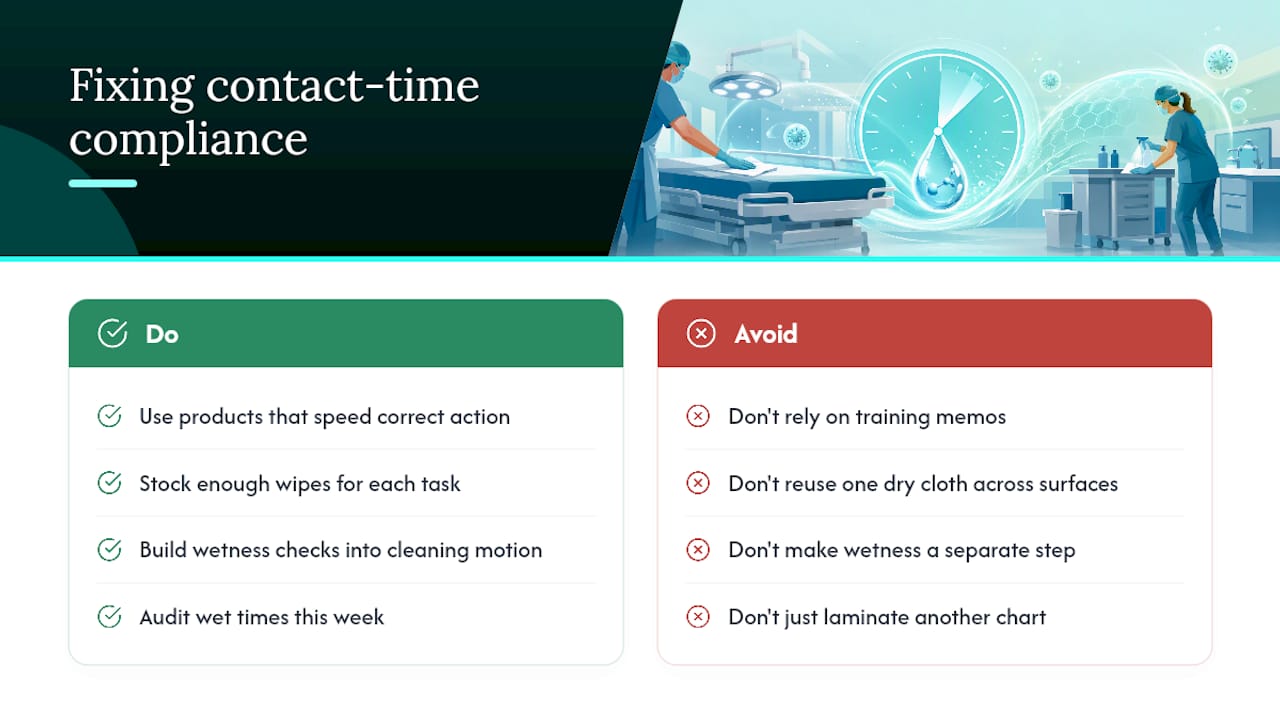
The fix isn’t more training memos. It’s picking products and formats that make the correct behavior the fastest behavior, stocking enough wipes that nobody stretches one dry cloth across three surfaces, and building wetness checks into the physical motion of cleaning rather than treating them as a separate mental step. Facilities that treat contact time as a supply chain and workflow design problem, not just an education problem, get better real-world compliance than ones that just laminate another chart. If your unit hasn’t audited actual wet times in the last quarter, that’s a fifteen-minute walk worth doing this week.
— QB
How Queenssurgical Helps You Meet Labeled Contact Times
Getting contact time right consistently comes down to having the right product on hand in the right format, not just knowing the rule. Queenssurgical stocks disinfectant sprays, pre-wetted wipes, and concentrates alongside the PPE and training resources that support a full infection-control program, including options like the Lysol multi-surface disinfectant spray for teams standardizing their supply cart.
If your facility is running short mid-shift or rebuilding par levels after an audit finding, that’s exactly the kind of procurement problem a wholesale medical supplier solves better than piecemeal retail ordering. Browse the infection-control catalog at Queenssurgical or reach out directly for bulk pricing and par planning support, so the correct contact time practice stays the easy option, not the one your staff skip when the unit gets busy.
Sources
This article is general information, not a substitute for advice from a qualified doctor. Consult a qualified healthcare professional about your own circumstances before acting on anything here.
FAQ
What does a 2 minute contact time mean?
It means the disinfectant must remain visibly wet on the surface for a full two minutes to achieve its labeled kill claim; if it dries sooner, reapply and restart the clock.
How do I find the required contact time for my disinfectant?
Check the product label directions first, then the SDS, and if either is unclear or missing, search the EPA’s Pesticide Product and Label System using the registration number on the bottle.
Why does contact time matter after applying a disinfectant?
The chemical needs sustained exposure to break down microbial cell walls or proteins, and cutting that exposure short, by wiping dry too early, leaves organisms alive on a surface that looks clean.
How long does it typically take a disinfectant to work?
It ranges widely: some virus claims take as little as 30 seconds to a few minutes, general bacterial disinfection often runs 1 to 10 minutes, and high-level disinfection or sterilant processes can take 12 minutes to several hours depending on the chemistry.
Is 70% or 90% alcohol better for disinfection?
Alcohol in the 60% to 80% range, including 70%, typically outperforms 90% or 99% concentrations because the added water content supports the protein denaturation that actually kills organisms, and it evaporates more slowly.
Recommended
Comments