Reimbursement Codes in Retail Medical: 2026 Guide

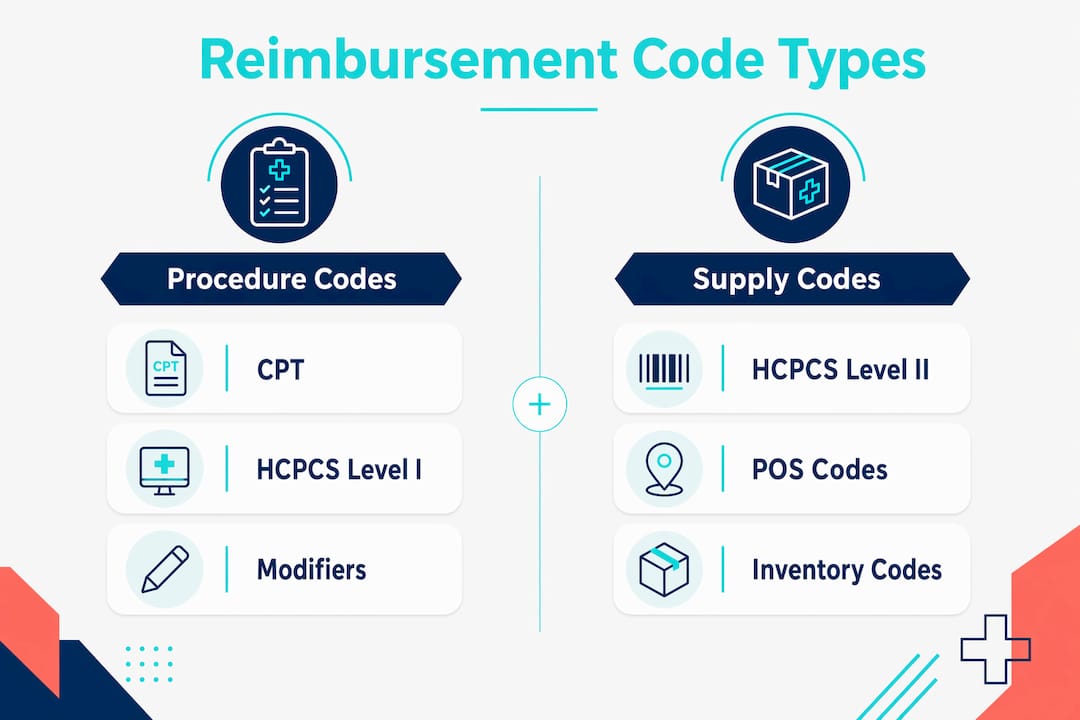
Reimbursement codes are standardized alphanumeric identifiers that translate healthcare services and product usage into billable claims, enabling providers to capture accurate payment and maintain regulatory compliance. The role of reimbursement codes in retail medical settings is foundational: without them, claims cannot be processed, revenue cannot be collected, and compliance cannot be demonstrated. Three code families govern most retail medical billing. CPT (Current Procedural Terminology) codes cover procedures and clinical services. HCPCS Level II codes cover medical supplies, devices, and durable medical equipment. Place of Service (POS) codes tell payers where care was delivered, directly affecting reimbursement rates. CMS and IRS regulations define the rules that govern how each code type must be applied.
What are the main types of reimbursement codes used in retail medical?
Healthcare reimbursement codes fall into distinct categories, and each one does a specific job in the billing process. Mixing them up or applying them incorrectly is one of the fastest ways to trigger a denial.
CPT codes
CPT codes are five-digit numeric codes maintained by the American Medical Association. They describe clinical procedures and professional services, from office visits to minor surgical procedures. Under value-based reimbursement models, CPT codes indicate service delivery but do not guarantee payment. Payers increasingly require quality metrics alignment alongside the code itself.
HCPCS Level II codes
HCPCS Level II codes are alphanumeric identifiers that begin with a letter followed by four digits. They cover medical supplies, orthotics, prosthetics, and durable medical equipment (DME) that CPT codes do not address. HCPCS Level II codes are mandatory for Medicare and Medicaid reimbursement of medical supplies and durable equipment. CMS processes over 5 billion claims annually using HCPCS standardized coding systems. That volume underscores why code accuracy at the supply level is not optional.

For retail medical administrators purchasing consumables and equipment, HCPCS Level II is the primary coding framework. A wound care dressing, a compression stocking, or a blood glucose monitor each carries a specific HCPCS code that determines whether the purchase qualifies for reimbursement. See the procurement guide for consumables for a detailed breakdown of how these codes apply to common supply categories.
POS codes and modifiers
Place of Service codes are two-digit numeric codes that identify the setting where a service was rendered. POS 11 is an office. POS 22 is an on-campus outpatient hospital. POS 17 is a walk-in retail clinic. The same procedure billed under different POS codes can yield significantly different reimbursement rates. Modifiers are two-character additions appended to CPT or HCPCS codes to refine meaning. They indicate whether a service was bilateral, performed by a different provider, or reduced in scope. Precise modifier usage is critical to avoid denials, compliance risks, and audits.
Pro Tip: Always verify the correct POS code before submitting a claim. A retail clinic operating under POS 17 that accidentally bills under POS 22 will receive a lower rate or a full denial, with no ability to rebill the patient for the difference.
How do reimbursement codes impact retail medical purchasing and revenue?
Accurate retail medical coding directly determines how much revenue a facility collects and how quickly it collects it. The financial stakes are concrete and measurable.
Reimbursement timeliness. Correct codes on first submission reduce the claim review cycle. Incorrect codes send claims into a denial queue that can take weeks to resolve, delaying cash flow for the entire billing period.
Denial reduction. A single incorrect POS code can cost busy clinics up to $3,000 in lost revenue per week. That figure reflects not just one denied claim but the cumulative effect of systematic miscoding across a high-volume practice.
Compliance exposure. Incorrect POS code use triggers CO-4 or CO-16 denial classifications that are contractual obligations. These denials prohibit balance billing to patients, meaning the revenue loss is total. There is no recovery path once the denial is classified this way.
Product selection and markup. Reimbursement codes shape purchasing decisions directly. If a supply item carries a HCPCS code with a fixed Medicare fee schedule rate, the administrator must know that rate before negotiating supplier pricing. Buying above the reimbursable rate without a clear markup strategy creates a structural loss on every unit sold. Review retail medical markup standards to understand how coding intersects with pricing strategy.
HSA/FSA compliance. Retail medical suppliers selling to consumers who pay with HSA or FSA funds face IRS requirements. Merchants must provide itemized receipts confirming product eligibility. Failure to comply triggers a 20% IRS penalty on the transaction. That penalty falls on the consumer but reflects directly on the retailer’s compliance standing.
The impact of coding on retail healthcare revenue is not abstract. Every code decision connects to a specific dollar outcome.
What are common coding errors in retail medical reimbursement?
Coding errors in retail medical billing follow predictable patterns. Knowing them in advance is the most effective form of denial prevention.
Unbundling errors. Unbundling means billing separately for services that should be billed together under a single comprehensive code. Unbundling errors and incorrect modifier logic frequently cause denials and increase audit risk. Payers use automated edits to detect unbundling, and repeated violations can trigger a formal audit.
Incorrect POS code selection. This is the single most costly error in retail medical settings. A walk-in clinic billing under a hospital outpatient POS code will receive a lower reimbursement rate or a full denial. Incorrect POS codes can reduce reimbursement by 20%–50% or cause major denials.
Dual-use product misclassification. Many retail medical products serve both medical and general consumer purposes. A heating pad, for example, may qualify as a medical supply under certain HCPCS codes when prescribed, but not when sold over the counter. Administrators must document medical necessity clearly to support the code applied.
HSA/FSA substantiation gaps. Retail merchants are required to generate itemized receipts for HSA/FSA audits. They should not hold or transmit Letters of Medical Necessity (LMN), which remain with providers and patients. Merchants only need itemized receipts for IRS compliance. Confusing these two requirements creates unnecessary documentation burdens and compliance risk.
Revenue code misuse. Revenue codes identify hospital departments on institutional claims and differ from CPT and HCPCS codes entirely. Incorrect revenue code use leads to subtle underpayment rather than outright denial, making it harder to detect. Hospital-affiliated retail medical operations must treat revenue codes as a separate coding layer.
Pro Tip: Build specialty-specific coding playbooks for each service line in your retail medical operation. Specialty-specific coding adherence improves first-pass claim acceptance by addressing payer-specific edit rules that generic coding logic misses entirely.
The 2026 compliance guide for retail medical covers how updated payer edit rules affect these error categories this year.
How do administrators integrate coding into retail medical procurement?
Reimbursement coding is not just a billing department concern. It belongs in procurement planning, vendor negotiations, and inventory management from the start.
Using HCPCS codes in purchasing decisions
Every supply item purchased for resale or clinical use should be evaluated against its HCPCS Level II code before the purchase order is placed. The code determines the Medicare fee schedule rate, which sets the ceiling for reimbursable cost. Purchasing above that ceiling without a documented markup strategy creates a recurring loss. Administrators who build HCPCS code lookups into their procurement workflow catch these mismatches before they become financial problems.
IIAS and HSA/FSA retail compliance
Retail medical merchants selling to HSA and FSA cardholders must use an Inventory Information Approval System (IIAS) or provide itemized receipts to qualify for the IRS 90% Rule exemption. The IIAS automatically flags eligible products at the point of sale, removing the need for manual substantiation on every transaction. This system is the standard for retail pharmacies and is increasingly expected by payers in retail medical settings.
Aligning vendor agreements with reimbursement rules
Supplier contracts should reference the HCPCS codes applicable to each product category. When a supplier changes a product formulation or packaging, the HCPCS code may change as well. A vendor agreement that requires notification of code-affecting product changes protects the administrator from billing a discontinued code.
The table below shows how coding integration applies across key procurement functions.
Procurement function | Coding integration point | Risk if ignored |
Product selection | HCPCS code lookup before purchase | Buying above reimbursable rate |
Vendor contracting | Code change notification clauses | Billing discontinued codes |
Inventory classification | IIAS eligibility tagging | HSA/FSA denial and IRS penalty |
Demand forecasting | Reimbursement rate trend analysis | Budget shortfalls from rate changes |
Billing workflow | POS and modifier verification | CO-4 and CO-16 denials |
Coding data also supports demand forecasting. When reimbursement rates for a specific HCPCS code drop, demand for that supply category often follows. Administrators who track rate changes can adjust inventory levels before the financial impact hits.
Key takeaways
Accurate reimbursement coding is the single most controllable factor in retail medical revenue performance, and errors in POS codes, HCPCS classification, or modifier logic translate directly into denied claims and lost revenue.
Point | Details |
Code types determine payment | CPT, HCPCS Level II, and POS codes each affect reimbursement rates and eligibility differently. |
POS errors are the costliest mistake | A single wrong POS code can cost a clinic up to $3,000 in lost revenue per week. |
HSA/FSA compliance requires IIAS | Retail merchants need itemized receipts or an IIAS system to meet IRS substantiation rules. |
Procurement must include coding | HCPCS code lookups before purchasing prevent buying above the reimbursable rate. |
Specialty playbooks reduce denials | Payer-specific coding logic improves first-pass acceptance better than generic coding approaches. |
What I’ve learned from watching coding errors drain retail medical revenue
The most expensive mistake I see healthcare administrators make is treating reimbursement coding as a back-office billing function. By the time a denial lands in the billing queue, the purchasing decision, the service delivery, and the documentation window have all closed. The damage is done.
The facilities that consistently achieve high first-pass payment rates share one practice: they build coding logic into procurement and clinical workflow before a claim is ever generated. They know the HCPCS code for every supply item they stock. They verify POS codes at the point of scheduling, not at the point of billing. They train front-desk staff on modifier basics because a missing modifier on a bilateral procedure is just as costly as a wrong diagnosis code.
The shift toward value-based reimbursement adds another layer of complexity. CPT codes no longer guarantee payment on their own. Payers increasingly tie reimbursement to quality metrics, outcome data, and care setting documentation. Retail medical operations that built their revenue model on fee-for-service volume are finding that the same codes produce less revenue than they did three years ago. The solution is not to code more aggressively. The solution is to align coding with documented clinical outcomes and invest in staff training that keeps pace with annual code updates.
Compliance risk from coding errors is also underestimated. CO-4 and CO-16 denials are not just revenue losses. They are audit signals. A pattern of POS miscoding tells a payer’s fraud detection system that something is wrong. One audit can consume more administrative time and legal cost than years of denial losses. The investment in accurate coding is always cheaper than the cost of defending it.
— QB
Queenssurgical products built for compliant retail medical supply
Healthcare administrators managing reimbursement compliance need suppliers who understand the connection between product quality and billing accuracy. Queenssurgical stocks medical supplies that meet industry standards and align with HCPCS-coded supply categories used in retail medical billing.

The DynaShield Skin Protectant Cream is one example of a product that fits clearly within documented supply categories, supporting clean coding and straightforward reimbursement. Queenssurgical’s catalog covers consumables, protective equipment, and clinical supplies across the Americas, with pricing structured to support compliant markup strategies. Browse the full catalog at Queenssurgical to find supplies that fit your coding and procurement requirements.
FAQ
What is the role of reimbursement codes in retail medical billing?
Reimbursement codes translate services and products into billable claims that payers can process. Without accurate codes, claims are denied and revenue cannot be collected.
How do HCPCS Level II codes affect medical supply purchasing?
HCPCS Level II codes determine whether a supply qualifies for Medicare or Medicaid reimbursement and set the fee schedule rate. Purchasing above that rate without a markup plan creates a structural loss.
What happens when a POS code is wrong on a claim?
An incorrect POS code triggers a CO-4 or CO-16 denial, which prohibits balance billing to the patient and results in total revenue loss for that service.
Do retail medical merchants need Letters of Medical Necessity for HSA/FSA compliance?
No. Retail merchants need itemized receipts for IRS substantiation, not Letters of Medical Necessity. LMNs remain with the provider and patient, not the merchant.
How can administrators reduce coding denials in retail medical operations?
Build HCPCS code lookups into procurement workflows, verify POS codes before billing, and use specialty-specific coding playbooks to address payer-specific edit rules.
Recommended
Comments