Medical Retail Inventory Shrinkage: What Administrators Must Know
- Qubit Technology
- Jun 30
- 8 min read

Medical retail inventory shrinkage is defined as the dollar-value gap between what your inventory system records and the physical stock actually on your shelves. The industry standard formula expresses this as (Shrinkage $ ÷ Recorded Inventory Value) × 100 to produce a shrinkage percentage. For healthcare administrators and supply chain managers, this number is not just an accounting metric. It signals compliance exposure, patient safety risk, and direct revenue loss. The retail industry average shrinkage rate sits around 1.6%, and any rate above 3% indicates systemic operational problems that demand immediate attention.
What is medical retail inventory shrinkage and why does it matter?
Inventory shrinkage in medical retail follows the same core definition used across all retail sectors, but the consequences are far more serious. A pharmacy or medical supply operation recording $45,000 in inventory with a $3,600 discrepancy carries an 8% shrinkage rate. That rate would be catastrophic in any retail setting. In healthcare, it can also trigger a Fraud, Waste, and Abuse (FWA) audit.
The term “inventory shrinkage” is the standard industry label. You may also encounter “inventory loss,” “stock shrinkage,” or “inventory variance” in healthcare supply chain literature. All refer to the same gap between recorded and actual stock. The distinction that matters in medical retail is whether the gap reflects a physical loss or a data error. Both require different responses.
Medical retail operations face a compounding risk that general retailers do not. Aesthetic and medical retail practices can lose up to 30% of potential annual revenue due to operational inefficiencies, with inventory shrinkage and waste as major contributors. That figure makes shrinkage one of the most financially significant problems a healthcare administrator can address.
What causes inventory shrinkage in medical retail settings?
Shrinkage in medical retail comes from four primary sources, each requiring a different control strategy.
External theft (shoplifting and organized retail crime): This category accounts for 28–35% of shrinkage in medical retail environments. High-value items like branded wound care products, controlled substances, and medical devices are frequent targets. Organized retail crime targeting medical supplies has grown as resale markets for these products have expanded.
Internal theft (employee-related loss): Employee theft contributes 26–32% of shrinkage. In healthcare settings, this includes diversion of controlled substances, unauthorized removal of consumables, and falsified dispensing records. The access levels that clinical staff require to do their jobs also create theft opportunities that general retail employees do not have.
Administrative errors: This category drives 8–12% of reported shrinkage but is consistently underestimated. Wrong unit-of-measure entries, unposted receipts, and duplicate transactions all create discrepancies that look like physical loss. These errors are fixable without any security investment.
Vendor and supply chain fraud: Short shipments, substituted products, and billing for items never delivered all reduce actual stock below recorded levels. Healthcare supply chains with multiple intermediaries face elevated exposure to this category.
Pro Tip: Audit your administrative error rate before investing in physical security. Many healthcare operations spend heavily on cameras and locks while leaving data entry processes unchecked, which means the largest source of their shrinkage goes unaddressed.
The causes of inventory shrinkage in medical retail are multi-causal and often interact. A vendor short-shipment that goes unrecorded, combined with a staff member who removes supplies without logging them, produces a discrepancy that looks far larger than either cause alone. Separating these sources requires both physical counts and system audits running in parallel.

Vendor fraud deserves specific attention in healthcare procurement. When ordering medical supplies online, administrators should verify shipment quantities against purchase orders at the point of receipt, not days later. Delayed reconciliation allows discrepancies to compound across multiple orders before anyone flags them.
How is medical retail inventory shrinkage measured and reported?
The standard measurement process uses two data points: the recorded inventory value from your system and the actual inventory value from a physical count. The formula is straightforward.
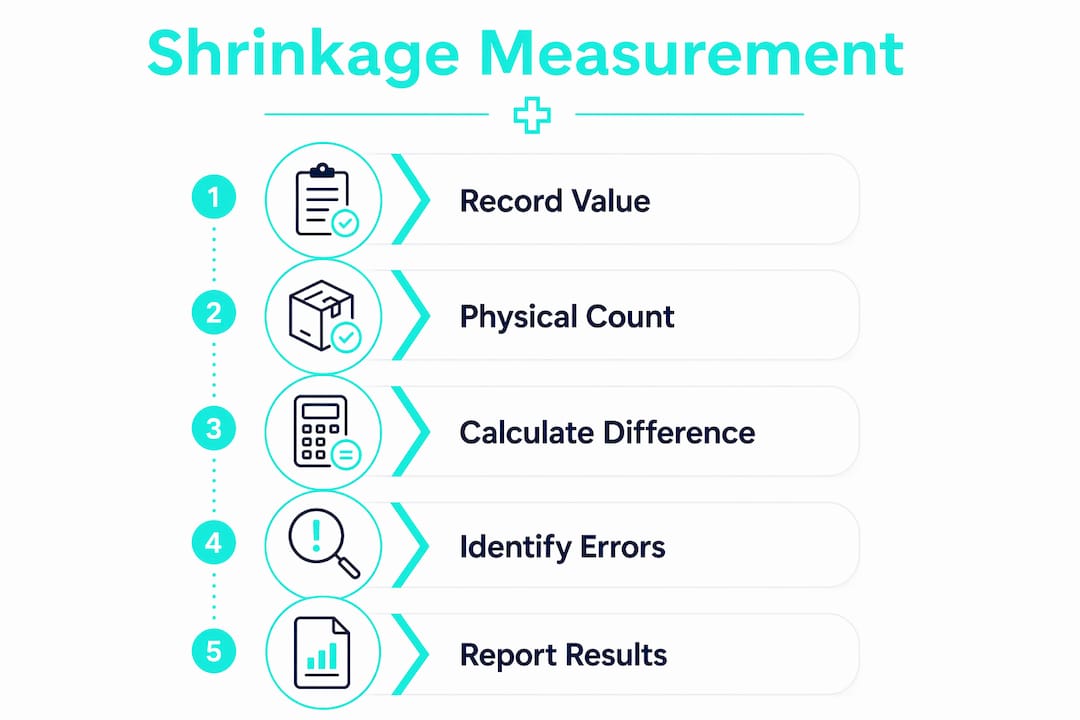
Step | Action | Example |
1. Record system value | Pull current inventory value from your system | $45,000 |
2. Conduct physical count | Count and value all physical stock | $41,400 |
3. Calculate shrinkage $ | System value minus physical count value | $3,600 |
4. Calculate shrinkage % | (Shrinkage $ ÷ System value) × 100 | 8% |
5. Classify the gap | Determine how much is physical vs. apparent | Investigate errors first |
The distinction between physical shrinkage and apparent shrinkage is critical. Apparent shrinkage is caused by system errors like unposted receipts, duplicate sales entries, and incorrect item coding. It looks identical to physical loss in your reports but requires no security response. It requires a data correction.
Most apparent shrinkage is what supply chain professionals call “phantom shrinkage.” Common phantom shrinkage errors include wrong unit-of-measure entries, unposted receipts, and duplicate transactions. Correcting these errors before acting on shrinkage data prevents over-ordering and unnecessary capital tied up in excess stock.
Pro Tip: Run a data audit before every physical count. Correcting system errors first gives you a clean baseline, so your physical count reveals actual loss rather than a mix of real and phantom discrepancies.
Shrinkage reporting frequency matters as much as the formula. Operations that count inventory annually miss months of accumulating loss. Cycle counting, where you count a rotating subset of products weekly, catches discrepancies early and narrows the window for undetected theft or error.
Why is inventory shrinkage especially critical in healthcare and medical retail?
Healthcare administrators face risks that general retailers simply do not encounter when inventory records are inaccurate.
Compliance and audit exposure: Inventory discrepancies in healthcare trigger FWA investigations by healthcare payors. Minor discrepancies are treated as potential non-compliance with NDC-specific billing requirements. The consequences include financial penalties, repayment demands, and network disconnection.
Patient safety risk: Inaccurate inventory records mean clinicians may believe a product is available when it is not. Expired products that were never tracked out of the system remain “available” on paper. Both scenarios create direct patient safety exposure.
Operational disruption: When shrinkage goes undetected, reorder points are miscalculated. Stock-outs of critical supplies force emergency procurement at premium prices. The importance of accurate inventory tracking extends directly to patient care continuity.
Financial impact at scale: A 1% shrinkage rate on a $2 million annual supply budget represents $20,000 in direct loss. That figure does not include the cost of emergency orders, compliance penalties, or staff time spent investigating discrepancies.
Regulatory framework requirements: Healthcare organizations operating under CMS guidelines, Joint Commission standards, and state pharmacy board regulations are all required to maintain accurate inventory records. Shrinkage is not just a financial problem. It is a compliance obligation.
Understanding retail medical compliance requirements helps administrators frame shrinkage control as a regulatory necessity, not just a cost-saving exercise. That framing gets organizational buy-in faster than a financial argument alone.
What practical strategies reduce medical retail inventory shrinkage?
The most effective shrinkage reduction programs combine technology, process controls, and staff accountability. These strategies work in sequence, not in isolation.
Adopt a perpetual inventory system integrated with your EMR. Perpetual inventory tied to patient charts automatically deducts used units when a treatment is recorded. This closes the gap between used and billed units, which is the single largest source of unrecorded loss in clinical settings.
Implement real-time tracking for high-value and high-velocity items. Fast-moving medical supply items like gloves, masks, and wound care products move quickly and are frequently miscounted. Real-time tracking flags unusual depletion rates before they become large discrepancies.
Apply the Triple A framework: Algorithms, AI, and Analytics. The future of shrinkage control in healthcare retail lies in predictive analytics that identify consumption anomalies and demand surges before they create stock-outs or undetected loss. AI-driven systems flag when a product is depleting faster than patient volume justifies.
Establish accountability protocols for staff access and dispensing. Every product removal should require a user login, a patient record link, or a documented reason. Anonymous access to supply rooms is the fastest path to undetected internal theft.
Conduct regular cycle counts and annual physical inventories. Cycle counting by product category, rather than counting everything at once, distributes the workload and catches discrepancies within days rather than months.
Train staff on accurate documentation at the point of care. Most administrative errors are not intentional. A nurse who grabs two gloves but documents one is not stealing. Targeted training on documentation accuracy reduces phantom shrinkage without creating a punitive culture.
Pro Tip: Segment your inventory by shrinkage risk before building controls. Controlled substances, high-cost devices, and fast-moving consumables each need different protocols. Applying the same control to a box of gauze and a $500 surgical instrument wastes resources and frustrates staff.
Setting up a medical supply room with physical organization that mirrors your inventory system reduces the chance of miscounts and misplaced stock. When physical layout and digital records align, discrepancies are easier to spot and faster to resolve.
Key takeaways
Medical retail inventory shrinkage is a compliance, safety, and financial risk that demands systematic controls, not just periodic counts.
Point | Details |
Define shrinkage precisely | Shrinkage is the dollar gap between recorded and actual inventory, expressed as a percentage. |
Separate physical from phantom loss | Correct system and data entry errors before acting on shrinkage data to avoid wasted spending. |
Administrative errors outpace theft | Data errors and process failures often cause more shrinkage than external or internal theft combined. |
Healthcare compliance raises the stakes | Inventory discrepancies can trigger FWA audits, penalties, and network disconnection under CMS and payor rules. |
Perpetual systems and AI close the gap | Integrating inventory with EMRs and applying predictive analytics shifts shrinkage control from reactive to proactive. |
The shrinkage problem most administrators are solving wrong
After working closely with healthcare supply chain operations, the pattern I see most often is this: administrators respond to a shrinkage finding by adding physical security. More cameras, locked cabinets, access badges. Those measures address theft, which is real. But in most medical retail environments I have observed, administrative errors and phantom shrinkage are the larger problem, and no camera fixes a wrong unit-of-measure entry.
The harder cultural shift is convincing clinical staff that documentation accuracy is a patient safety issue, not a paperwork burden. When a nurse understands that an unrecorded supply use creates a phantom stock-out that could affect the next patient, the behavior changes. That framing works better than any audit threat.
The other overlooked vector is vendor reconciliation. Healthcare operations that trust their distributor invoices without checking them against received quantities are handing money away. I have seen operations with otherwise tight internal controls lose significant value annually because no one was verifying shipment quantities at the dock.
The organizations that control shrinkage most effectively treat it as a continuous improvement process, not a one-time fix. They review their shrinkage rate quarterly, investigate every significant variance, and update their protocols when new loss patterns emerge. AI and predictive analytics are making that process faster and more accurate. But the discipline to act on what the data shows still comes down to the people running the operation.
— QB
Queenssurgical’s medical supply catalog supports tighter inventory control

Controlling shrinkage starts with sourcing supplies from a reliable distributor whose products are consistently labeled, accurately shipped, and easy to track through your inventory system. Queenssurgical supplies healthcare facilities across the Americas with a full catalog of medical consumables, from isolation gowns to wound care products like DynaShield Skin Protectant Cream, all sourced to meet clinical and compliance standards. Accurate product descriptions, consistent unit-of-measure labeling, and reliable fulfillment reduce the vendor-side errors that create phantom shrinkage in your records. Browse the full Queenssurgical product catalog to find the supplies your facility needs, priced for both individual providers and larger purchasing organizations.
FAQ
What is the standard formula for calculating inventory shrinkage?
Inventory shrinkage percentage equals (Shrinkage Dollar Value ÷ Recorded Inventory Value) × 100. A $3,600 discrepancy on $45,000 of recorded inventory produces an 8% shrinkage rate.
What shrinkage rate is considered acceptable in medical retail?
The retail industry average is around 1.6%. A rate above 3% signals systemic problems. In healthcare, even rates below 3% carry compliance risk if discrepancies affect NDC-specific billing records.
What is phantom shrinkage in healthcare inventory?
Phantom shrinkage is apparent inventory loss caused by data entry or system errors, such as wrong unit-of-measure entries or unposted receipts, rather than physical loss of product. It requires data correction, not security measures.
How does inventory shrinkage create compliance risk in healthcare?
Inventory discrepancies can trigger Fraud, Waste, and Abuse investigations by healthcare payors. Minor gaps between inventory records and billing data are treated as potential non-compliance, with penalties including repayment demands and network disconnection.
What is the most effective technology for reducing medical retail shrinkage?
Perpetual inventory systems integrated with electronic medical records automatically deduct used units at the point of care. Predictive analytics and AI then flag consumption anomalies before they grow into significant discrepancies.
Recommended
Comments