How Secondary Market Medical Supplies Works in 2026
- Qubit Technology
- Jun 20
- 8 min read

Secondary market medical supplies are used, refurbished, or surplus clinical devices and consumables that re-enter the healthcare supply chain through verified resale channels. The industry term for this practice is secondary market redistribution, and it covers everything from imaging systems and surgical instruments to single-use consumables that never left their original packaging. Understanding how secondary market medical supplies works gives procurement managers a direct path to 20–40% cost savings on capital equipment while reducing clinical waste. Platforms like HHG GROUP LTD and resellers such as iMed Sales have formalized this market with documented workflows, compliance requirements, and escrow protections that rival new-equipment purchasing in rigor.
How does the medical supply resale process work?
The medical supply resale process follows a defined lifecycle from seller preparation through post-sale acceptance. Each stage carries specific documentation and compliance requirements that protect both parties.
Seller data compilation. The seller gathers all equipment details: model number, serial number, manufacture date, maintenance history, and any known defects. Incomplete records at this stage delay listing approval on reputable platforms.
Listing and pricing. Sellers choose between fixed price, open negotiation, or request-for-quote formats. Platforms like HHG GROUP LTD support all three models, giving sellers flexibility based on equipment urgency and buyer demand.
Platform compliance review. The platform verifies that the listing includes required regulatory documentation, decontamination confirmation, and calibration certificates before the item goes live. This step is where most listings stall when sellers are unprepared.
Buyer inspection and negotiation. Buyers review documentation, request additional photos or test reports, and negotiate final terms. Inspection checklists covering visual damage, functional testing, calibration validity, and accessory completeness give buyers concrete leverage in price discussions.
Escrow and payment. Funds are held in escrow until the buyer confirms receipt and acceptance. Acceptance periods run 30–90 days, giving clinical staff time to validate performance under real operating conditions.
Installation and functional testing. The seller or a contracted biomedical engineer completes installation. Post-installation testing confirms the device meets the specifications documented at listing.
Pro Tip: Request a copy of the platform’s escrow release policy before signing any purchase agreement. Some platforms release funds after delivery confirmation alone, not after clinical acceptance. That distinction matters when you are buying imaging or monitoring equipment.
Understanding the medical consumables vs. durable equipment distinction also shapes how you approach each transaction. Consumables rarely require the same compliance trail as capital devices, but they still need lot traceability and expiration verification.

How do you vet suppliers and verify equipment quality?
Supplier vetting is the single highest-leverage activity in secondary market procurement. A credible supplier is transparent about process, not just price.
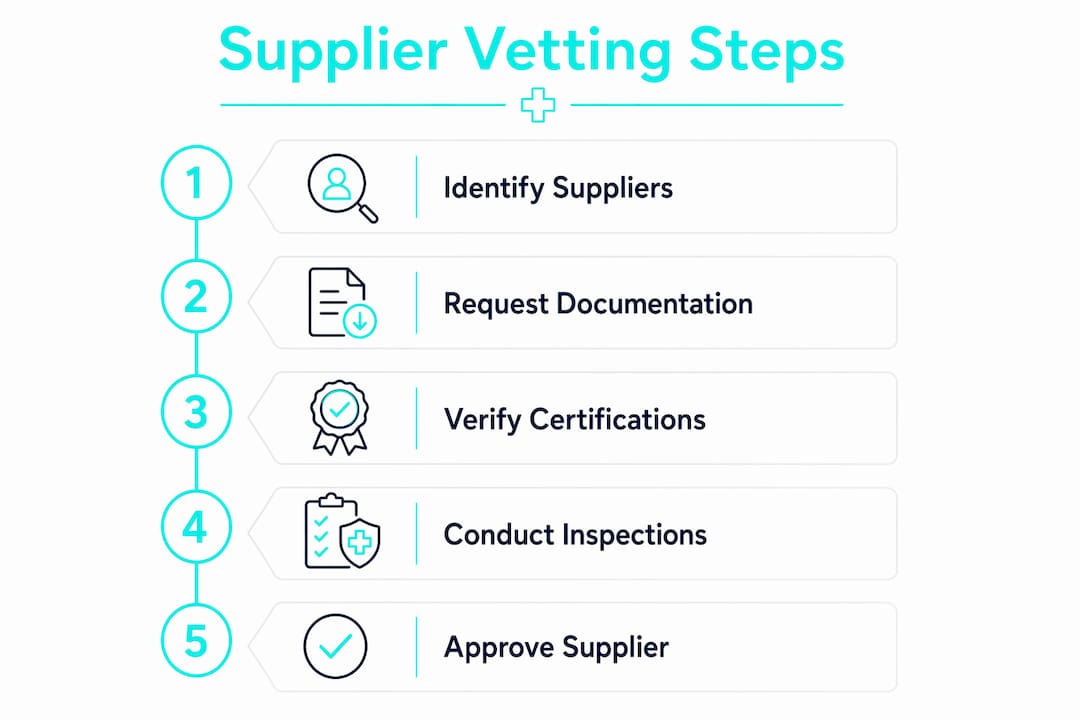
The first distinction to understand is the difference between a reseller and a refurbisher. A reseller acquires and sells equipment with minimal intervention. A refurbisher disassembles, replaces worn components, cleans, calibrates, and functionally tests the device before resale. The term “refurbished” lacks legal standardization, so demanding a written, stepwise refurbishment process from any supplier claiming that label is non-negotiable.
Documents every procurement team must require:
Serialized service history tied to the device’s specific serial number
Calibration certificates with dates and technician credentials
Electrical safety test reports (IEC 62353 or equivalent)
Preventive maintenance logs covering the past 24–36 months
Decontamination confirmation from a licensed facility
Parts replacement records identifying OEM versus third-party components
Institutional buyers reject suppliers who cannot produce this documentation on request. That standard exists for good reason: missing records are the most common precursor to post-purchase failures.
Pro Tip: Ask the supplier directly whether any modification to the device triggers a remanufacturing classification under FDA or applicable regional regulations. Refurbishment versus remanufacturing carries different regulatory pathways, and a vendor who cannot answer that question clearly is a vendor you should not use.
Refurbisher vs. reseller: a quick comparison
Criteria | Refurbisher | Reseller |
Disassembly and part replacement | Yes, documented | Rarely |
Calibration and safety testing | Performed and certified | Often relies on prior records |
Warranty offered | Typically 6–12 months | Varies, often “as-is” |
Regulatory disclosure | Required for modifications | Limited |
Documentation depth | Comprehensive | Minimal to moderate |
Confirm OEM support availability before committing to any purchase. Purchasing from known brands ensures better access to parts, software updates, and field service engineers. A device with no local biomedical support network is a liability, regardless of its purchase price.
What are the benefits and challenges of buying secondary market medical supplies?
Secondary market sourcing delivers measurable financial and operational advantages, but it also introduces risks that require active management.
Core benefits:
Cost savings. Secondary markets deliver 20–40% savings versus new equipment, freeing budget for staffing, consumables, and patient services.
Lifecycle extension. Secondary markets extend clinical asset lifecycles by 5–7 years on average. That extension directly reduces scope 3 carbon emissions and supports ESG reporting requirements.
Access to advanced technology. Smaller facilities and rural hospitals can acquire imaging, monitoring, and surgical equipment that would be unaffordable at new-equipment prices.
Circular economy alignment. The secondary medical market aligns with sustainable healthcare goals through lifecycle extension and reduced electronic waste.
Primary risks:
Counterfeit and substandard devices. Online marketplaces aggregate listings from unverified sellers. Treating online marketplaces as lead generators only, then validating condition and documentation independently, is the standard practice among experienced procurement teams.
Supply chain integrity gaps. Devices that passed through multiple owners without continuous documentation lose traceability. Traceability gaps create liability exposure.
Regulatory complexity. Evolving FDA guidance and international equivalents mean that what was compliant two years ago may require new review today.
“Procurement teams should demand explicit, written condition, testing, and warranty confirmations rather than relying on vague ‘as-is’ claims.” — Relink Online
The risk profile of secondary market purchases drops significantly when you work with suppliers who carry professional liability insurance, offer documented return policies, and can name their authorized local biomedical service partners. Price alone is never sufficient justification for bypassing those criteria.
For a deeper look at compliance obligations tied to device condition and classification, the regulated medical device retail guide from Queenssurgical covers the key regulatory checkpoints procurement teams face in 2026.
How can procurement teams manage secondary purchases sustainably?
Sustainable secondary market procurement requires a structured approach to both sourcing and asset disposal. Ad hoc purchasing without a framework produces inconsistent results and leaves value on the table.
A tiered channel approach maximizes return on surplus assets and minimizes disposal losses. Apply it in this order:
Internal redeployment. Identify departments with underutilized equipment before purchasing externally. Many facilities buy devices that already exist elsewhere in their network.
Direct sale. Sell surplus equipment directly to other healthcare organizations or verified buyers. Direct transactions preserve the most value and maintain documentation continuity.
Third-party brokerage. Engage a reputable resale platform or broker when direct sale is not feasible. Platforms with compliance review workflows reduce your regulatory exposure compared to informal channels.
Recycling and responsible disposal. Reserve this tier for devices that cannot be safely reused. Certified e-waste recyclers handle hazardous components and provide disposal certificates for compliance records.
Align your procurement program with your organization’s ESG reporting framework. Lifecycle extension data, scope 3 emission reductions, and e-waste diversion figures are all measurable outputs of a well-run secondary market program. Finance and sustainability teams increasingly expect procurement to contribute to these metrics.
Establish a preventive maintenance regime for every secondary purchase from day one. Document service intervals, calibration schedules, and responsible technicians in a centralized asset management system. This documentation becomes the foundation for the device’s next resale cycle, which directly increases its residual value.
Pro Tip: Use inspection and testing data as negotiation currency. A buyer who arrives with a completed checklist covering visual damage, functional test results, and calibration expiry dates consistently secures better pricing and stronger warranty terms than one who negotiates on price alone.
For facilities managing large equipment inventories, the medical equipment maintenance schedule resource from Queenssurgical provides a practical framework for tracking service intervals across mixed new and secondary assets.
Key Takeaways
The secondary medical supply market delivers real cost and sustainability gains only when procurement teams apply rigorous documentation standards, structured sourcing channels, and verified supplier relationships.
Point | Details |
Cost savings are significant | Secondary market equipment costs 20–40% less than new, freeing budget for patient care. |
Documentation is non-negotiable | Require serialized service history, calibration records, and electrical safety reports from every supplier. |
Refurbisher vs. reseller matters | Demand a written, stepwise refurbishment process before accepting any “refurbished” label. |
Use a tiered channel approach | Prioritize internal redeployment, then direct sale, then brokerage to maximize asset recovery value. |
Escrow protects both parties | Insist on escrow with a 30–90 day clinical acceptance period before funds are released. |
What I have learned from years in medical procurement
The most common mistake I see procurement managers make in the secondary market is treating price as the primary filter. It is the last filter that should matter. I have reviewed transactions where a facility saved $40,000 on a refurbished ultrasound system and then spent $60,000 over three years on service calls because the supplier had no local biomedical support network and the OEM had discontinued parts for that model.
The secondary market rewards buyers who think in total cost of ownership, not purchase price. That means asking hard questions before any commitment: Who services this device in my region? Are OEM parts still manufactured? What does the warranty actually cover, and who backs it?
I am also skeptical of any listing that uses the phrase “as-is.” That phrase is a legal disclaimer, not a product description. Experienced procurement teams verify condition and documentation independently rather than accepting marketplace claims at face value. The platforms that have earned my trust are the ones that enforce documentation standards on sellers before a listing goes live, not after a dispute arises.
The regulatory environment is tightening. The distinction between refurbishment and remanufacturing is receiving more scrutiny from the FDA and equivalent bodies in Latin America. Procurement teams that build compliance verification into their standard workflow now will avoid costly remediation later. ESG metrics are also moving from voluntary to mandatory in many health systems. Secondary market sourcing is one of the clearest ways procurement can contribute measurable sustainability data to organizational reporting.
Build supplier relationships, not just supplier lists. A trusted refurbisher who knows your facility’s equipment mix, service requirements, and budget cycles is worth more than a catalog of unknown vendors offering the lowest price.
— QB
How Queenssurgical supports your procurement program
Secondary market equipment purchases cover capital assets, but every clinical environment also runs on high-volume consumables that need a reliable, cost-effective source. Queenssurgical supplies healthcare facilities across the Americas with protective equipment, instruments, and clinical consumables that meet professional standards. Whether your team is outfitting a newly acquired secondary market device or restocking daily-use supplies, the disposable laboratory uniforms and isolation gowns available through Queenssurgical keep your staff protected without straining your consumables budget. Explore the full product catalog at Queenssurgical to find competitively priced supplies that complement your secondary market sourcing strategy.
FAQ
What does “secondary market medical supplies” mean?
Secondary market medical supplies are used, refurbished, surplus, or certified pre-owned clinical devices and consumables that re-enter the healthcare supply chain through resale. The category includes capital equipment like imaging systems and monitors as well as unopened consumables from facility closures or inventory reductions.
How much can a hospital save by buying used medical equipment?
Secondary market equipment typically costs 20–40% less than equivalent new devices. Savings vary by equipment category, certification level, and supplier, but the gap is consistent enough to make secondary sourcing a standard strategy for budget-constrained facilities.
What documents should I require before buying refurbished medical equipment?
Require serialized service history, calibration certificates, electrical safety test reports, preventive maintenance logs, and decontamination confirmation. Institutional buyers reject suppliers who cannot produce these records on request.
What is the difference between refurbished and remanufactured medical devices?
Refurbishment restores a device to its original specifications without altering its performance characteristics. Remanufacturing involves modifications that change performance, triggering a new regulatory review pathway. Vendors must disclose any modifications that cross into remanufacturing territory.
How do medical supply auctions and online marketplaces fit into secondary sourcing?
Online marketplaces and auctions function best as lead generation tools, not as the sole verification mechanism. Validate condition, documentation, and warranty terms independently after identifying a listing, rather than relying on the platform’s description alone.
Recommended
Comments