Medical Supply Chain Management: A Guide for Healthcare Managers

Medical supply chain management is the coordinated process of planning, procuring, storing, and distributing medical products to ensure healthcare providers have what they need, when they need it. The field sits at the intersection of logistics, clinical operations, and risk management. A breakdown anywhere in that chain carries direct consequences for patient safety. Supply chain failures cause unavailability or expiry of essential medical items in 57% of clinician-reported cases. That number makes supply chain management one of the most consequential operational disciplines in healthcare.
What is medical supply chain management and what does it cover?
Medical supply chain management is the end-to-end oversight of how medical products move from manufacturers to the point of care. The industry term for this discipline is healthcare supply chain management, though both phrases describe the same function. It covers five core processes: planning, sourcing, procurement, inventory management, and contract lifecycle management.
Each function connects to the next. Planning sets demand forecasts based on patient volume and procedure mix. Sourcing identifies qualified suppliers and evaluates their stability. Procurement executes purchase orders against negotiated contracts. Inventory management tracks stock levels, expiration dates, and reorder points. Contract lifecycle management governs supplier agreements, pricing, and compliance obligations.

The difference between traditional and modern supply chain approaches is significant. Traditional models rely on manual purchase orders, siloed department budgets, and reactive restocking. Modern approaches use digital supply networks, real-time inventory visibility, and supplier market intelligence to anticipate shortages before they affect care delivery.
Dimension | Traditional approach | Modern approach |
Demand forecasting | Manual, department-level | Data-driven, system-wide |
Supplier relationships | Transactional | Collaborative partnerships |
Inventory visibility | Periodic counts | Real-time digital tracking |
Risk management | Reactive | Proactive with contingency plans |
Cost focus | Unit price reduction | Total cost of ownership |
Pro Tip: Build a supply chain committee that includes clinical staff, finance, and procurement. Clinicians flag substitution risks that procurement teams miss entirely.
What are the main risks and vulnerabilities in medical supply chains?
Supply chain risk in healthcare is not limited to obvious shortages. The deeper threat is structural. 100 clinically important medicines face vulnerability because 48% rely on Key Starting Materials sourced from a single country. A product can appear available on a distributor’s shelf while the upstream manufacturing base is one geopolitical event away from collapse.
This is the hidden vulnerability problem. Healthcare managers who track only finished product availability miss the upstream exposure entirely. Effective supply chain mapping must extend to raw material sources, not just tier-one suppliers.
Global disruptions amplify these structural weaknesses. The COVID-19 pandemic exposed single-source dependencies for personal protective equipment across the Americas. Geopolitical tensions affect active pharmaceutical ingredient supply from concentrated manufacturing regions in Asia. Natural disasters disrupt regional distribution networks with little warning.
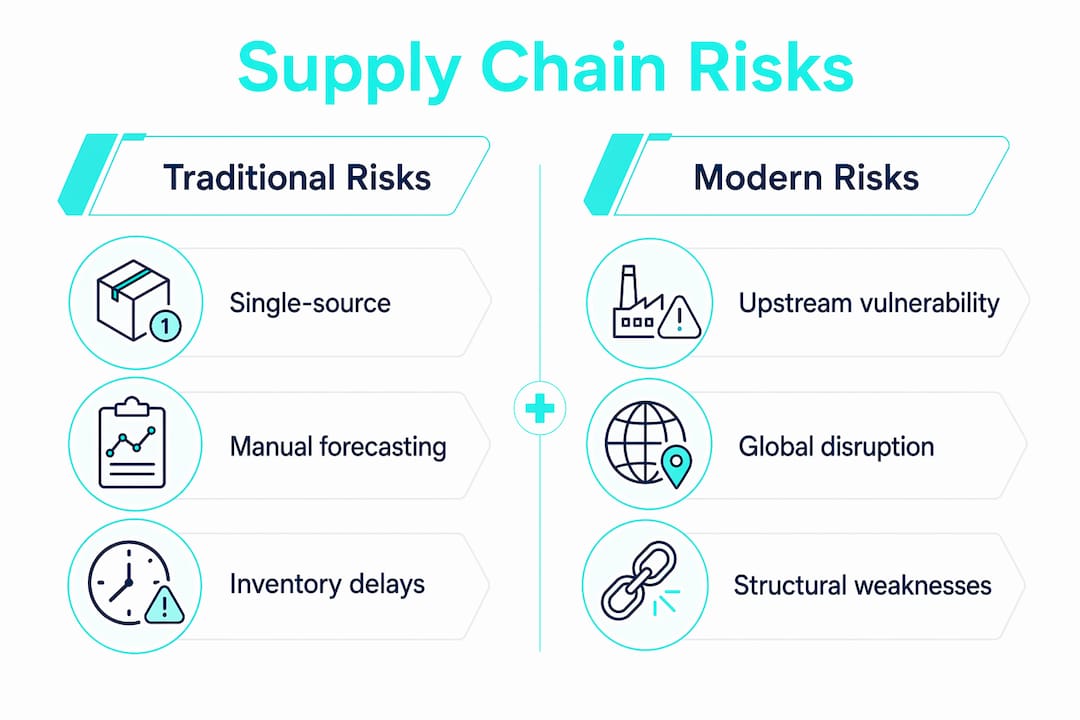
Risk category | Example | Patient impact |
Single-source dependency | 48% of essential drugs rely on one country for Key Starting Materials | Sudden shortage with no substitute available |
Expiry and waste | Supply failures cause item expiry in clinical settings | Clinicians unable to access needed items at point of care |
Logistics disruption | Trauma cases require delivery within hours | Delayed care when local stock is absent |
Geopolitical events | Manufacturing concentration in single regions | Supply interruptions with long recovery timelines |
The consequences are measurable. When supply chains fail, clinicians report direct impacts on care delivery. That is not a financial metric. It is a patient safety metric, and it reframes the entire importance of medical supply chain management.
How can healthcare organizations design resilient supply chains?
Resilience in healthcare supply chains comes from deliberate design, not from reacting to crises. The most effective starting point is rethinking inventory strategy. Just-in-Time inventory reduces costs but creates vulnerability when supply is disrupted. A hybrid model that combines Just-in-Time for routine consumables with Just-in-Case safety stock for critical items gives organizations both cost discipline and continuity protection.
Structured risk management produces measurable results. Research shows that formal risk management programs have a statistically significant impact on supply chain resilience (F = 5.63, p = 0.004). That level of statistical confidence means this is not a best practice suggestion. It is an evidence-based requirement for any organization serious about supply continuity.
Digital supply networks add a layer of visibility that manual systems cannot match. Real-time tracking of inventory levels, supplier lead times, and demand signals lets procurement teams act before a shortage reaches the clinical floor. Platforms that integrate with electronic health record systems can tie supply consumption directly to patient volume, making forecasting far more accurate.
Here are four design principles that consistently improve supply chain resilience:
Diversify suppliers by geography. Single-country sourcing for any critical item creates a concentration risk that no contract can fully mitigate.
Map upstream to Key Starting Materials. Finished product availability is not the same as supply security. Know where raw materials originate.
Maintain a critical materials register. Classify every item by clinical criticality and supply risk, then set inventory policies accordingly.
Apply process thinking to reduce waste. Viewing supply chains as value chains identifies lean waste in clinical supply activities and frees resources for higher-priority needs.
Pro Tip: Run a tabletop exercise simulating a 30-day shortage of your top five critical items. The gaps in your contingency plan will surface faster than any audit.
What practical steps can healthcare managers take to optimize supply chain operations?
Translating supply chain principles into daily operations requires a structured approach. The following steps give healthcare managers a practical framework for improving procurement and inventory performance.
Conduct a Business Impact Analysis. A Business Impact Analysis, or BIA, identifies which supply functions are critical to patient care and what the consequences of disruption would be. Start with your highest-volume procedures and work backward to the supplies they depend on. This exercise reveals single points of failure that routine procurement reviews miss.
Evaluate supplier stability and compliance. Supplier evaluation goes beyond price. Assess each supplier’s financial stability, manufacturing location, regulatory compliance history, and capacity to scale during demand surges. For surgical supplies sourcing, geographic diversification of your supplier base reduces the risk that a regional disruption takes out your entire source for a given product category.
Balance inventory for routine and emergency needs. Not every item warrants the same inventory strategy. Use your critical materials register to segment stock into three tiers:
Tier 1 (critical, low substitutability): Maintain safety stock of 30–90 days. Review reorder points monthly.
Tier 2 (important, some substitutes available): Apply standard Just-in-Time reorder cycles with a modest buffer.
Tier 3 (routine, multiple substitutes): Minimize on-hand stock and rely on distributor relationships for rapid replenishment.
Understanding fast-moving supply items and their turnover rates is the foundation of any effective tiering system. Items that move quickly need tighter reorder triggers and more frequent supplier communication.
Build emergency preparedness into procurement contracts. Contracts with preferred suppliers should include provisions for priority allocation during declared emergencies, agreed substitution protocols, and communication timelines for shortage notifications. Integrated delivery networks that use formal supply chain committees consistently outperform decentralized models in managing these provisions.
Leverage distributor relationships for market intelligence. Distributors see demand signals across hundreds of customers. A strong distributor relationship gives your procurement team early warning on emerging shortages, access to alternative products, and faster response when primary sources fail. Supply chain resilience requires active supplier collaboration, not just transactional purchasing.
Key Takeaways
Effective medical supply chain management requires mapping risk upstream to raw materials, balancing inventory strategy by clinical criticality, and building supplier relationships that go beyond transactional procurement.
Point | Details |
Define scope clearly | Medical supply chain management covers planning, sourcing, procurement, inventory, and contract management as connected functions. |
Map upstream risk | 48% of essential medicines rely on a single country for Key Starting Materials, creating hidden vulnerabilities beyond finished product availability. |
Use hybrid inventory models | Combine Just-in-Time for routine items with Just-in-Case safety stock for critical supplies to balance cost and continuity. |
Apply structured risk management | Formal risk management programs have a statistically significant impact on supply chain resilience and are not optional for high-stakes environments. |
Prioritize patient safety over cost | Supply chain optimization in healthcare measures failure in patient harm, not just financial loss. |
The supply chain lesson healthcare keeps relearning
Every major disruption, whether a pandemic, a port closure, or a manufacturing plant fire, reveals the same gap. Healthcare organizations know their tier-one suppliers. They rarely know their tier-two or tier-three suppliers. They almost never know where the Key Starting Materials for their most critical drugs come from.
I have seen procurement teams with sophisticated contract management systems get caught completely off guard by a shortage that was visible in the upstream data for months. The problem was not a lack of tools. It was a mental model that treated supply chain management as a purchasing function rather than a risk management function.
The cost of supply chain failure in healthcare is measured in patient harm, not budget variances. That reframing changes everything about how you prioritize investments, staff your supply chain teams, and structure your supplier relationships. Cost efficiency matters, but it is always secondary to care continuity.
The organizations that handle disruptions best are not the ones with the lowest unit costs. They are the ones that ran the tabletop exercises, mapped their upstream dependencies, and built supplier relationships deep enough that a phone call gets them priority allocation when supply is tight. That kind of resilience is built in the quiet periods, not during the crisis.
— QB
Queenssurgical: a reliable supply partner for healthcare providers
Healthcare managers need a procurement partner that keeps critical products in stock and ships reliably across the Americas. Queenssurgical offers a broad catalog of clinical supplies, from isolation gowns and BP cuff barrier sleeves to skin protectant creams, all meeting clinical-grade standards.
Queenssurgical serves hospitals, clinics, and individual practitioners through both wholesale and retail channels. The platform makes it straightforward to browse by product category, compare options, and place orders without the friction of traditional distributor relationships. For procurement teams building out their supplier base, Queenssurgical provides the product depth and supply reliability that clinical operations depend on.
FAQ
What is medical supply chain management in simple terms?
Medical supply chain management is the process of coordinating how medical products are sourced, stored, and delivered to healthcare providers. It covers everything from supplier contracts to inventory levels to emergency preparedness.
Why does the medical supply chain matter for patient safety?
Supply chain failures directly affect care delivery. Research shows that 57% of clinician-reported supply issues involved unavailability or expiry of essential items, with direct impact on patient safety.
What is the difference between Just-in-Time and Just-in-Case inventory?
Just-in-Time inventory minimizes stock on hand to reduce costs, while Just-in-Case maintains safety stock to protect against disruptions. Healthcare organizations perform best with a hybrid model that applies each approach based on item criticality.
What are the biggest challenges in medical supply chain management?
The main challenges include single-source supplier dependencies, hidden upstream vulnerabilities in raw material sourcing, demand surges during emergencies, and the difficulty of balancing cost efficiency with care continuity requirements.
How do healthcare managers start improving their supply chain?
Start with a Business Impact Analysis to identify critical supply functions, then evaluate supplier geographic diversity, segment inventory by clinical criticality, and build emergency provisions into procurement contracts.
Recommended
Comments