Why Product Bundling in Retail Medical Works
- Qubit Technology
- Jun 23
- 8 min read

Product bundling in retail medical is defined as the practice of combining complementary medical supplies into a single purchasable package, sold at a unified price. This approach is the leading driver of purchasing efficiency for healthcare administrators and procurement managers who need to consolidate vendor relationships and reduce order complexity. Why product bundling retail medical works comes down to three forces: it cuts procurement friction, raises perceived value, and creates a single point of accountability for supply quality. Queenssurgical and other medical distributors across the Americas have built entire catalog strategies around this model, and the results are measurable.
Why does product bundling in retail medical work for procurement?
Product bundling reduces procurement complexity by collapsing multiple line items into one SKU or package order. For procurement managers, this means fewer purchase orders, fewer vendor contacts, and fewer opportunities for supply gaps between related items. The industry term for this practice is “product kitting” when it involves physical assembly, and “bundle pricing” when it refers to the commercial structure.
Vendor fragmentation is one of the most underappreciated risks in healthcare supply chains. When a facility sources gloves from one vendor, masks from another, and gowns from a third, each relationship carries its own lead time, contract terms, and failure risk. Bundling addresses this by giving procurement managers a single accountable source for a complete product set.
The psychological dimension matters too. Procurement managers face what researchers call “fragmentation anxiety,” the stress of coordinating multiple vendors for items that must arrive together and perform together. Bundled solutions lower implementation risk and make ROI justification far easier to present to finance teams. A single invoice for a wound care bundle is easier to approve than five separate line items from five vendors.
Fewer purchase orders reduce administrative labor and approval cycles.
Single-vendor accountability means one point of contact when quality issues arise.
Consolidated delivery cuts receiving time and storage coordination.
Aligned expiration dates on bundled consumables reduce waste from staggered stock rotation.
Simplified compliance documentation when all items in a bundle share one supplier’s quality certifications.
Pro Tip: When evaluating bundles, map each item to a specific clinical care pathway. A wound care bundle should contain every product a nurse needs from initial assessment through dressing change. Bundles built around care pathways get used completely. Bundles built around inventory convenience get partially used and partially wasted.
What are the financial benefits of bundling in medical retail?
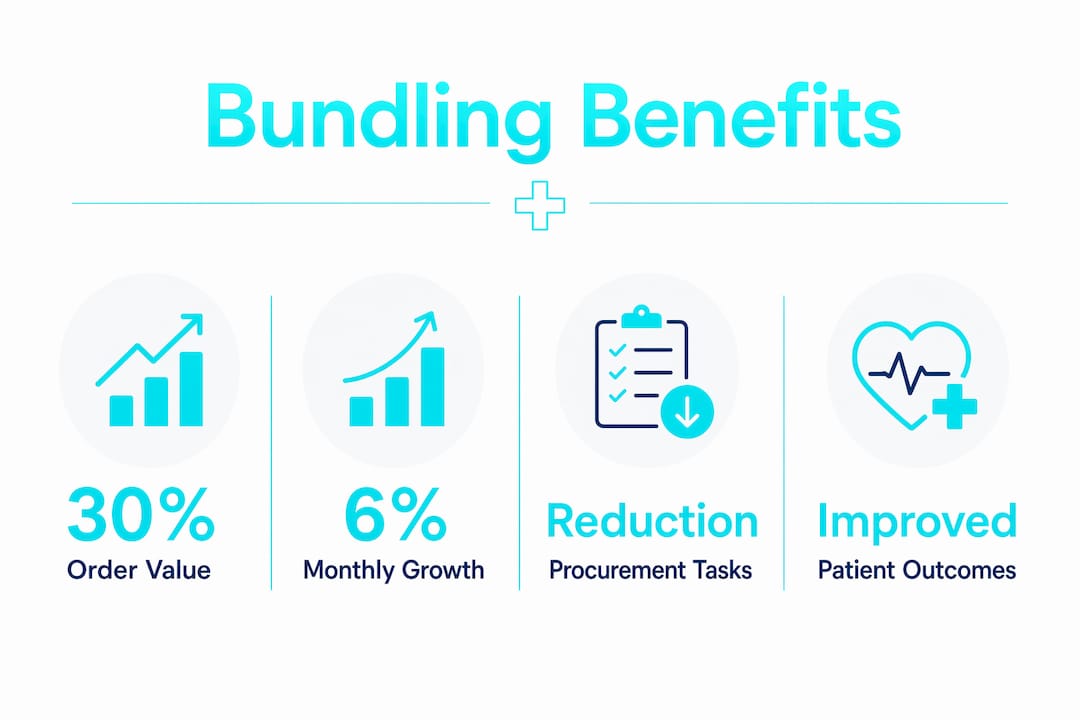
Bundling produces a direct and measurable lift in revenue per transaction. Organizations that apply strategic product bundling see an average 30% increase in revenue and average order value. That figure reflects the core mechanic: buyers spend more when they purchase a complete solution than when they assemble one item at a time.

The psychology behind this is well documented. Bundling reduces the pain of paying by cutting the number of individual payment moments. Each time a buyer approves a purchase, they experience a small psychological cost. One bundle approval feels less painful than five separate approvals, even if the total spend is higher. This increases willingness to pay without requiring price discounts.
Bundling also moves slow inventory. A distributor sitting on excess stock of a specific type of isolation gown can bundle it with fast-moving gloves and masks. The combined package sells faster than the gown would alone. This is a standard tactic in medical retail strategies and one that procurement managers should watch for when evaluating supplier pricing.
Metric | Without bundling | With bundling |
Average order value | Baseline | Up to 30% higher |
Month-over-month AOV growth | Flat or incremental | Up to 6% monthly |
Vendor contacts per order cycle | Multiple | Single |
Administrative processing time | Higher | Reduced |
Inventory clearance rate | Slower | Faster |
Pro Tip: Ask your distributor to show you the per-unit cost of each item inside a bundle versus its standalone price. A well-structured bundle should show a 10–20% effective discount per unit. If the math does not work out, the bundle is priced for the seller’s margin, not your savings.
How does clinical endorsement improve bundle effectiveness?
Clinically endorsed bundles outperform generic product packages in both sales volume and patient outcomes. Shelf-endorsed bundles paired with clinical guidance produce sales lifts exceeding 25% in health-focused retail categories. The reason is credibility. When a pharmacist, dietitian, or clinical specialist recommends a bundle, buyers trust that the product combination is medically sound, not just commercially convenient.
The most effective bundles are designed around the patient’s problem, not around the distributor’s inventory. Patient-centric bundles built around care pathways consistently outperform generic bundles in driving both sales and measurable patient outcomes. A post-surgical skin care bundle that includes a barrier cream, sterile gauze, and a moisture-wicking dressing addresses a complete clinical need. A bundle that groups three different types of gloves addresses a storage preference, not a patient need.
Bundle type | Clinical relevance | Sales lift | Patient outcome impact |
Care pathway bundle | High | Exceeds 25% | Measurable improvement |
Clinically endorsed bundle | High | Significant | Positive |
Generic product bundle | Low | Moderate | Minimal |
Inventory clearance bundle | None | Variable | None |
Personalization is the next frontier for clinical bundling. Facilities that track patient population data can request bundles tailored to their most common diagnoses. A clinic serving a high proportion of diabetic patients, for example, benefits from a wound care and glucose monitoring bundle far more than a standard general practice bundle. Queenssurgical’s catalog supports this kind of targeted product selection across multiple clinical categories.
What regulatory and operational risks come with medical bundling?
Medical product bundling carries compliance requirements that standard retail bundling does not. ISO 13485 governs Quality Management Systems for medical device kitting, requiring controlled environment assembly, documented traceability, and strict contamination control. A bundle that mixes sterile and non-sterile items without proper segregation can compromise the entire package and expose the facility to liability.
Expiration date synchronization is a specific operational challenge. If a wound care bundle contains items with different shelf lives, the bundle expires when the shortest-dated item expires. Procurement managers who do not check individual expiration dates within a bundle can end up discarding usable product. This is a hidden cost that erodes the financial benefit of bundling if not managed carefully.
The legal dimension is equally serious. Coercive bundling in healthcare raises scrutiny under anti-kickback statutes and fair competition laws. A supplier that requires a facility to purchase a bundle containing unwanted items as a condition of accessing a preferred product is engaging in coercive bundling. This practice can trigger regulatory review and contract disputes.
Audit every bundle contract for tie-in clauses that restrict your ability to source individual items elsewhere.
Verify ISO 13485 compliance for any bundle containing classified medical devices.
Check expiration dates on each component, not just the bundle’s outer label.
Request itemized pricing to confirm the bundle discount is real and not offset by inflated component prices.
Document clinical justification for each bundle to support compliance audits.
For a deeper look at regulated device procurement, the regulatory framework around bundled medical devices is worth reviewing before signing any long-term supply contract.
How can procurement managers apply bundling strategies in 2026?
The most effective starting point for any bundling strategy is the patient care pathway. Map the consumables your clinical teams use from admission through discharge for your five most common diagnoses. Every item that appears consistently in that pathway is a candidate for a bundle. This approach produces bundles that get fully used, which is the only way bundling delivers its promised cost savings.
Expanding your bundled catalog drives up to 6% month-over-month average order value growth in specialty retail. That growth compounds. A facility that adds two or three well-designed bundles per quarter will see meaningful AOV improvement within two to three purchasing cycles. The key is adding bundles that address real clinical needs, not bundles that simply group products by category.
Vendor negotiations should center on three terms: bundle flexibility, transparent component pricing, and substitution rights. Bundle flexibility means you can swap one item for a clinically equivalent alternative if a component goes out of stock. Transparent pricing means you can see what each item costs inside the bundle. Substitution rights mean you are not locked into a specific brand for every component. These three terms protect you from the coercive bundling risks described above.
Track these metrics to measure bundling success:
Average order value per bundle category compared to the same items purchased separately.
Order processing time before and after consolidating to bundled purchasing.
Vendor contact frequency per procurement cycle.
Inventory waste rate for bundled versus individually sourced consumables.
Clinical staff satisfaction with bundle completeness for their care pathways.
Pro Tip: Start with your highest-volume consumable category and build one bundle around it. Measure AOV and waste for 90 days before expanding. Bundling works best when it is tested incrementally, not rolled out across your entire catalog at once.
For a broader view of how wholesale purchasing strategies interact with bundling decisions, the comparison between individual and consolidated sourcing is worth reviewing before your next contract cycle.
Key takeaways
Product bundling in retail medical works because it cuts procurement friction, raises average order value, and creates single-vendor accountability that reduces both operational and compliance risk.
Point | Details |
Bundling raises order value | Strategic bundling produces up to a 30% increase in average order value per transaction. |
Care pathway design wins | Bundles built around clinical care pathways outperform generic product groupings in sales and outcomes. |
Regulatory compliance is non-negotiable | ISO 13485 and anti-kickback rules apply to medical bundles and require active contract auditing. |
Vendor fragmentation is a real risk | Single-source bundling reduces procurement complexity and lowers implementation risk for facilities. |
Track the right metrics | Average order value, waste rate, and processing time are the three metrics that reveal whether bundling is working. |
The part most procurement guides skip
The conversation about bundling in healthcare almost always focuses on price. Suppliers lead with discount percentages. Procurement teams evaluate bundles based on cost per unit. That framing misses the real value.
The most significant benefit I have seen from well-designed medical bundles is not the cost saving. It is the reduction in clinical error risk that comes from having the right products arrive together, configured correctly, and ready to use. When a nurse opens a wound care bundle and every item she needs is present, she does not improvise. Improvisation in clinical settings is where errors happen.
The trend I am watching most closely in 2026 is data-driven bundle personalization. Distributors who can analyze a facility’s purchasing history and suggest bundles aligned to that facility’s actual patient population will win long-term contracts. Generic catalogs will lose to personalized recommendations. Queenssurgical’s approach of combining a broad product catalog with category-specific expertise positions it well for this shift.
The uncomfortable truth about bundling is that it only works when both parties are honest. A bundle that hides a price increase inside a discount structure is not a bundle. It is a pricing tactic. Procurement managers who demand itemized pricing and substitution rights will get the real benefits. Those who accept bundles at face value will eventually find the savings were illusory.
— QB
Queenssurgical’s bundled medical supply options
Queenssurgical supplies healthcare facilities across the Americas with medical products that fit naturally into clinical bundle strategies.
The Queenssurgical catalog includes protective equipment such as the CPE Thumb Loop Isolation Gown and the Full Length Face Shield, both of which are standard components in infection control and surgical safety bundles. For facilities building skin care pathways, the DynaShield Skin Protectant Cream is a clinically recognized option. Queenssurgical operates as both a wholesale and retail distributor, which means procurement managers can source bundle components at volume pricing without sacrificing product quality or compliance standards. Visit Queenssurgical to review current catalog offerings and weekly supply deals.
FAQ
What is product bundling in medical retail?
Product bundling in medical retail is the practice of combining complementary medical supplies into a single package sold at one price. It simplifies procurement, reduces vendor fragmentation, and raises average order value for healthcare facilities.
How does bundling reduce procurement costs for hospitals?
Bundling consolidates multiple vendor relationships into one, cutting administrative labor, reducing purchase order volume, and lowering the risk of supply gaps between related items.
What regulations apply to medical product bundles?
Medical device bundles must comply with ISO 13485 Quality Management System requirements, including controlled assembly environments and expiration date synchronization. Coercive bundling practices also carry legal risk under anti-kickback statutes.
How do I know if a medical bundle is priced fairly?
Request itemized pricing for each component inside the bundle and compare it to standalone prices. A fair bundle should show a clear per-unit discount. If the math does not show savings, the bundle pricing favors the supplier.
What makes a clinically endorsed bundle more effective?
Clinically endorsed bundles tied to specific care pathways produce sales lifts exceeding 25% compared to generic product groupings. The endorsement signals medical appropriateness, which increases buyer confidence and reduces hesitation at the point of purchase.
Recommended
Comments