How Medical Retail Supply vs Wholesale Differs for Buyers

If you’ve ever debated whether to order directly from a distributor or pick up supplies through a retail channel, you already understand the core tension in medical procurement. Understanding how medical retail supply vs wholesale differs is not an abstract exercise. It shapes your per-unit costs, your compliance exposure, your lead times, and ultimately your facility’s operational reliability. The confusion between these two models is common, and it’s costly. This article cuts through that confusion with precise, practical guidance built specifically for procurement managers and healthcare professionals who make these decisions daily.
Table of Contents
Key takeaways
Point | Details |
Retail serves end users directly | Retail channels are B2C and suit small, immediate orders for individual practitioners or clinics. |
Wholesale reduces per-unit cost | Bulk purchasing through wholesale channels lowers unit costs but requires larger order commitments. |
Compliance burden falls on wholesalers | Wholesale distributors carry strict DSCSA traceability and licensing obligations that affect vendor selection. |
GPOs amplify wholesale buying power | Group Purchasing Organizations let smaller facilities access wholesale pricing through pooled contract leverage. |
Hybrid sourcing balances cost and flexibility | Combining retail and wholesale channels protects supply continuity without sacrificing cost efficiency. |
How medical retail supply vs wholesale differs at the core
The most fundamental distinction is who the customer is. Retailers are B2C, wholesalers B2B: retailers sell smaller quantities directly to end users, while wholesalers sell larger quantities to healthcare facilities and businesses. That single difference cascades into almost every other operational distinction between the two models.
A retail medical supplier might sell a box of nitrile examination gloves to a solo practitioner or a small clinic that needs 100 units on short notice. A wholesale distributor sells 5,000 units to a hospital system that schedules monthly replenishment orders. The inventory storage model reflects this difference. Wholesalers operate large warehouses and distribution centers designed for high-volume throughput. Retailers manage smaller, forward-facing stock designed for frequent turnover across a wider product assortment.
From an operational standpoint, this also changes how each channel competes:
Retail invests in customer experience, marketing, and product accessibility across diverse SKUs
Wholesale operates with fewer direct customers, lower marketing overhead, and a focus on reliable, high-volume fulfillment
Retail customers include individual clinicians, small practices, and home health providers
Wholesale customers include hospitals, surgery centers, long-term care facilities, and large group practices
Understanding this customer-type distinction is the first step in knowing which supply channel fits your needs at any given moment.
Pricing models and what they actually mean for procurement
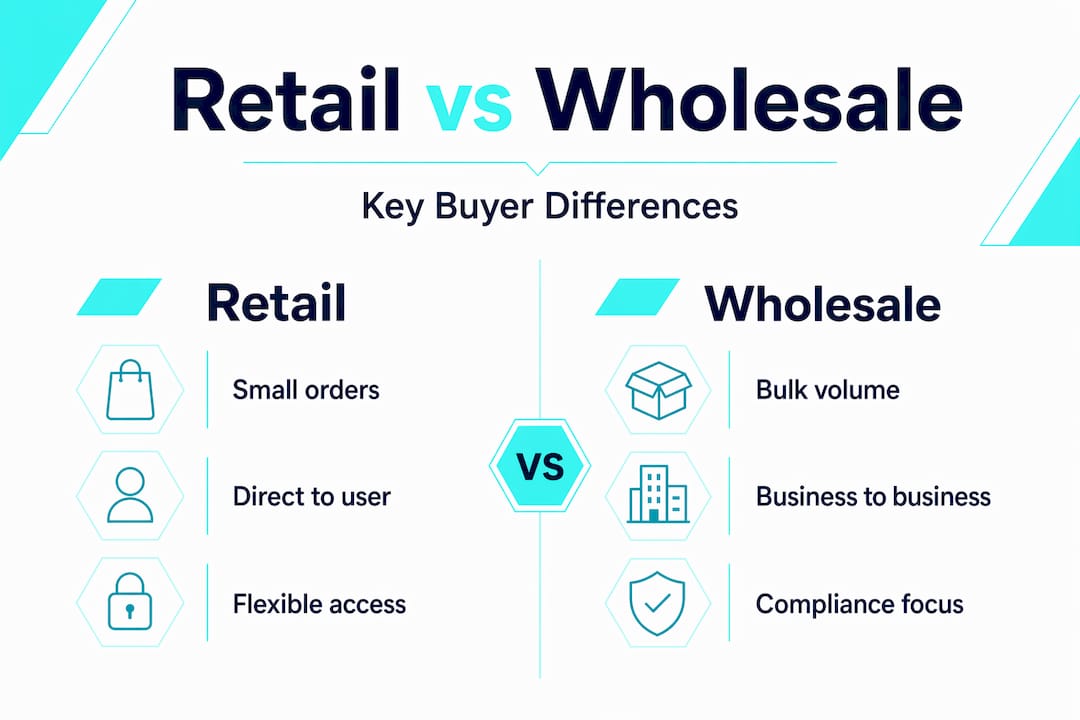
Cost per unit is the number everyone focuses on first. Wholesale purchasing generally delivers lower per-unit pricing because volume justifies it. Retail pricing includes a 30–50% margin over wholesale to cover storefront operations, staff, customer acquisition, and the cost of holding diverse, smaller inventory runs. Wholesale margins are typically 15–30%, driven by bulk sales efficiency rather than per-transaction profitability.
That math looks straightforward until you factor in the full cost picture. Wholesale orders require minimum quantities that tie up working capital and require storage space. If your facility lacks a well-managed central supply room, the carrying cost of a bulk order can erode the per-unit savings quickly. Wholesale has lower per-unit pricing due to bulk volume, but retail pricing absorbs the operational overhead so you don’t have to.
Here is a simplified comparison of the two pricing models:
Factor | Retail | Wholesale |
Per-unit cost | Higher (30–50% markup) | Lower (15–30% margin) |
Minimum order quantity | Low or none | Often required |
Working capital required | Low | Higher |
Storage responsibility | Supplier | Buyer |
Suitable for | Urgent, small orders | Planned, high-volume orders |
Pro Tip: When evaluating wholesale contracts, calculate your total cost of ownership. Include storage, handling, expiration risk, and any compliance verification steps required. A lower price per unit only wins if the operational math supports it.
Compliance and regulatory obligations in wholesale distribution
This is where comparing medical supply models gets genuinely complex. Wholesale distributors carry a compliance burden that retail channels simply do not face at the same scale, and procurement managers who overlook this expose their facilities to serious supply chain risk.

Under the Drug Supply Chain Security Act (DSCSA), wholesale distributors must verify product identifiers, respond to verification requests within 24 hours, and maintain transaction documentation for six years. These are not optional. They represent federal law. Distributors who fall short face product removal, operational shutdowns, and legal liability.
Beyond DSCSA, wholesale distributors must be licensed in each state they operate. If they handle controlled substances, DEA registration is also required. This web of state and federal licensing means that not every entity calling itself a wholesaler is actually operating in full legal compliance. Vetting your wholesale vendors for proper credentials is not optional due diligence. It’s a procurement responsibility.
DSCSA-compliant wholesalers implement specific operational systems to meet these requirements:
Verification workflows that confirm product authenticity at receipt
Quarantine protocols for suspicious or unverifiable products
Interoperable transaction data systems that enable traceability across the supply chain
Compliance verification systems that add operational overhead, which must be managed carefully to avoid costly delays
“Wholesale channel compliance is not optional. It dictates wholesaler choice and ultimately affects supply chain integrity and risk for medical facilities.”
For procurement managers evaluating wholesale vendors, confirming DSCSA compliance capability and state licensure should occur before any other negotiation. A vendor that can’t demonstrate both is a liability, regardless of their pricing.
Practical procurement decisions: lead times, flexibility, and supply continuity
When you move from theory to the actual workflow of buying medical supplies, the differences in medical supply channels become sharply practical. Lead times are the clearest example. Retail channels are built for speed on small orders. You can place an order today and receive sterile prep pads or examination gloves within one to two business days. There is no minimum quantity negotiation, no contract review, and no scheduled delivery window.
Wholesale channels operate differently. Wholesale supports scheduled replenishment and institutional stocking rather than on-demand convenience. That’s not a flaw. It’s a feature when you’re managing a hospital system with predictable monthly consumption. The tradeoff is rigidity. When an unexpected demand spike hits, a wholesale channel can’t pivot the way a retail source can.
Here is a practical framework for deciding which channel to use in different procurement scenarios:
Urgent, low-volume need. A clinic running low on disposable underpads before the weekend. Retail is the right call. Speed matters more than unit cost.
Planned, high-volume replenishment. A surgery center ordering 10,000 surgical gauze sponges for the next quarter. Wholesale contracts deliver better value and more reliability.
New product category being piloted. Order retail quantities first to validate usage and fit before committing to wholesale minimums.
Disruption or supply shortage. During supply disruptions, retail channels may stay accessible when wholesale distribution is strained, and vice versa. Maintaining relationships in both channels is a resilience strategy.
Contract leverage opportunity. If your facility qualifies for or belongs to a GPO, pooled volume purchasing through wholesale channels can unlock pricing that rivals direct manufacturer contracts.
Pro Tip: GPOs earn administrative fees averaging 1.2% to 2.3% from suppliers, but the price leverage they pass to member facilities typically far exceeds those fees. If you’re not already evaluating GPO membership for your wholesale procurement, you’re likely leaving significant savings on the table.
The case for maintaining both retail and wholesale relationships is strong. Facilities that rely exclusively on one channel create a single point of failure. The smartest procurement teams treat these channels as complementary tools in a hybrid sourcing strategy, not competing alternatives.
Choosing your channel: a decision framework
The final decision between retail and wholesale is not always binary, and that’s the insight most comparison guides miss. Here’s a side-by-side view to ground your thinking:
Criteria | Retail | Wholesale |
Customer type | Individual or small practice | Facility, institution, or reseller |
Order size | Small, flexible | Large, often with minimums |
Pricing | Higher per unit | Lower per unit |
Compliance burden | Lower | High (DSCSA, state licensing) |
Lead time | Short | Longer, planned cycles |
Supply disruption risk | Lower immediate impact | Warehouse-dependent |
When evaluating which model to prioritize, procurement managers should ask a few concrete questions. What is your average monthly consumption by SKU? Do you have storage infrastructure to hold bulk inventory safely? Have your wholesale vendors demonstrated DSCSA compliance and valid state licensing? Are you eligible for GPO contracts that would unlock wholesale pricing tiers?
Common pitfalls to avoid when switching or choosing supply channels:
Assuming the lowest unit price equals the lowest total cost
Failing to verify wholesale distributor licensing before signing contracts
Using retail channels for high-volume consumables when wholesale contracts are available
Relying on a single channel without a backup source for critical supplies
My take on where procurement managers actually go wrong
I’ve seen procurement teams spend weeks negotiating wholesale pricing and almost no time verifying that the distributor they’re about to sign with is fully DSCSA-compliant and licensed in their state. The price conversation is comfortable. The compliance conversation feels like someone else’s job. It isn’t.
What I’ve learned working with medical supply decisions across facilities of different sizes is that the retail versus wholesale question is almost always answered incorrectly when organizations frame it purely as a cost comparison. Price matters. But a wholesale vendor that can’t produce verifiable transaction documentation, or one that doesn’t have a quarantine protocol for suspect product, is a compliance liability sitting inside your supply chain. That risk doesn’t show up on a per-unit cost analysis.
My honest take is this: wholesale medical supply explained correctly is as much a compliance story as a pricing story. The facilities that handle procurement well are the ones that treat vendor qualification and relationship management as seriously as they treat contract pricing. They also maintain retail access for speed and flexibility, rather than abandoning it entirely in pursuit of bulk savings. The operational cost of a supply gap almost always exceeds the savings from going wholesale-only.
Long-term supplier relationships, built on demonstrated compliance capability and service consistency, outperform transactional vendor-switching every time I’ve seen it play out.
— QB
Get the right supplies through the right channel with Queenssurgical
Queenssurgical is built to support both sides of this equation. Whether you need a single case of CPE isolation gowns for an immediate clinical need or a wholesale order of full-length face shields for your facility’s quarterly stock, the platform handles both without requiring you to manage two separate vendor relationships.
Queenssurgical’s catalog spans gloves, protective apparel, instruments, consumables, and wellness products. Featured items like the DynaShield Skin Protectant Cream are available for both small and bulk orders, with competitive pricing across the Americas. For procurement managers who need a reliable partner that understands both retail convenience and wholesale volume requirements, Queenssurgical delivers the flexibility to buy the way your facility actually operates.
FAQ
What is the main difference between medical retail and wholesale supply?
Retail medical supply sells smaller quantities directly to end users like individual clinicians or small practices (B2C), while wholesale supply sells larger volumes to healthcare facilities and businesses (B2B). The distinction affects pricing, order size, compliance requirements, and lead times.
Why is wholesale medical supply cheaper per unit?
Wholesale pricing is lower because distributors sell in bulk, which reduces per-unit costs and operational overhead. Retail pricing carries a 30–50% markup to cover storefront operations, customer service, and diverse inventory management.
What compliance requirements apply to wholesale medical distributors?
Wholesale distributors in the U.S. must comply with DSCSA requirements, including product identifier verification, six-year transaction recordkeeping, and responding to verification requests within 24 hours. They must also hold valid state distribution licenses and DEA registration if handling controlled substances.
When should a healthcare facility use retail instead of wholesale?
Retail channels are best for urgent, low-volume needs where speed outweighs cost savings. They also work well for piloting new product categories before committing to wholesale minimums or as a backup during wholesale supply disruptions.
How do GPOs change the wholesale procurement equation?
Group Purchasing Organizations pool member volumes to negotiate wholesale contracts with suppliers, giving smaller facilities access to pricing tiers they couldn’t reach alone. GPOs earn administrative fees of 1.2% to 2.3% from suppliers, but the savings passed to members typically exceed that cost significantly.
Recommended
Comments