Surgical Suite Equipment Essentials for Healthcare Pros
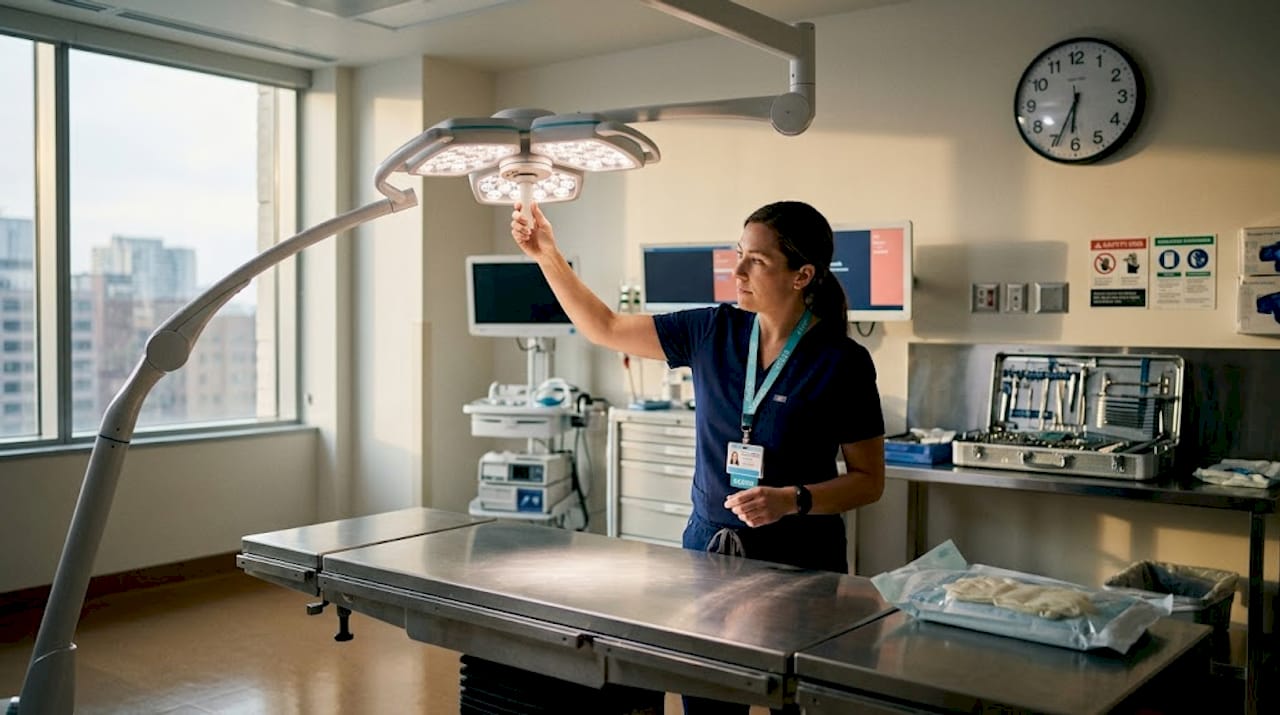
Understanding what are surgical suite equipment essentials is not as straightforward as most textbooks suggest. The modern operating room has evolved far beyond a table, a light, and a scalpel. Today’s surgical suite integrates precision instruments, digital monitoring systems, anesthesia technology, and smart infrastructure into a single coordinated environment. Whether you are equipping a new ambulatory surgery center or auditing an existing OR, knowing exactly what belongs in that room and why it matters can directly affect patient outcomes and your team’s efficiency.
Table of Contents
Key takeaways
Point | Details |
Operating tables lead equipment spend | Operating tables hold 24% of OR market share, making them the single largest capital investment in any suite. |
Smart OR integration changes the game | Centralized digital platforms connect lights, anesthesia, and monitors, reducing manual management and improving patient safety. |
Material grade matters for instruments | Instruments made from 420 or 316L stainless steel resist corrosion and withstand repeated sterilization cycles reliably. |
Specialty settings require tailored lists | Equipment needs differ significantly between general surgery, neurosurgery, orthopedics, and ambulatory surgery centers. |
Consumables are part of the system | Sterile gloves, drapes, sutures, and infusion pumps are not afterthoughts. They are woven into every surgical workflow. |
What are surgical suite equipment essentials: core categories
Every surgical suite shares a foundational surgical suite equipment list that serves patient positioning, visibility, anesthesia delivery, monitoring, and field management. These are not optional categories. They are the floor.
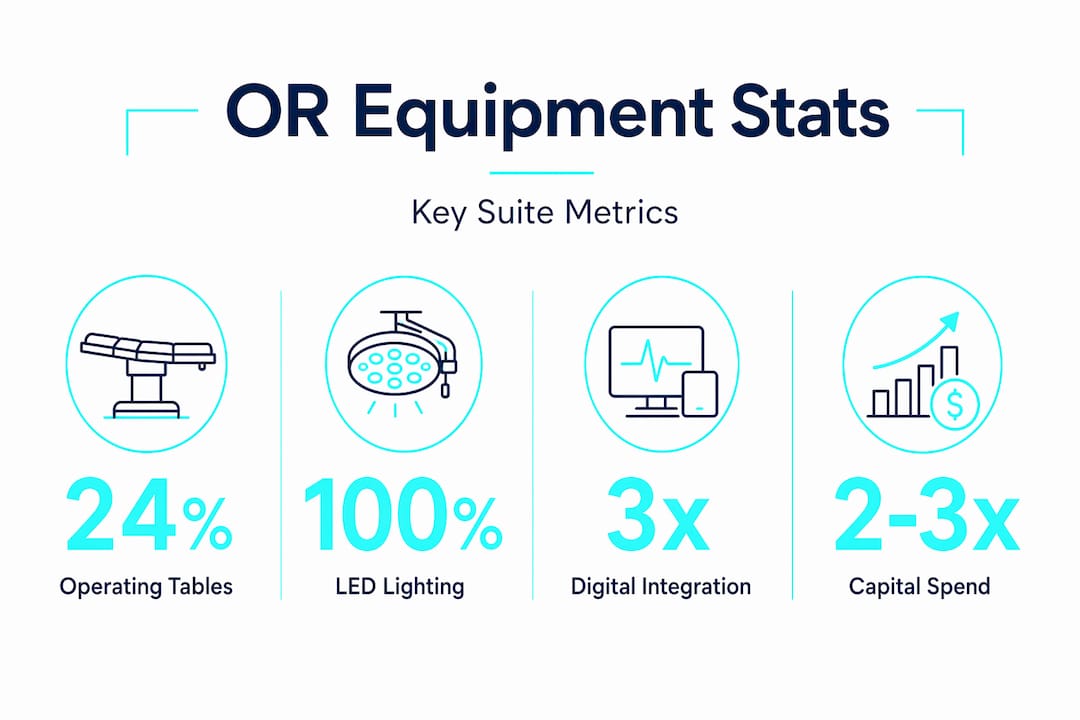
Operating tables are where every procedure begins and ends. Operating tables represent 24% of the OR equipment market in 2026, which reflects how much clinical teams depend on their functionality. Modern tables offer radiolucency for intraoperative imaging, motorized positioning, and weight capacity ratings that accommodate a wide patient population. A table that cannot be repositioned quickly during a complex case is a liability.
Surgical lighting has shifted almost entirely to LED technology. LED surgical lights with adjustable intensity and color temperature controls are now standard in modern ORs, providing shadow management that older halogen systems could never match. Better lighting means fewer errors at the tissue level, and less heat means a more tolerable environment for the entire surgical team.
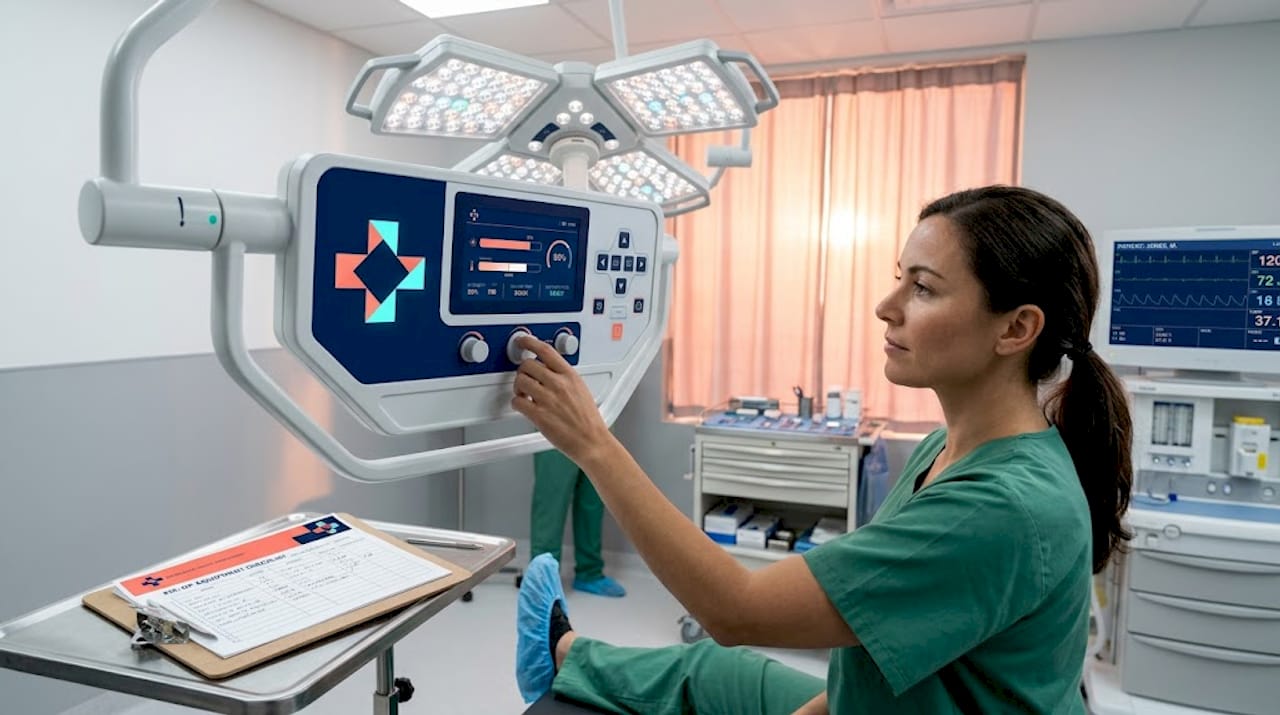
Anesthesia machines are among the most technically complex pieces of equipment in the room. A modern anesthesia workstation integrates a ventilator, vaporizer, gas supply monitoring, and an electronic record module into a single unit. Any failure here is not a workflow disruption. It is a patient emergency.
Other must-have surgical tools in the core category include:
Suction devices: Wall-mounted or portable surgical suctions remove blood and fluid from the operative field, maintaining visibility. Without reliable suction, even a routine procedure can deteriorate rapidly.
Patient monitors: Monitors track heart rate, oxygen saturation, blood pressure, and respiratory rate continuously throughout the case. A lapse in real-time data is a lapse in patient safety.
Electrosurgical units (ESUs): Bipolar and monopolar electrosurgery are used in nearly every open and laparoscopic procedure for cutting and hemostasis.
Pro Tip: When evaluating patient monitors for your suite, prioritize systems with waveform capture and alarm customization. Generic threshold alarms generate noise and desensitize staff. Custom parameters reduce alarm fatigue and catch genuine deterioration faster.
Advanced instruments and digital integration
The surgical suite equipment list does not stop at capital equipment. The instruments your team handles directly are where precision medicine meets physical skill, and the materials and design behind them matter more than most procurement teams acknowledge.
High-precision hand instruments: Forceps, scissors, needle holders, and retractors come in hundreds of configurations. The difference between a poorly manufactured instrument and a properly graded one shows up in the first dozen sterilization cycles. Surgical-grade 420 and 316L stainless steel resist corrosion and maintain their edge through repeated autoclave exposure. Instruments made from inferior alloys pit, discolor, and degrade faster, which creates both performance and sterility concerns.
Powered surgical equipment: Orthopedic drills, saws, and insufflators for laparoscopic cases are specialty-specific but common across high-volume surgical facilities. These require dedicated maintenance contracts and staff training to operate safely.
Imaging systems: C-arms for intraoperative fluoroscopy, portable ultrasound units, and endoscopic camera towers have become standard operating room essential items in most facilities. They extend what the surgical team can see without opening the patient further.
Robotics and AI-assisted tools: Robotic-assisted surgical systems are no longer exclusive to major academic centers. Smaller regional hospitals are adopting them for urology, gynecology, and general surgery. The OR equipment market is growing at 7.8% CAGR through 2030, driven largely by this digital adoption.
The shift toward smart OR infrastructure is perhaps the most significant change in surgical suite design in the past decade. Integrated digital platforms connect lights, anesthesia machines, and patient monitors through centralized control interfaces, allowing the scrub technician or circulating nurse to adjust the entire room environment without leaving their position. This reduces distraction, decreases manual error, and creates a documented workflow log for quality review.
“The operating room of the future is not a room full of separate machines. It is a single connected system where every device talks to every other device.” This shift is already underway in most large-volume surgical facilities, and understanding it is now a baseline expectation for surgical professionals.
You can explore the leading OR technologies in more detail to see how these integrated systems are being deployed across different practice settings.
Equipment needs by specialty and setting
Not every OR is the same room with the same tools. Understanding variability is what separates a functional surgical facility from a genuinely efficient one. Here is a direct comparison of what equipment is needed for surgery across different specialties and settings:
Surgery type / Setting | Core equipment | Specialty additions | Setting notes |
General surgery (hospital OR) | Table, lights, anesthesia machine, monitors, ESU | Laparoscopic tower, insufflator | Full support staff, large case volume |
Neurosurgery | All core items | Operating microscope, cranial navigation system, IOM equipment | Requires dedicated neuromonitoring team |
Orthopedic surgery | All core items | Powered drills, saws, fluoroscopy (C-arm), implant sets | High implant inventory burden |
Ambulatory surgery center (ASC) | Streamlined table, lights, anesthesia machine, monitors | Procedure-specific only | Lean staffing, rapid turnover priority |
Cardiac surgery | All core items | Heart-lung bypass machine, transesophageal echo, cell saver | Requires perfusionist on team |
The ambulatory surgery center model deserves specific attention. ASCs are designed for efficiency and cost control, and their surgery suite supplies reflect that philosophy. You will not find a full suite of rarely used specialty items in an ASC. Instead, you will find a carefully curated set of high-quality, high-use equipment maintained to a tight schedule.
Capital expenditure per surgical suite is increasing 2 to 3 times in facilities adopting hybrid OR and integrated digital platforms. If you are planning a new ASC or upgrading an existing hospital OR, budget accordingly. The upfront cost of a smart OR is real, but the downstream efficiency gains, fewer instrument errors, faster room turnover, and better data capture, make the math work over a 5 to 10 year horizon.
Equipment selection, maintenance, and procurement
Knowing the surgical facility equipment checklist is only half the job. Selecting the right products, maintaining them properly, and procuring them without falling into common traps requires a different kind of expertise.
Prioritize ergonomic design: Ergonomic instruments reduce fatigue and improve performance during long cases. A scissor with poor balance will tire a surgeon’s hand in 90 minutes. Over hundreds of cases a year, that adds up to both performance degradation and potential injury.
Verify manufacturing standards: Look for ISO 13485 certification from instrument manufacturers. This is the medical device quality management standard. If a supplier cannot provide documentation, walk away.
Lifecycle management matters: Every piece of capital equipment has a manufacturer-recommended service interval. Anesthesia machines, patient monitors, and ESUs require annual biomedical inspections at minimum. Tracking this in a CMMS (computerized maintenance management system) prevents lapses.
Avoid gray market risks: Gray market equipment, devices sold outside authorized distribution channels, may appear identical to legitimate products but carry no manufacturer warranty and often lack proper sterilization history. The savings are not worth the liability.
Pro Tip: When sourcing surgical supplies from new vendors, always request a sample lot and put it through your facility’s full sterilization protocol before committing to a bulk order. This one step eliminates most material failure surprises.
For a practical guide on sourcing strategies, the resource on surgical supplies sourcing tips covers how to vet vendors and negotiate terms without compromising on quality.
Supporting supplies and consumables
The operating room essential items that get consumed during every case are just as critical as the capital equipment. They just do not get the same attention in procurement planning, which is a mistake.
Sterile gloves and gowns: These are the primary barrier between the surgical team and the patient. Glove failure during a procedure is not a minor issue. Always maintain a buffer stock and source from verified manufacturers.
Surgical drapes: Disposable drapes provide consistent sterile field coverage and eliminate the reprocessing burden of reusable fabric alternatives. For high-volume facilities, disposables generally reduce total cost and infection risk.
Sutures and wound closure: The right suture for the tissue type matters. Absorbable versus non-absorbable, monofilament versus braided, each has specific indications. Stocking a narrow, well-curated suture formulary reduces waste and confusion in the OR.
Infusion pumps and IV supplies: Infusion pumps deliver precise medication and fluid volumes during surgery, and their accuracy directly affects patient safety. Syringe pumps, volumetric pumps, and PCA devices each serve different intraoperative roles.
Suction canisters and tubing: Single-use suction accessories prevent cross-contamination and eliminate the biohazard burden of cleaning contaminated canisters between cases.
These consumables integrate into the surgical workflow at every step. Understanding the essential surgical kit components helps OR managers plan par levels and avoid the mid-case shortages that disrupt procedures and stress teams.
My take on what actually matters in surgical suite equipment
I have spent years watching the gap between what facilities plan for and what actually drives performance in the OR. The honest truth is that most under-equipped surgical suites are not missing capital equipment. They are missing reliable consumables and properly maintained instruments.
Hospitals and surgical centers spend heavily on the flagship items, the latest imaging tower, the newest anesthesia workstation, and then purchase instruments and disposables from whatever vendor offers the lowest price on that week’s purchase order. The result is a beautifully equipped room full of substandard tools at the point of contact.
What I have found actually works is treating instrument procurement with the same rigor as capital equipment procurement. That means specifying material grades, testing ergonomics before committing to a set, and tracking failure rates across cases. It also means building a relationship with one or two trusted suppliers rather than chasing the lowest price across a dozen vendors.
The shift to smart ORs is real and worth the investment. However, I would caution against assuming that digital integration solves human problems. A centralized control interface does not replace proper training, sterile technique, or a well-stocked supply room. Technology enhances a competent team. It does not substitute for one.
— QB
Source your surgical suite essentials with Queenssurgical

When you are ready to move from planning to procurement, Queenssurgical has the product depth to support your entire surgical suite needs. From stainless steel instrument trays to disposable scalpels, sterile gloves, and surgical consumables, the Queenssurgical catalog covers both the capital-adjacent tools and the case-by-case supplies that keep your OR running without interruption.
The platform serves medical professionals, clinics, hospitals, and surgical centers across the Americas, with both wholesale and retail purchasing options. You can browse and purchase an instrument tray with flat cover or a box of disposable scalpels directly through the site, with weekly offers updated regularly for cost-conscious procurement teams.
FAQ
What are the most important pieces of equipment in a surgical suite?
The most critical items include the operating table, surgical lighting, anesthesia machine, patient monitors, and electrosurgical unit. These form the foundation of any functional surgical suite regardless of specialty.
How does a smart OR differ from a traditional operating room?
A smart OR uses integrated digital platforms to connect lighting, anesthesia, monitors, and hospital systems through a centralized interface, reducing manual device management and creating real-time workflow documentation.
What stainless steel grade should surgical instruments be made from?
Surgical instruments should be manufactured from 420 or 316L stainless steel, as these grades resist corrosion and maintain sterilization compatibility through repeated autoclave cycles.
Do ambulatory surgery centers need the same equipment as hospital ORs?
No. ASCs use a curated, procedure-specific equipment set focused on efficiency and rapid room turnover, while hospital ORs carry broader specialty equipment inventories for higher-acuity and more varied case types.
Why do surgical consumables matter as much as capital equipment?
Consumables like sterile gloves, drapes, sutures, and infusion pumps are used in every single case. A failure or shortage of consumables disrupts the surgical workflow immediately and can directly affect patient safety.
Recommended
Comments