Sourcing Wholesale Medical Equipment Suppliers in 2026

Sourcing wholesale medical equipment suppliers is defined as the systematic process of identifying, qualifying, and contracting vendors who supply medical devices and consumables at volume pricing to healthcare facilities. Done well, it directly reduces procurement costs, protects clinical outcomes, and keeps your facility audit-ready under FDA and ISO 13485 requirements. Group Purchasing Organizations like Vizient and Premier, along with direct manufacturer contracts and regional medical distributors, represent the three dominant channels procurement teams use today. The difference between a reactive purchasing approach and a formal supplier sourcing strategy can mean the difference between supply disruptions and a resilient, cost-controlled supply chain.
What compliance and quality criteria should you use to evaluate wholesale suppliers?
Supplier qualification is not a formality. Under FDA 21 CFR Part 820, manufacturers and healthcare facilities purchasing medical devices must apply risk-based supplier oversight, meaning the rigor of your evaluation scales with how much a supplier’s product impacts device safety or patient care. A vendor supplying sterile surgical instruments requires a fundamentally different qualification process than one supplying administrative consumables.

The regulation requires you to maintain an approved supplier list and document the criteria used to place each vendor on it. Supplier controls extend throughout the entire relationship, including corrective and preventive action (CAPA) processes and change management notifications. If a supplier modifies a product’s materials, manufacturing site, or labeling without notifying you, your facility inherits the compliance risk.
ISO 13485 adds another layer. Facilities operating under this quality management system must define supplier evaluation criteria in documented procedures and re-evaluate suppliers at defined intervals. The practical implication: your approved supplier list is a living document, not a one-time exercise.
Key qualification criteria to apply to every critical supplier:
FDA clearance or 510(k) status for any Class II device
Unique Device Identification (UDI) compliance for traceability
Quality system certification (ISO 13485 or equivalent)
Financial stability and supply chain capacity verified through references or audits
CAPA history and responsiveness to nonconformances
Supplier audits are widely expected by FDA inspectors as part of supplier qualification, particularly for critical suppliers. Audits assess quality systems, change management practices, CAPA effectiveness, and documentation compliance. Scheduling an on-site or remote audit before contract award is not excessive due diligence. It is the standard that FDA inspectors will look for in your records.
Pro Tip: Build a two-tier supplier classification into your approved supplier list. Tier 1 covers suppliers of critical or patient-contact products and requires full audits and annual re-evaluation. Tier 2 covers lower-risk consumables and requires only documentation review and periodic performance scoring.
How do direct distributors, GPOs, and subcontracted suppliers compare?
The channel you choose for buying wholesale medical supplies determines your pricing leverage, regulatory responsibilities, and contract complexity. Each option carries distinct trade-offs that procurement teams must weigh against their facility’s size, volume, and compliance infrastructure.
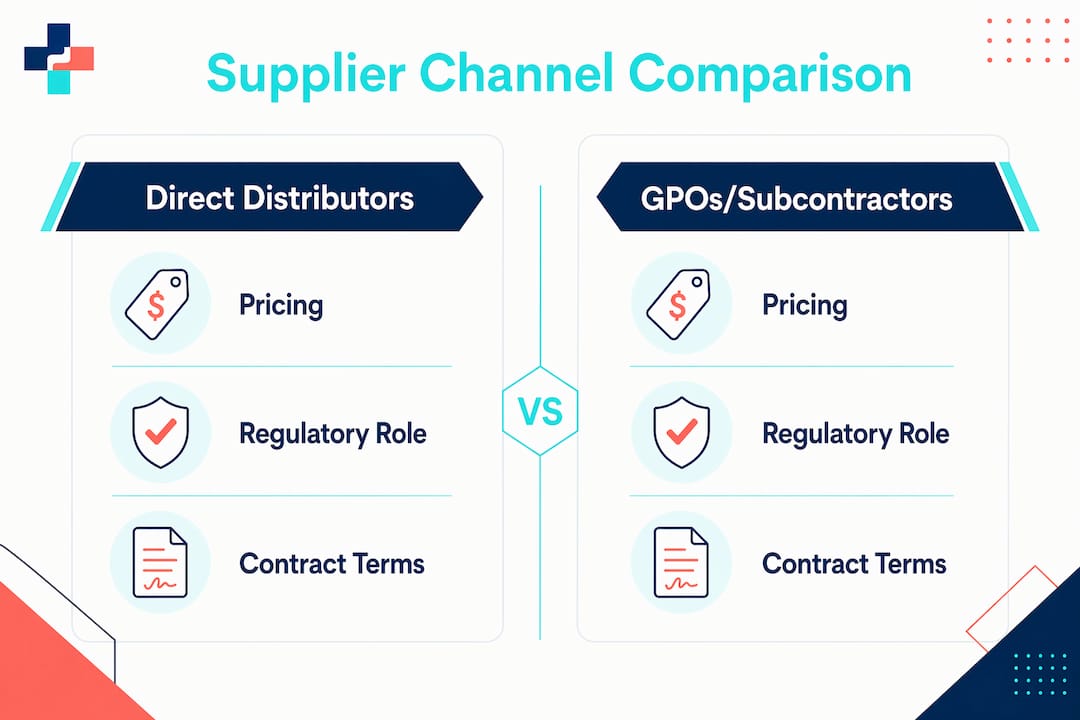
Channel | Pricing | Regulatory role | Contract term | Best for |
Direct manufacturer | Negotiated, no intermediary margin | Importer or end-user | 1 to 3 years | High-volume, specialized devices |
GPO contract | End-user only | 3 to 5 years | Broad consumables, standardized products | |
Regional distributor/wholesaler | Moderate discount, faster delivery | Distributor (may hold importer duties) | 1 to 2 years | Urgent needs, smaller facilities |
GPOs dominate approximately 72% of US hospital supply spend, with the top three GPOs controlling roughly 75% of all GPO spend. That concentration means access to a GPO contract is a significant competitive advantage for suppliers and a meaningful cost lever for procurement teams. GPO administrative fees, typically 1.2 to 2.3% of sales, are paid by suppliers under anti-kickback safe harbor protections, so the cost structure is transparent.
Direct manufacturer contracts give you the most control over specifications, labeling requirements, and supply terms. The trade-off is that your facility assumes the importer role if the manufacturer is foreign-based, which triggers FDA registration, Medical Device Reporting (MDR) obligations, and UDI record-keeping responsibilities. Many procurement teams underestimate this regulatory burden when pursuing direct sourcing to cut costs.
Regional medical distributors and wholesalers sit in the middle. They absorb the importer role, simplify your compliance obligations, and often provide faster delivery for urgent needs. The cost premium over GPO pricing is real, but for smaller clinics or facilities without dedicated regulatory staff, the trade-off is worth it. You can review a detailed breakdown of these channel differences in this wholesale vs. retail comparison for healthcare buyers.
Pro Tip: When evaluating GPO membership, request the administrative fee disclosure and the supplier’s GPO compliance history. A supplier with repeated GPO compliance issues is a red flag regardless of price.
Step-by-step guide to sourcing wholesale medical equipment suppliers
A structured sourcing process protects your facility from compliance gaps, supply disruptions, and contract disputes. The following sequence applies whether you are onboarding a new supplier for the first time or renegotiating an existing contract.
Define your procurement requirements. Specify product categories, volume estimates, delivery frequency, and any clinical performance requirements. Include FDA clearance status and UDI compliance as non-negotiable prerequisites before any supplier reaches the evaluation stage.
Issue a formal Request for Proposal (RFP). GPO contracting involves a criteria-driven evaluation covering quality, clinical evidence, supply chain reliability, and price. Apply the same rigor to direct sourcing. Your RFP should request quality system certifications, references from comparable healthcare facilities, financial statements, and a sample compliance documentation package.
Evaluate suppliers against documented criteria. Score each respondent on quality system maturity, regulatory standing, pricing structure, delivery performance history, and CAPA responsiveness. Do not allow price to override quality system deficiencies. Procurement success relies on formalized evaluation integrating quality, clinical evidence, and supply chain capacity, not pricing alone.
Conduct supplier qualification activities. For critical suppliers, this means an on-site or remote audit. For lower-risk vendors, a documentation review and reference check may suffice. Record all findings in your supplier qualification file.
Negotiate and execute the contract. Key contract clauses must address:
Regulatory obligations and role definitions (importer vs. distributor)
Change notification requirements for product modifications
Audit rights and access to quality records
Nonconforming material procedures and return policies
Exclusivity terms, minimum order volumes, and pricing escalation limits
Onboard the supplier and establish performance monitoring. Set measurable KPIs covering on-time delivery, defect rates, and CAPA closure times. Review performance quarterly for critical suppliers and annually for lower-risk vendors.
Maintain audit-ready documentation. Your supplier qualification file should contain the approved supplier list entry, evaluation records, audit reports, contracts, and all CAPA correspondence. FDA inspectors will request this file. It must be current, complete, and retrievable within hours, not days.
GPO contract awards involve a rigorous RFP and evaluation process with multi-year terms. Suppliers must plan 18 to 36 months ahead, including regulatory clearance and onboarding. Procurement teams should factor this timeline into their supply planning, particularly when transitioning away from an incumbent supplier.
For practical sourcing efficiency tips beyond the compliance framework, the Queenssurgical guide on surgical supplies sourcing covers operational shortcuts that experienced procurement teams use.
Common challenges and best practices in medical supply sourcing
Even well-structured sourcing programs encounter predictable obstacles. Knowing them in advance lets you build mitigation into your process rather than react after a problem surfaces.
Gray market suppliers represent the most serious risk in bulk medical supplies sourcing. Gray market products are genuine devices sold outside authorized distribution channels, often without valid warranties, proper storage history, or current labeling. They can pass visual inspection and still expose your facility to patient safety liability. The gray market risks for procurement teams are well-documented and include counterfeit documentation, expired products relabeled for resale, and devices that have been recalled in their country of origin.
Regulatory documentation gaps are the second most common failure point. Medical device distribution agreements must clearly define roles including importer and distributor. Failure to define these roles risks compliance failures and enforcement exposure. Many procurement teams treat contract language as a legal formality. FDA inspectors treat it as evidence of your quality system’s rigor.
Best practices that experienced procurement teams apply consistently:
Verify FDA registration status for every supplier before contract execution using the FDA’s online establishment registration database
Require suppliers to notify you in writing within 30 days of any product change, manufacturing site change, or regulatory action
Include a right-to-audit clause in every critical supplier contract, even if you never exercise it
Separate your procurement channel decision (GPO vs. direct) from your regulatory onboarding decision (importer vs. distributor) to prevent documentation gaps
“Blurring procurement channel decisions with regulatory role assignments leads to late-cycle documentation and compliance gaps that are expensive to correct during an FDA inspection.” Source: MedDeviceGuide
Pro Tip: When a supplier proposes exclusivity clauses or aggressive sales targets, negotiate a regulatory compliance carve-out. The clause should state that exclusivity does not apply to situations where compliance with FDA or applicable law requires sourcing from an alternative supplier.
For a current overview of compliance requirements affecting your supplier qualification process, the 2026 retail medical compliance guide covers the regulatory updates most relevant to procurement teams this year.
Key takeaways
Effective medical supply sourcing requires separating procurement channel decisions from regulatory role assignments to maintain compliance and prevent audit failures.
Point | Details |
Compliance drives qualification | Apply FDA 21 CFR Part 820 risk-based criteria before price when evaluating any supplier. |
GPOs offer structural savings | GPO contracts typically price 10 to 25% below list and cover 72% of US hospital supply spend. |
Channel choice determines regulatory role | Direct sourcing from foreign manufacturers triggers importer duties including FDA registration and MDR reporting. |
Documentation must be audit-ready | Maintain supplier qualification files with evaluation records, audit reports, and CAPA correspondence retrievable within hours. |
Gray market is an active threat | Verify FDA registration and authorized distributor status for every bulk medical supplies supplier before purchase. |
What I’ve learned about sourcing that most procurement guides won’t tell you
The conventional advice on medical supply chain management focuses almost entirely on price negotiation and GPO membership. After working closely with procurement teams across hospital systems and independent clinics, the pattern I see most often is not a pricing problem. It is a role confusion problem.
Procurement teams select a supplier through a GPO or direct contract, then hand the relationship to a logistics coordinator who has no visibility into the regulatory obligations that were embedded in the contract. The importer duties, the UDI record-keeping, the MDR reporting triggers: these get lost between the procurement decision and the operational execution. Effective wholesale sourcing programs separate procurement channel decisions from regulatory onboarding to maintain audit readiness. Most facilities do not do this deliberately. They do it accidentally, and the gaps show up during inspections.
The second thing I would push back on is the assumption that GPO membership is always the right answer for smaller facilities. GPO contracts are optimized for volume. If your facility cannot commit to the volume thresholds that make GPO pricing meaningful, a regional wholesaler with a strong compliance record and responsive account management will often serve you better. The 2026 buyer’s guide on comparing medical supply wholesalers makes this case with specific channel comparisons worth reviewing before your next contract cycle.
Build your sourcing program around supplier qualification first, channel selection second, and price negotiation third. That sequence is counterintuitive for budget-driven administrators, but it is the one that survives an FDA inspection.
— QB
Wholesale medical supplies available now at Queenssurgical
Queenssurgical supplies healthcare facilities across the Americas with quality-verified medical products at wholesale pricing, backed by a catalog built for procurement professionals who cannot afford supply gaps or compliance surprises.
For facilities sourcing protective apparel in bulk, Queenssurgical offers the CPE thumb loop isolation gown and the fluid-resistant universal isolation gown in yellow, both designed to meet clinical barrier requirements. The disposable laboratory uniform in 10-piece packs offers a latex-free, anti-fluid option for bulk ordering in lab and clinical settings. For infection control consumables, the BP cuff barrier sleeve in non-woven material is available at competitive wholesale pricing. Every product ships with documentation to support your supplier qualification file.
FAQ
What is sourcing wholesale medical equipment suppliers?
Sourcing wholesale medical equipment suppliers is the process of identifying, qualifying, and contracting vendors who supply medical devices and consumables at volume pricing. It includes compliance verification, supplier evaluation, contract negotiation, and ongoing performance monitoring.
How do GPO contracts work for medical equipment procurement?
GPO contracts run 3 to 5 years and are awarded through a structured RFP and evaluation process covering quality, clinical evidence, and supply chain reliability. Pricing is typically 10 to 25% below commercial list price.
What FDA requirements apply to wholesale medical equipment suppliers?
FDA 21 CFR Part 820 requires risk-based supplier qualification, an approved supplier list, documented evaluation criteria, and ongoing monitoring including CAPA and change management. Critical suppliers are subject to audit expectations.
What are the risks of buying from gray market medical suppliers?
Gray market suppliers sell genuine devices outside authorized channels, often without valid warranties, proper storage records, or current labeling. This exposes your facility to patient safety liability and potential FDA enforcement action.
Where can I find a reliable medical equipment suppliers directory?
The FDA’s online establishment registration database is the authoritative source for verifying supplier registration status in the US. GPO portals from Vizient and Premier also maintain vetted supplier directories for contracted products.
Recommended
Comments