How Technology Drives Supply Chain Transparency
- Qubit Technology
- 4 days ago
- 10 min read

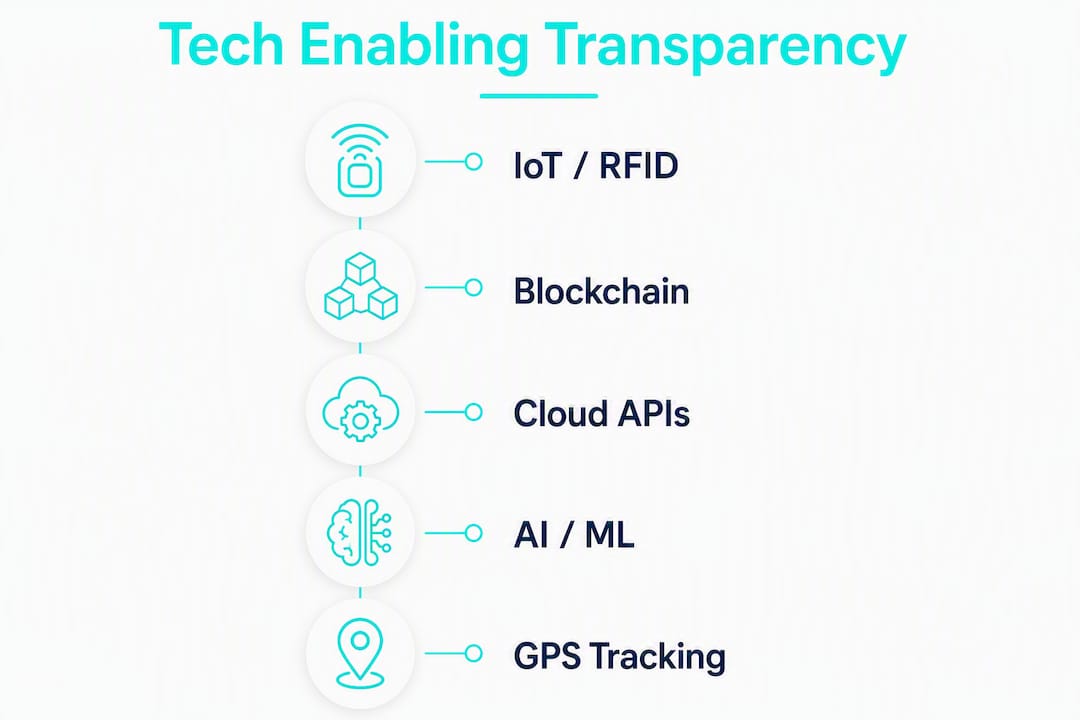
Technology is the operational backbone of modern supply chain transparency. Without it, provenance claims are unverifiable, exception detection is slow, and audit trails exist only on paper. The technologies that actually move the needle are AI and machine learning, IoT sensors and RFID, blockchain and distributed ledgers, cloud platforms with open APIs, GPS tracking, and big-data analytics. Together, they deliver four outcomes procurement leaders care about most:
Provenance and traceability: verify origin, manufacturing steps, and distribution history at the item level
Real-time visibility: detect location, condition, and status of goods as they move
Regulatory auditability: produce immutable, timestamped records for compliance reviews
Supplier accountability: surface deviations in supplier performance before they become recalls or shortages
The role of technology in supply transparency is not optional for healthcare procurement teams. A single counterfeit surgical instrument or a temperature excursion on a vaccine shipment can trigger patient harm and regulatory action. The tech stack described below is how you prevent both.
Table of Contents
Which technologies actually enable supply transparency?
Supply chain technology broadly covers tools that digitize data, enable information sharing, automate tasks, and support visibility and resilience. For transparency specifically, six technology categories do the heavy lifting.
IoT, RFID, and 5G
IoT sensors and RFID tags capture physical-world data at the item, pallet, or container level. Temperature loggers on cold-chain shipments, humidity sensors in storage, and RFID readers at dock doors all feed continuous data streams into your visibility platform. 5G matters here because it cuts network latency enough to make real-time edge processing practical in warehouses and distribution centers where Wi-Fi coverage is inconsistent.

Traceability for medical products depends directly on RFID, 5G-enabled tracking, and blockchain to verify origin, manufacturing steps, and distribution history, supporting safety, ethical, and environmental compliance. Prefer this combination when physical-trace accuracy is the primary requirement.
Blockchain and distributed ledgers
Blockchain creates an immutable, time-stamped record that no single party can alter retroactively. Its strongest use case is cross-party provenance: when a hospital, a distributor, a manufacturer, and a raw-material supplier all need to share a record without trusting a single intermediary, a distributed ledger is the right architecture. It is not the right tool for high-frequency transactional data where speed and cost matter more than immutability.
Cloud platforms and APIs
Cloud infrastructure is what makes integration possible at scale. Open APIs let ERP systems, supplier portals, logistics platforms, and analytics tools exchange data without custom point-to-point connections. For most organizations, cloud is the connective tissue that makes every other technology in this list work together.
AI, machine learning, and explainable AI
AI-enabled systems enable multi-step decision-making that reconciles service levels with cost constraints and reduce information latency versus siloed systems. AI agents are moving beyond copilot roles toward autonomous orchestration that synchronizes logistics, information, and value chains in real time. Explainable AI (XAI) adds a layer of accountability: it produces a “provenance of logic” so that automated reorder decisions or risk flags can be audited and explained to regulators or clinical staff.
Big-data analytics
Analytics platforms aggregate data from IoT, ERP, and supplier systems to surface patterns that no human analyst could detect manually. Supplier on-time rates, defect clustering by production batch, and demand volatility signals all become visible at scale. The output is early warning, not just historical reporting.
GPS and real-time tracking
GPS tracking gives shipment-level location data throughout transit. Combined with geofencing alerts, it tells you when a shipment deviates from its planned route or sits idle at a border crossing longer than expected.
Pro Tip: When network connectivity is unreliable, pair IoT sensors with edge computing so data is processed and stored locally, then synced when connectivity resumes. This prevents gaps in cold-chain records that regulators will flag during audits.
How do these technologies actually produce transparency?
The causal chain matters. Technology does not create transparency by existing; it creates transparency by producing specific outputs that change decisions.
Technology | Provenance | Real-time visibility | Audit trail | Predictive insight |
IoT / RFID | Partial (item-level ID) | Strong | Moderate | Moderate |
Blockchain | Strong | Weak | Strong | Weak |
Cloud / APIs | Weak | Strong | Moderate | Moderate |
AI / ML / XAI | Weak | Moderate | Strong (XAI) | Strong |
Big-data analytics | Weak | Moderate | Moderate | Strong |
GPS tracking | Weak | Strong | Moderate | Weak |
An immutable ledger produces auditability because the record cannot be altered after the fact. A hospital auditing a surgical instrument’s chain of custody can trace every handoff without relying on any single supplier’s self-reported data. IoT combined with 5G produces real-time condition monitoring: a cold-chain excursion on nitrile examination gloves or temperature-sensitive biologics triggers an alert within seconds, not hours. AI analytics produce early risk signals by detecting anomalies in supplier lead times or defect rates before they cascade into stockouts.
ERP, EDI, RFID, big data, and blockchain have all been shown to increase supply chain visibility historically, with blockchain specifically proposed to ensure immutable records across multiple tiers. The practical outcome for procurement teams is faster tracebacks, lower exception rates, and improved supplier compliance visibility across tier-two and tier-three suppliers who were previously invisible.
What barriers should you expect when deploying these technologies?
Implementation rarely fails because the technology does not work. It fails because the organizational conditions around the technology are not ready.
Common barriers include:
Upfront capital cost: Sensor hardware, ledger infrastructure, and cloud integration all require significant investment before any ROI is visible.
Legacy-system integration: Most hospitals and distributors run ERP systems that were not designed to consume real-time IoT streams or blockchain data. Middleware and API layers add cost and complexity.
Supplier data quality: If a tier-two supplier enters data manually into a spreadsheet, even the most advanced AI platform will produce unreliable visibility. Fragmented or manually entered supplier inputs create what researchers call an “impact gap” where technology presence does not equal impact.
Data governance and confidentiality: Firms must decide what data is shareable externally versus what is proprietary before buying any tool. Without that policy, the tools cannot deliver accountable transparency.
Cybersecurity and privacy: Supply chain platforms aggregate sensitive operational data. US privacy frameworks and sector-specific regulations like HIPAA create compliance obligations that must be designed in from the start, not retrofitted.
Supplier adoption resistance: Smaller suppliers often lack the technical capacity or incentive to participate in a buyer’s transparency platform.
A phased migration approach is the standard mitigation. Phase one covers discovery and pilot: select a high-risk product category, define your data disclosure policy, onboard a small cohort of tier-one suppliers, and measure baseline KPIs. Phase two expands to tier-two suppliers and integrates additional data streams. Phase three moves toward full orchestration with automated exception management.
Technology implementations commonly fail when firms purchase tools before defining their information disclosure policy and data hygiene processes. Clean, sustained inputs are mandatory for meaningful transparency. This is the single most preventable failure mode.
Pro Tip: Segment your supplier base before the pilot. Prioritize the 20% of suppliers who represent 80% of your spend or supply risk. Getting those relationships right first gives you proof of concept and negotiating leverage for the broader rollout.
What do these technologies look like in practice?
Surgical instrument provenance
A hospital system sourcing surgical instruments can use RFID tags and a distributed ledger to trace each instrument from raw-material origin through machining, sterilization, and distribution. When a quality alert is issued, the traceback takes hours instead of weeks.
Cold-chain monitoring for vaccines and biologics
IoT temperature loggers on vaccine shipments record condition data continuously. If a refrigeration unit fails during transit, the system flags the excursion, logs it to an immutable record, and routes an alert to the procurement manager before the shipment reaches the clinic. The efficient sourcing of surgical supplies depends on exactly this kind of condition monitoring for high-risk items.
Supplier social-compliance traceability for disposables
For disposable products like isolation gowns or CPE thumb loop isolation gowns, buyers use supplier auditing platforms integrated with their ERP to track labor compliance certifications, factory audit scores, and corrective action timelines. The same platform flags when a certification lapses.
XAI for automated replenishment in hospital networks
A hospital medical-supplies network running AI-driven replenishment can use XAI to explain why the system triggered an emergency reorder for a specific SKU. The explanation references lead-time variance, current stock level, and historical demand patterns, giving the procurement manager enough information to approve, override, or escalate without exposing proprietary supplier pricing data. This is the AI-blockchain orchestration and XAI model that researchers identify as the near-term frontier for healthcare procurement accountability.
Technology increases visibility but requires managerial design choices and supplier engagement to deliver durable transparency and sustainability outcomes. The procurement manager’s job is not just to select the right tool but to decide whether the deployment serves a control purpose (compliance monitoring) or a relational purpose (collaborative problem-solving with suppliers). Both are valid; the choice shapes which features matter most.
How do you measure whether transparency initiatives are working?
Six KPIs cover most of what procurement leaders need to track:
Trace rate to tier N: the percentage of products for which you can reconstruct a complete chain of custody to a specified supplier tier
Time-to-trace: how long it takes to produce a full traceback for a flagged item (target: hours, not days)
Data completeness: the percentage of required data fields populated across all supplier records
Exception rate: the frequency of detected deviations (temperature excursions, late shipments, certification lapses) per period
Supplier response time: average time from exception alert to supplier acknowledgment and corrective action
Verified provenance rate: the percentage of shipments with a complete, verified provenance record at point of receipt
Dashboard cadence should match the audience. Operational teams need daily or real-time exception feeds. Compliance teams need weekly summaries with audit-ready exports. Executive stakeholders need monthly trend views showing movement on trace rate and time-to-trace against pilot targets.
During a pilot, set realistic thresholds rather than aspirational ones. An initial trace rate for tier-one suppliers at the start of a pilot is a reasonable starting benchmark. Pushing for 100% before data hygiene processes are mature will produce false confidence.
What does a practical adoption roadmap look like?
Define your data disclosure policy — Decide what data you will share with suppliers, what you will share with regulators, and what stays internal before you evaluate any vendor.
Pilot success criteria to watch: a measurable improvement in trace rate versus baseline, time-to-trace under 24 hours for flagged items, supplier participation rate above 80% for the pilot cohort, and at least one documented exception caught earlier than it would have been under the prior process.
When evaluating vendors, ask: Who owns the data? How is proprietary operational data protected from other platform users? What explainability features does the AI provide? How does the platform handle offline or low-connectivity environments? What is the integration path for your existing ERP? A vendor comparison checklist built around these questions will surface integration and data-ownership risks before you sign a contract.
What does current research say about the future of supply transparency?
The research picture is more nuanced than most vendor pitches suggest. Scholars warn of “transparency fallacies”: implementing technology without aligning disclosures to actionable decision-making, or producing low-quality disclosures that do not change stakeholder behavior. More data is not better transparency. Better decisions are.
The near-term frontier is AI-blockchain orchestration combined with XAI. Together, these can automate supply decisions while providing auditable, understandable rationales for those actions. For healthcare procurement, that means an automated reorder decision can be explained to a clinical director or a regulator in plain language, not just logged in a system that no one can interpret.
Managers adopt two distinct orientations for transparency technologies: a control orientation focused on monitoring and compliance, and a relational orientation focused on dialogue and capacity-building with suppliers. The same IoT platform can serve either purpose depending on how it is deployed. Resilient medical supply networks tend to combine both, using strict control for safety-critical documentation and collaborative platforms for joint problem-solving with trusted suppliers.
Near-term trends worth monitoring for vendor evaluation:
XAI-ready tooling that produces human-readable explanations for automated supply decisions
Standardized data models and industry metadata schemas (GS1, HL7 FHIR for healthcare data interoperability)
Edge computing deployments that enable offline traceability in low-connectivity environments
AI-blockchain orchestration platforms that combine immutable records with autonomous decision-making
Key Takeaways
Technology enables supply chain transparency only when paired with clear data governance, supplier engagement, and measurable KPIs tied to real decisions.
Point | Details |
Define policy before buying tools | Set your data disclosure policy before evaluating any vendor to avoid the most common implementation failure. |
Prioritize IoT and blockchain for healthcare | Use RFID and distributed ledgers for medical product traceability where provenance and auditability are safety-critical. |
Measure time-to-trace and trace rate | Track these two KPIs from day one of your pilot; they reveal whether the technology is actually working. |
Pilot on high-risk items first | Start cold-chain telemetry on your highest-risk consumables before expanding to the full catalog. |
Ask vendors about XAI readiness | Explainable AI is the accountability layer that lets procurement teams defend automated decisions to regulators and clinical staff. |
The transparency gap no one talks about
The conversation about digital solutions for supply visibility tends to focus on the technology itself, which is the wrong place to focus. The tools are mature enough. What most organizations are missing is the discipline to use them well.
The transparency fallacy is real in healthcare procurement. A hospital that deploys a blockchain-based provenance platform but never acts on the data it produces has spent capital to create the appearance of accountability without the substance. The same failure happens when AI flags a supplier anomaly and the procurement team overrides it without documentation. The technology logged the event; the organization ignored it.
The practical recommendation for medical-supplies procurement managers: start with one high-value consumable category, define exactly what “verified provenance” means for that category, and build the process around the data before you scale the technology. For high-volume items like nitrile examination gloves, that means agreeing with your supplier on what data fields constitute a complete provenance record, then measuring data completeness weekly until it is above 90% before adding more SKUs.
Queenssurgical works with procurement teams across the Americas on exactly this kind of structured approach to medical supply accountability. If you are ready to move from visibility aspiration to verified provenance, start with your order and build the transparency layer from there.
Authoritative sources for further reading
Technology traceability for medical products (Springer): Peer-reviewed research on RFID, 5G, and blockchain for medical product traceability, with methods and compliance implications.
What is Supply Chain Technology? (ASCM): Industry-standard overview of supply chain technology capabilities from the Association for Supply Chain Management.
The Limits of AI Data Transparency Policy: Three Disclosure Fallacies (arXiv): Academic analysis of transparency fallacies and data governance failures, directly applicable to procurement technology deployments.
Tools and Technologies of Transparency in Sustainable Global Supply Chains (SAGE): Empirical study of control versus relational orientations for transparency technology, with case evidence from global supply networks.
AI-Blockchain Orchestration and XAI for Supply Chains (MDPI Systems): Research on explainable AI and blockchain integration for accountable automated supply decisions, with healthcare relevance.
A Review of Supply Chain Transparency Research (Wiley): Comprehensive literature review covering antecedents, technologies, types, and outcomes of supply chain transparency initiatives.
Recommended
Comments