How Retail Medical Pricing Regulations Work in 2026
- Qubit Technology
- Jul 6
- 9 min read

Retail medical pricing regulations are defined as federal and state rules that require hospitals and healthcare providers to publicly disclose standardized pricing data so patients and administrators can make informed cost decisions. Understanding how retail medical pricing regulations work is no longer optional for healthcare administrators. The Hospital Price Transparency Rule (45 CFR 180.50) mandates that hospitals post machine-readable files listing five types of standard charges, and non-compliance now carries penalties scaling up to $2 million annually. That financial exposure makes pricing governance a core compliance function, not a back-office task.
How retail medical pricing regulations work: the core framework
Retail healthcare pricing in the United States operates under a layered regulatory structure. The Centers for Medicare and Medicaid Services (CMS) sits at the top, setting federal disclosure requirements that apply to all hospitals. The No Surprises Act adds a second layer, requiring providers to give uninsured patients a good faith cost estimate before scheduled services, covering procedural fees, facility fees, anesthesiologist fees, and all other anticipated charges.
The chargemaster is the starting point for understanding retail medical costs. It is the hospital’s internal master list of prices before any insurer negotiation. From that list, hospitals derive discounted cash prices for self-pay patients and then negotiate separate rates with each insurer. Those negotiated rates are the numbers that matter most for cost management, and they vary significantly by plan and contract even within the same facility.

The term “retail medical pricing” is an informal descriptor. The recognized industry term is hospital standard charges, as defined by CMS. Both phrases refer to the same underlying data set, and healthcare administrators should know both to communicate clearly with regulators, auditors, and finance teams.
What key pricing data must hospitals disclose under current regulations?
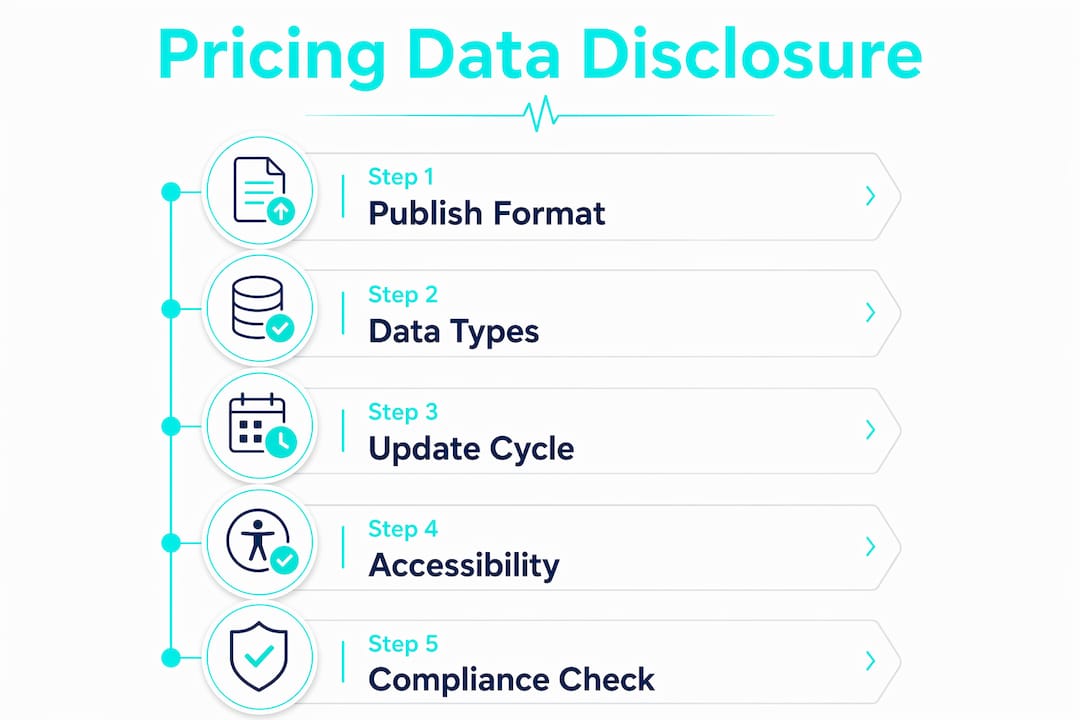
The Hospital Price Transparency Rule requires five specific data types in every public file. Each type serves a different purpose for administrators and patients.
Gross charges: The full undiscounted price from the chargemaster before any negotiation.
Discounted cash prices: The rate offered to self-pay or uninsured patients.
Payer-specific negotiated rates: The exact price agreed with each insurer for each service.
De-identified minimum negotiated rate: The lowest rate negotiated across all payers for a given item.
De-identified maximum negotiated rate: The highest rate negotiated across all payers for a given item.
Files must be accessible without a login, published in JSON or CSV format, and updated annually. Hospitals must also post a consumer-friendly display listing at least 300 shoppable services. As of mid-2026, enforcement has intensified, with over 500 hospitals warned for non-compliance. That number signals a shift from voluntary adherence to active federal scrutiny.
Data type | Format required | Update frequency |
Gross charges | JSON or CSV | Annual |
Discounted cash prices | JSON or CSV | Annual |
Payer-specific negotiated rates | JSON or CSV | Annual |
De-identified min/max rates | JSON or CSV | Annual |
Shoppable services display | Consumer-friendly webpage | Annual |
Pro Tip: Assign a dedicated compliance officer to audit your machine-readable file against CMS field requirements every quarter, not just at the annual update. Errors in field labeling are the most common trigger for enforcement warnings.
Why is retail medical pricing transparency challenging for patients and administrators?
Legal compliance and practical usability are two different things. The American Hospital Association acknowledges significant transparency gaps despite widespread compliance efforts. Publishing a file and making that file useful are not the same task.
The core problem is structural complexity. Negotiated insurance contracts vary by plan, insurer, and even employer group within the same insurer. A single hospital may have hundreds of distinct negotiated rates for one procedure. That means a patient comparing prices across two hospitals is not comparing equivalent numbers unless they know their specific plan’s rate at each facility.
“The transparency gap exists where legal data disclosure mandates do not translate into usable, actionable pricing insights for patients. Published files meet the letter of the law but rarely answer the question a patient actually needs answered: what will I pay out of pocket?” American Hospital Association on Transparency Gap
Administrators face a parallel challenge. Hospitals use different internal coding schemas, meaning a procedure listed under one description at one hospital may appear under a completely different code at another. Without third-party data tools for cleaning and normalization, cross-hospital benchmarking is unreliable. Standardization beyond CMS file type requirements is minimal, and investment in data-cleaning infrastructure is now a practical necessity for any administrator who wants to use transparency data for contract negotiations.
The lack of standardized coding also creates risk for administrators reviewing competitor pricing. A negotiated rate that appears lower at another facility may reflect a different service bundle, a different acuity level, or a different set of included fees. Comparing raw numbers without verifying the underlying service definition leads to bad decisions.
How do pricing regulations affect retail medical pricing strategy and compliance management?
Healthcare demand is not price-elastic in the way consumer goods demand is. Patients choose providers based on trust, network coverage, and proximity, not primarily on published price lists. That reality shapes how administrators should think about pricing strategy in healthcare retail. Reactive price cuts in response to a competitor’s published rate often erode margins without gaining volume.
The risk of reactive pricing is margin leakage. When procurement or finance teams adjust prices without verifying that the competitor’s product or service is truly equivalent, they give away revenue for no competitive gain. Reacting to competitor price drops without verifying product equivalence leads directly to this outcome, as many displayed comparable items differ in specifications or service terms.
Effective pricing governance under current medical pricing laws requires three disciplines:
Set margin floors before any competitive review. Know the minimum acceptable margin for each product or service category before looking at external pricing data.
Limit price movement without specification verification. No price adjustment should occur until procurement confirms the competitor item matches on all material specifications, including quality standards and service terms.
Conduct selective competitive reviews. Focus competitive analysis on high-volume, high-margin items where a pricing gap creates real volume risk, not on the full catalog.
Prior authorization adds another layer of complexity. Prior authorization is a clinical milestone but does not guarantee payment. Insurers can retroactively deny claims for coding or medical necessity reasons unrelated to the original approval. Administrators must train finance and billing staff to treat prior authorization as a necessary condition, not a payment guarantee. That distinction prevents revenue surprises that undermine cost management targets.
For administrators who want to use transparency data for benchmarking, third-party tools that parse and normalize machine-readable files are the practical path forward. Understanding reimbursement codes in retail medical settings is a prerequisite for making that data useful. CPT codes provide a national standard, but hospitals often layer internal descriptions on top, requiring reconciliation before any meaningful comparison is possible.
Pro Tip: Use de-identified minimum and maximum negotiated rates as a range for contract negotiation benchmarks, not as exact targets. The spread between min and max tells you how much room exists in the market before you commit to a specific rate.
What are the practical steps for healthcare administrators to comply with pricing regulations?
Compliance with retail healthcare pricing regulations is a process, not a one-time publication. The following steps reflect current CMS requirements and the practical realities of enforcement in 2026.
Publish and verify machine-readable files. Confirm that your JSON or CSV file includes all five required charge types, uses CMS-specified field names, and is accessible without a login from your hospital’s main website.
Align internal coding with CPT standards. Work with your coding team to map internal service descriptions to Current Procedural Terminology (CPT) codes. This alignment makes your data comparable and reduces the risk of enforcement findings based on ambiguous descriptions.
Educate procurement and finance teams on negotiated rate structures. Staff who understand retail medical markup standards make better purchasing decisions and avoid the margin leakage that comes from uninformed price comparisons.
Use transparency data in contract negotiations. De-identified min/max rates give your negotiating team a market range. Use that range to anchor discussions with insurers rather than accepting the first offer.
Build a regulatory update calendar. CMS has updated the Hospital Price Transparency Rule multiple times since its 2021 launch. Assign someone to monitor the Federal Register and CMS announcements quarterly so your compliance program stays current.
Prepare for good faith estimate obligations. Under the No Surprises Act, uninsured patients must receive a written cost estimate before scheduled services. Build that workflow into your scheduling and billing systems now, before an audit surfaces a gap.
Reviewing your retail medical compliance requirements annually against the current CMS checklist is the most direct way to stay ahead of enforcement. The penalty structure rewards early correction over reactive fixes after a warning letter arrives.
Key Takeaways
Retail medical pricing regulations require hospitals to publish five types of standardized charge data in machine-readable files, with penalties up to $2 million annually for non-compliance and enforcement intensifying significantly in 2026.
Point | Details |
Five required charge types | Publish gross charges, cash prices, payer-specific rates, and de-identified min/max rates annually. |
Machine-readable file format | Files must be in JSON or CSV, publicly accessible without a login, and updated every year. |
Transparency gap is real | Published data meets legal requirements but rarely answers what a specific patient will actually pay. |
Reactive pricing erodes margins | Never adjust prices based on competitor data without first verifying product specification equivalence. |
Prior authorization is not a guarantee | Insurers can deny claims retroactively; train billing staff to treat approval as a necessary step only. |
What transparency laws actually changed, and what they did not
Transparency mandates changed hospital behavior in one clear way: pricing data that was once proprietary is now public. That is a genuine shift. Before the Hospital Price Transparency Rule, negotiated rates between hospitals and insurers were treated as trade secrets. Now any administrator, employer, or researcher can download a file and see what a hospital charges a specific insurer for a specific procedure.
What the regulations did not change is the underlying complexity of healthcare contracting. I have seen administrators assume that because the data is public, it is also simple. It is not. The files are large, the coding is inconsistent, and the rates reflect contract terms that are not visible in the file itself. A lower negotiated rate may come with volume commitments or quality bonuses that change its real value entirely.
The practical lesson is this: use transparency data as a starting point for questions, not as a final answer. When you see a rate that looks out of line with your own contracts, that is a signal to investigate, not a reason to immediately renegotiate. The administrators who get the most value from these regulations are the ones who invest in the data infrastructure to interpret the files correctly, not the ones who react to raw numbers.
The future of healthcare pricing transparency will likely move toward greater standardization of coding and file formats. Until that standardization arrives, the competitive advantage belongs to administrators who build the internal capability to work with imperfect data rather than waiting for a cleaner regulatory environment.
— QB
Queenssurgical’s role in compliant medical supply purchasing
Healthcare administrators managing pricing compliance also need supply partners who meet the same standards they are held to. Queenssurgical serves hospitals, clinics, and healthcare facilities across the Americas with a catalog of medical supplies built around reliability and regulatory alignment.
Whether your facility needs surgical face masks with ties for procedural use or disposable medical face masks for daily clinical operations, Queenssurgical stocks products that meet industry safety standards. The platform offers both wholesale and retail purchasing, making it practical for large facilities and individual practitioners alike. Transparent pricing, no hidden fees, and a catalog built for medical professionals make Queenssurgical a straightforward choice for compliant procurement.
FAQ
What is the Hospital Price Transparency Rule?
The Hospital Price Transparency Rule (45 CFR 180.50) requires US hospitals to publicly post machine-readable files listing five types of standard charges, including payer-specific negotiated rates. Non-compliance can result in penalties up to $2 million annually.
What are the five required charge types under CMS rules?
Hospitals must publish gross charges, discounted cash prices, payer-specific negotiated rates, and de-identified minimum and maximum negotiated rates. All five types must appear in a publicly accessible JSON or CSV file updated annually.
Why can’t patients use hospital price files to compare costs?
Published files meet legal requirements but are difficult to interpret without knowing your specific insurance plan’s negotiated rate. Coding inconsistencies across hospitals also make direct comparisons unreliable without third-party data tools.
Does prior authorization guarantee that an insurer will pay a claim?
Prior authorization does not guarantee payment. Insurers can retroactively deny claims for coding errors or medical necessity reasons unrelated to the original approval, so billing teams must treat authorization as a necessary step, not a payment confirmation.
How often must hospitals update their price transparency files?
CMS requires hospitals to update their machine-readable files at least once per year. Hospitals must also ensure the files remain publicly accessible without a login at all times, not just at the annual update date.
Recommended
Comments