Gray market medical equipment: what procurement teams must know

Not every medical device on the market is as legitimate as it appears. Gray market medical equipment refers to genuine devices sold through unauthorized distribution channels, often imported illegally and stripped of their original country-specific labeling. For procurement managers, the danger is not obvious: these are real products, not outright fakes, which makes them far easier to accept without scrutiny. The price looks right. The packaging looks close enough. But behind that discount sits a web of voided warranties, regulatory violations, and patient safety risks that can cost your facility far more than you saved.
Table of Contents
Understanding gray market medical equipment and how it enters the US supply chain
Legal and regulatory challenges with gray market medical equipment
Hidden costs and risks of using gray market medical equipment in healthcare facilities
Implications of gray market medical equipment on patient safety and legal liability
How to identify and avoid gray market medical equipment in your procurement process
Rethinking gray market purchases: why initial savings are never worth the risks
Secure your medical equipment with trusted sources like Queens Surgical
Key Takeaways
Point | Details |
Gray market definition | Gray market medical devices are authentic products sold through unauthorized and illegal channels without proper FDA clearance. |
Regulatory risks | Gray market equipment violates FDA 510(k) requirements and poses compliance and legal challenges for facilities. |
Hidden costs | Though cheaper upfront, gray market devices incur higher failure rates, voided warranties, and costly repairs. |
Patient safety | Using gray market equipment risks patient injury and legal liability due to substandard or expired products. |
Procurement prevention | Verify authorized distributors, inspect packaging closely, and avoid suspicious low prices to prevent gray market purchases. |
Understanding gray market medical equipment and how it enters the US supply chain
Gray market medical devices are authentic products, meaning they are manufactured by legitimate companies, but they reach US healthcare facilities through channels the original manufacturer never authorized. The mechanism is straightforward: a distributor purchases devices cheaply in a country where prices are significantly lower, then imports them into the US market where they can be sold at a profit while still appearing cheaper than authorized alternatives.
Price arbitrage is the engine driving this. Medical device pricing varies dramatically across countries, with price disparities reaching up to 56% between markets. That gap is enough to fund an entire unauthorized distribution operation and still leave margin on the table. With 40 to 50% of US medical devices manufactured abroad, the supply chain has enough complexity and geographic spread to make these diversions difficult to detect.
The tactics used to disguise gray market goods are more sophisticated than most procurement managers expect:
Label removal or alteration: Phrases like “not for resale in the US” are physically removed or covered with replacement labels.
Repackaging: Products are removed from original packaging and placed in new boxes that mimic authorized US distribution packaging.
Bundling with legitimate goods: Gray market items are sometimes mixed into shipments of authorized products to reduce scrutiny.
False documentation: Shipping and customs paperwork is altered to misrepresent the product’s origin or intended market.
Pro Tip: When reviewing a potential supplier’s product catalog, request the lot number and country of origin for every device. Cross-reference these details directly with the OEM. A legitimate authorized distributor will never hesitate to provide this information. Reviewing surgical supplies sourcing tips can also help your team build a more defensible procurement process from the ground up.
Legal and regulatory challenges with gray market medical equipment
FDA clearance is not a blanket approval for a device category. It is specific to the manufacturer, the device model, and the intended market. When a gray market importer removes or alters a label to bring a foreign-market device into the US, they are not just bending a rule. They are bypassing the entire regulatory framework that ties a specific product to its specific clearance.
This matters enormously for procurement managers. Gray market devices lack company-specific FDA 510(k) clearance, which means they are technically illegal for US market distribution regardless of how genuine the underlying product is. Your facility’s purchase of such a device does not transfer legal responsibility away from you. It creates it.
Key regulatory violations associated with gray market medical devices include:
Misbranding: Altering or removing required labeling constitutes misbranding under the Federal Food, Drug, and Cosmetic Act.
Adulteration risk: Devices stored or transported outside manufacturer specifications may be considered adulterated even if physically intact.
Unauthorized importation: Importing devices not cleared for the US market violates FDA import regulations.
Traceability failure: Without proper chain-of-custody documentation, devices cannot be traced in the event of a recall.
“The Safeguarding Therapeutics Act of 2020 enabled the FDA to seize and destroy counterfeit medical devices at the US border, closing previous enforcement loopholes that gray market operators had exploited for years.”
This legislative shift matters. It signals that gray market activity is no longer a low-enforcement gray area. Facilities caught using non-compliant devices face inspection risk, potential fines, and serious reputational exposure. Working with a trusted medical supply distributor is one of the simplest ways to keep your procurement process on the right side of these regulations.
Hidden costs and risks of using gray market medical equipment in healthcare facilities
The 30% discount that made a gray market device look attractive at purchase will not look so good after the third service call, the first equipment failure mid-procedure, or the moment your legal team explains your liability exposure. The economics of gray market purchasing are genuinely deceptive, and the numbers bear this out.

Procurement managers may see 50 to 80% price discounts on gray market devices, but those same devices carry failure rates of 15 to 40%, compared to 2 to 5% for authorized products. That is not a minor performance gap. At scale, across a facility’s device inventory, that difference translates into workflow disruptions, unplanned capital expenditures, and patient safety incidents.
Factor | Authorized equipment | Gray market equipment |
Price discount | Standard MSRP | 30 to 80% below MSRP |
Failure rate | 2 to 5% | 15 to 40% |
Warranty coverage | Full OEM warranty | Voided upon purchase |
FDA traceability | Complete chain of custody | None |
Recall participation | Automatic notification | Not possible |
OEM repair support | Available | Refused by authorized centers |
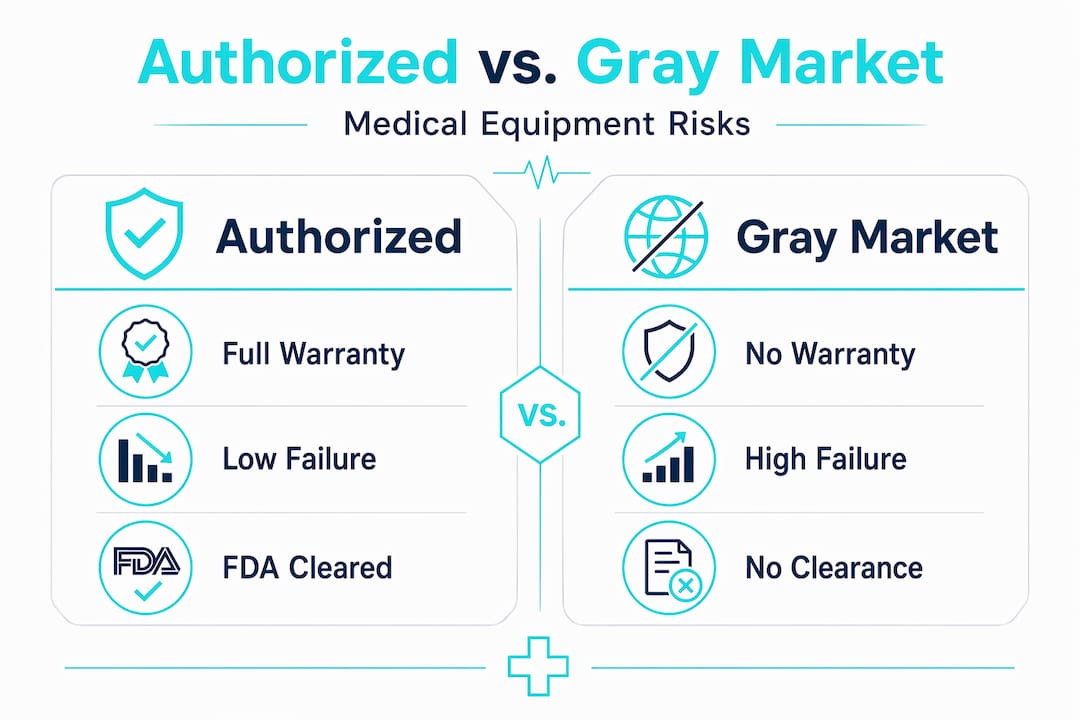
Gray market equipment voids entire warranties, leaving your facility responsible for every repair and replacement cost from day one. OEM-authorized service centers routinely refuse to service gray market devices, which means you are also locked out of the manufacturer’s technical support network.
Additional risks that procurement managers often underestimate include:
Storage and handling degradation: Gray market devices may have been stored in non-climate-controlled warehouses or transported without cold chain compliance, compromising performance before the device ever reaches your facility.
Counterfeit mixing: Because gray market channels lack oversight, genuine gray market devices can become mixed with outright counterfeits at the distributor level, making it impossible to know what you actually received.
Recall invisibility: Without proper registration and traceability, your facility will not receive recall notifications. You may continue using a device that has been flagged as dangerous.
Pro Tip: Before approving any purchase order for medical equipment, require your supplier to provide the full chain-of-custody documentation and OEM warranty registration details. If they cannot produce these within 24 hours, treat that as a disqualifying red flag. The medical supply distributor benefits of working with authorized partners go well beyond compliance. They protect your operational continuity.
Implications of gray market medical equipment on patient safety and legal liability
The patient safety consequences of gray market medical devices are not theoretical. In orthodontics and dental practice, use of gray market products has caused patient injuries due to substandard manufacturing quality and expired items repackaged to appear current. Dental lasers, handpieces, and sterilization equipment sourced through unauthorized channels have failed during procedures, with direct harm to patients.
These are not edge cases. They are the predictable outcome of using devices that were never validated for the conditions in which they are being used, stored by parties with no accountability, and sold without any quality assurance checkpoint.
The legal exposure for practitioners and facilities is equally serious:
Standard of care violations: Legally, the standard of care requires the use of FDA-approved devices. Practitioners face liability exposure to lawsuits if non-FDA-approved products cause harm to patients or staff.
Malpractice claims: If a device failure contributes to a patient injury, using gray market equipment will be treated as evidence of negligence.
Regulatory sanctions: State licensing boards and accreditation bodies can act against facilities found using non-compliant devices.
Reputational damage: A single publicized incident involving unauthorized equipment can permanently damage a facility’s standing with patients and referral networks.
“Rigorous sourcing from FDA-cleared distributors is not just a procurement best practice. It is a legal and ethical obligation that protects both patients and the professionals responsible for their care.”
Reviewing surgical equipment benefits from authorized sources makes clear how much value is embedded in proper certification and traceability, value that gray market channels strip away entirely.
How to identify and avoid gray market medical equipment in your procurement process
Identifying gray market medical gear before it enters your supply chain requires a structured approach. The following steps give your procurement team a practical framework for verification:
Verify the distributor’s authorized status directly. Go to the OEM’s official website and check their list of authorized distributors. Do not rely on the seller’s own claims of authorization.
Treat aggressive discounts as a warning signal. Prices 30 to 60% below MSRP without a clear explanation (such as a documented clearance sale or volume contract) are a strong indicator of gray market goods.
Demand warranty documentation before purchase. Legitimate authorized distributors can provide OEM warranty cards and registration details at the point of sale. Authorized service centers refuse gray market repairs, so warranty documentation is your clearest proof of authorized sourcing.
Inspect packaging on arrival. Look for spelling errors, mismatched fonts, missing lot numbers, signs of repackaging, or labels that appear to have been applied over existing text.
Verify serial numbers with the manufacturer. Most OEMs have a portal or customer service line where serial numbers can be confirmed as authorized for US distribution.
Review storage and shipping conditions. Request documentation of storage temperatures and handling procedures, especially for devices with environmental sensitivity requirements.
Report suspicious products to the FDA. If you receive a device you believe is gray market or counterfeit, report it through the FDA’s MedWatch program. This protects other facilities and triggers regulatory action.
Additional protective measures worth building into your procurement policy:
Maintain a pre-approved vendor list with documented authorization status for each supplier.
Conduct annual audits of your supplier relationships to confirm continued authorized status.
Train purchasing staff to recognize the specific red flags associated with gray market goods.
Pro Tip: Build a simple verification checklist into your purchase order approval workflow. Requiring sign-off on distributor authorization status, warranty documentation, and packaging inspection before any device is accepted takes less than 10 minutes per order and can prevent months of downstream problems. Pairing this with efficient surgical supplies sourcing practices gives your team a complete procurement defense strategy.
Rethinking gray market purchases: why initial savings are never worth the risks
Here is the uncomfortable truth that most gray market conversations avoid: the procurement managers most likely to purchase gray market devices are not reckless. They are under budget pressure, operating in resource-constrained environments, and trying to do more with less. The appeal of a 50% discount is not irrational. It is understandable. But it is also a trap.
The problem with gray market purchasing is not just that it violates regulations or voids warranties, though it does both. The deeper problem is that it creates a category of risk that is fundamentally unmanageable. You cannot audit a supply chain that does not exist. You cannot file a warranty claim on a device that was never registered. You cannot participate in a recall notification system when your device has no traceability. Every gray market purchase is a bet that nothing will go wrong, and in healthcare, that is not a bet any procurement manager should be making.
Legitimate distributors validate FDA clearance, ensuring device safety and efficacy in ways that gray market channels structurally cannot replicate. That validation is not bureaucratic overhead. It is the mechanism by which your facility maintains accountability to its patients.
The regulatory environment is also tightening. Geographic arbitrage drives the gray market underground economy, but FDA enforcement under the Safeguarding Therapeutics Act of 2020 now closes many of the loopholes that made gray market importing relatively low-risk for bad actors. Facilities that have relied on gray market sourcing should expect increased scrutiny, not less.
The long-term math is simple. Authorized equipment costs more upfront. It also fails less, comes with full support, keeps your facility legally protected, and ensures your patients receive care with devices that have been validated for exactly the purpose you are using them for. That is not a premium. That is the actual cost of safe procurement. Working with a trusted medical supply source is not just the compliant choice. It is the only defensible one.
Secure your medical equipment with trusted sources like Queens Surgical
Understanding the full scope of gray market risks makes one thing clear: the distributor you choose is as important as the device itself. Authorized sourcing is not a formality. It is your primary defense against the failures, liabilities, and patient safety risks that gray market equipment introduces.

Queens Surgical operates as a fully authorized medical supply distributor serving clinics, hospitals, and healthcare facilities across the Americas. Every product in the catalog, from surgical instruments to consumables like sterile cotton balls, is sourced through verified, legitimate channels with complete traceability and OEM warranty backing. Your procurement team gets the documentation, the compliance assurance, and the supply reliability that gray market channels can never provide. When your facility’s reputation and your patients’ safety depend on what you purchase, Queens Surgical gives you a partner you can verify, trust, and rely on.
Frequently asked questions
What exactly defines gray market medical equipment?
Gray market medical equipment refers to genuine medical devices sold through unauthorized channels, often imported illegally by removing “not for resale in US” labels, and lacking proper FDA clearance for the US market.
Why is buying gray market medical equipment risky for healthcare facilities?
Gray market devices void warranties, carry failure rates of 15 to 40% compared to 2 to 5% for authorized products, and expose facilities to serious legal liability and patient safety risks.
How can procurement managers identify gray market medical equipment?
Verify sellers through OEM websites, demand official warranty cards, avoid prices 30 to 60% below MSRP, and inspect packaging for label alterations. Authorized service centers refuse gray market repairs, so warranty documentation is a clear proof point.
Are gray market medical products ever FDA approved?
No. While the physical devices may be genuine, gray market imports lack company-specific FDA 510(k) clearance, making them illegal for US distribution regardless of the product’s underlying authenticity.
What should healthcare facilities do if they suspect gray market equipment?
Cease use of the suspected device immediately and report it via FDA’s MedWatch website to trigger regulatory review and protect other facilities from the same risk.
Recommended
Comments