Health Equity and Equipment Access: A Procurement Guide

Health equity requires that every patient can physically use the equipment in your exam room. That is the CDC and WHO definition made operational: equitable access to care is not just about insurance coverage or appointment availability, it is about whether a height-adjustable exam table exists, whether a wheelchair-accessible scale is calibrated and in the room, and whether your procurement policy mandated those items in the first place. The National Council on Disability (NCD) documents directly that the absence of accessible medical diagnostic equipment (MDE) reduces preventive screening uptake for people with mobility impairments. The Access Board MDE standards set the technical floor. Queenssurgical supplies the consumables and equipment that make those standards real in your facility.
Three immediate priorities for procurement teams:
Audit every exam room against Access Board MDE specifications before the next budget cycle.
Update RFP language to require height-adjustable tables, wheelchair-accessible scales, and transfer clearance in all primary care settings.
Engage a supplier, such as Queenssurgical, who can confirm specification compliance and spare-parts commitments at the quote stage.
Table of Contents
Why equipment access sits at the center of health equity
The CDC and WHO define health equity as eliminating unfair, avoidable differences across social, economic, demographic, and geographic groups. Equipment availability is a structural requirement of that definition, not a peripheral concern.
“Access barriers often result in incomplete medical exams and lower rates of preventive screenings and recommended treatments for people with disabilities, as well as a greater likelihood of delaying or forgoing needed care, leading to worse health outcomes.” — Barriers to Accessing Medical Equipment, Issue Lab / Urban Institute
The Levesque access framework, adopted by AHRQ, treats availability and accommodation as supply-side components of access that are just as important as affordability. When a facility lacks a height-adjustable table, a patient with a mobility impairment either receives an incomplete exam or skips the appointment entirely. Both outcomes feed directly into the population-level disparities that procurement leaders are now accountable for under CMS equity frameworks.
Racial, ethnic, and socioeconomic inequities in care quality persist even after insurance expansions, which points squarely at facility infrastructure and equipment as the remaining lever.
Which equipment makes the biggest equity impact?
Prioritize in this order, starting with primary care settings. WHO and NASEM identify primary care as the highest-leverage point for equitable equipment distribution because it is where prevention and chronic disease management happen first.
Height-adjustable exam tables. Specify a range of 18–34 inches, side-transfer capability, and a minimum 500 lb weight capacity per Access Board MDE guidance. At least one per exam room, not one per floor.
Wheelchair-accessible weight scales. Must accommodate a standard power wheelchair footprint (30 × 48 inches clear floor space) and be calibrated quarterly.
Patient lifts and transfer devices. Ceiling-track or portable floor lifts with sling compatibility; specify load ratings and sling inventory in the same purchase order.
Accessible imaging positioning aids. Adjustable-height mammography units, MRI table extensions, and positioning wedges that work without requiring a patient to stand unsupported.
Accessible procedure chairs. Adjustable height, lateral tilt, and removable armrests for dental, ophthalmology, and infusion settings.
Home-care consumables. Breathing equipment, diabetes supplies, and mobility aids for patients who rely on home health equipment rather than clinic visits.
Pro Tip: Avoid the “one accessible room” trap. NCD standardization findings show that concentrating accessible equipment in a single room segregates patients and signals that accessibility is an afterthought. Distribute compliant equipment across all exam rooms.
What non-price barriers actually block access in the US?
Budget is rarely the only obstacle. A scoping review of barriers for persons with disabilities documents persistent equipment gaps even in well-funded systems. The real blockers are operational:
Coverage denials and authorization delays. Among households with delayed equipment needs, 52% reported equipment not being covered by their health plan, and 47% cited difficulty securing authorization.
Placement failures. A compliant table pushed against a wall eliminates the transfer clearance the Access Board requires. Procurement must specify placement and transfer-cycle workflow, not just the device.
Supply-chain gaps for home-care consumables. During and after COVID-19, hospital-prioritized supply chains left home-based patients without breathing equipment and mobility aids. Procurement diversity strategies should include home-use lines explicitly.
Geographic gaps. Rural and frontier facilities often lack any accessible MDE, meaning patients travel hours for a preventive exam that an urban peer receives locally.
Staff training shortfalls. Equipment that staff cannot operate safely is functionally inaccessible. Maintenance and competency training must be written into procurement contracts.
Pro Tip: When evaluating a new exam table for compliance, run a full transfer simulation with a staff member in a wheelchair before signing the acceptance form. A table that meets spec on paper but requires two staff to operate safely is not accessible in practice.
Procurement policies that actually move the needle
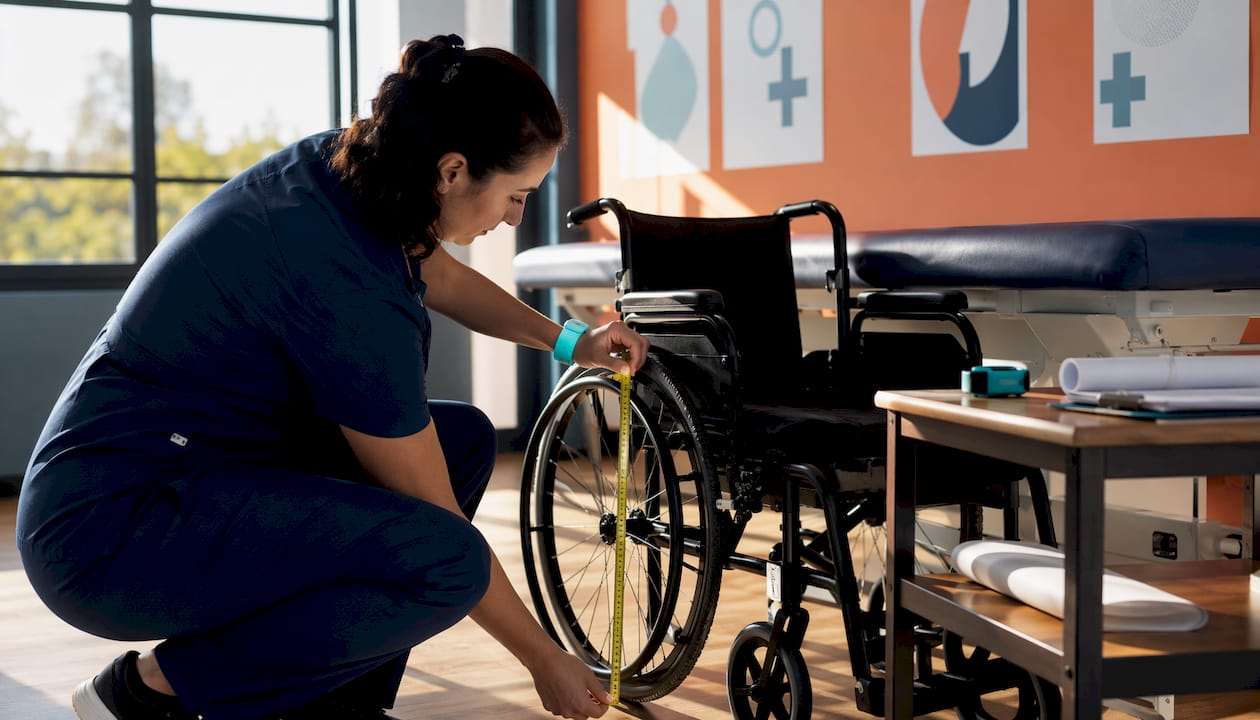
Procurement transforms equity when specifications, placement, and supplier requirements are enforced, not just listed. Build these elements into every RFP:
Procurement checklist:
Accessibility specifications citing Access Board MDE standards (table height range, clear floor space, weight capacity).
Site-placement requirements: transfer clearance dimensions, aisle width, and power-outlet proximity.
Minimum distribution policy: one accessible exam table per exam room, not per department.
Maintenance and spare-parts commitment: 48-hour response SLA, local parts availability.
Staff training requirement: vendor-delivered competency training within 30 days of installation.
Supplier diversity clause: preference for vendors with documented equity commitments and local/minority-owned supply partners.
Sample RFP language (adapt as needed):
“All exam tables supplied under this contract shall meet U.S. Access Board MDE technical standards, including a height range of 18–34 inches, a minimum 500 lb weight capacity, and a 60-inch clear floor space on the transfer side. Vendor shall provide written confirmation of spare-parts availability within the continental US and deliver staff competency training within 30 days of delivery acceptance.”
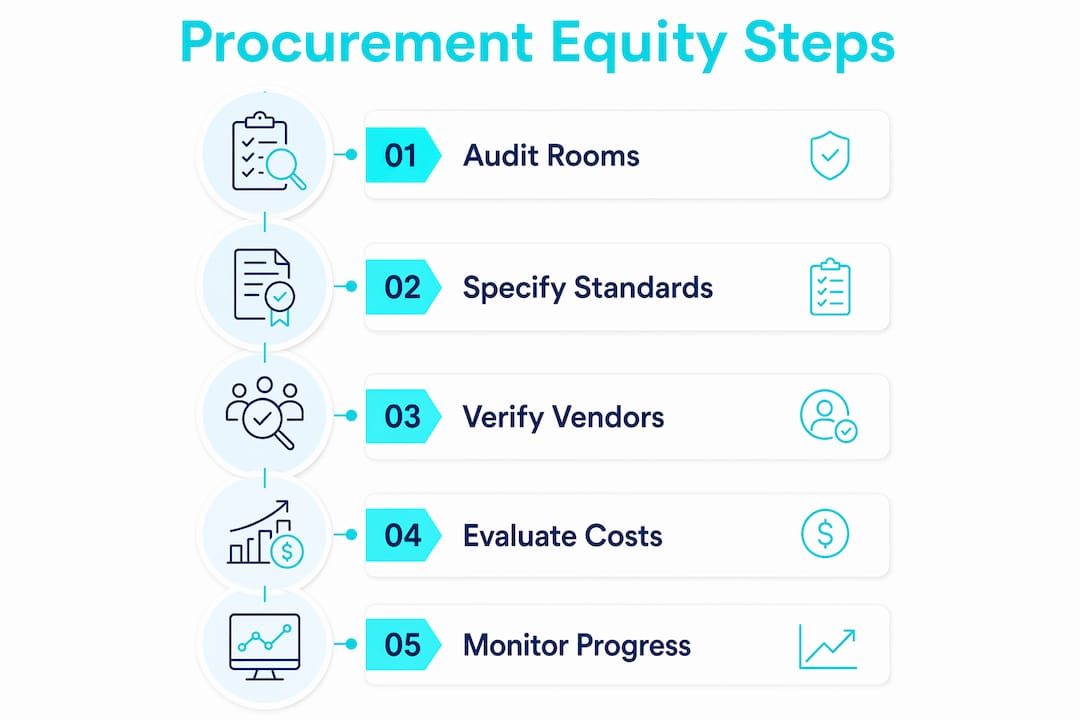
For sourcing wholesale suppliers who can meet these specifications, verify that the vendor’s product data sheets reference Access Board MDE standards explicitly, not just ADA compliance in general terms.
Cost consideration: Accessible equipment typically carries a higher purchase price than standard alternatives. The total-cost-of-ownership calculation reverses that gap when you factor in avoided downstream ED visits, reduced staff injury from manual transfers, and lower liability exposure. Treating accessible equipment as a capital infrastructure investment rather than a specialty line item is the framing shift that gets it funded.
How to measure progress toward equipment equity
The top-line metrics procurement and quality teams should track:
Metric | Baseline | 12-Month Target | Cadence |
% exam rooms with accessible table | Audit now | Track quarterly | Quarterly |
% preventive visits completed, mobility-impaired patients | Audit now | Aim for parity with general population | Semi-annual |
Mean time to equipment repair | Audit now | Maintain a 48-hour or faster response | Monthly |
Supplier diversity spend on accessible MDE | Audit now | Establish annual internal targets | Annual |
Audit template items (room-level):
Confirm table height range and weight capacity against Access Board MDE spec.
Measure transfer clearance on the dominant transfer side (minimum 60 inches).
Verify scale accessibility: floor space, ramp or flush threshold, calibration date.
Check lift/sling inventory: sling sizes available, last inspection date.
Staff competency: at least one trained staff member per shift per room.
Maintenance log: last service date, open work orders.
Tie these metrics to your existing quality dashboard. CMS equity frameworks expect facilities to report on access disparities, and equipment audit data is direct evidence of structural progress. Present results to leadership quarterly so capital budget requests for the next cycle are backed by gap data, not anecdote.
Funding sources and compliance considerations
Funding pathways:
Internal capital budgets: frame accessible MDE as infrastructure, not specialty equipment, to compete for capital dollars.
HRSA grants and federal programs: Health Center Program funding and Section 330 grants support primary care facility upgrades, including equipment.
Medicaid-related streams: state Medicaid agencies have funded accessible equipment through managed care quality improvement pools.
Philanthropic and community health foundation grants: often available for rural and safety-net facilities.
Employer health programs: organizations like Hadaco Health Solutions work with employers on workforce health infrastructure that can include accessible equipment funding partnerships.
Compliance pointers:
Access Board MDE standards: the primary technical reference for exam table, scale, and imaging equipment specifications.
ADA Title III and Title II: placement and usability requirements apply to both private and public facilities.
CMS Equity Framework: cite equipment audit results in your institutional equity plan.
CDC health equity resources: operational guidance for multi-sector partnerships and community engagement.
The Affordable Care Act reduced affordability barriers meaningfully, but federal policy reviews confirm that non-price barriers, including equipment availability and administrative obstacles, remain significant. Insurance coverage alone does not close the gap.
Step-by-step implementation plan for procurement teams
Audit first, then procure. Every other sequence wastes budget.
Months 0–3 — Audit and prioritize. Clinical lead and facilities team complete room-level audit against Access Board MDE specs. Score gaps by equity impact (patient volume with mobility impairments) and feasibility (room dimensions, power availability). Output: prioritized equipment list with cost estimates.
Months 3–6 — Procurement cycle. Issue RFPs with the specification language above. Require product demonstrations and acceptance testing before final payment. Queenssurgical and other compliant vendors should be evaluated against the checklist in Section 5.
Months 6–12 — Installation, training, and first measurement. Confirm placement meets transfer-clearance requirements before signing acceptance forms. Deliver staff competency training within 30 days. Pull first quarterly metrics and report to leadership.
Roles:
Procurement: RFP issuance, vendor evaluation, contract management.
Clinical Lead: audit participation, acceptance testing, training sign-off.
Facilities: placement verification, maintenance scheduling.
Equity Officer: metric reporting, community input coordination.
Pilot vs. fleet rollout: Start with two to three primary care exam rooms. Validate the placement workflow and staff training before ordering facility-wide. Scale once acceptance criteria are confirmed in the pilot rooms.
Queenssurgical supports your equity procurement goals
Procurement teams that have completed their audit and need to move fast on consumables and exam-room supplies have a direct path through Queenssurgical.
Queenssurgical stocks a broad catalog of medical consumables, from nitrile examination gloves to disposable lab uniforms and procedural room supplies, available for wholesale and retail purchase across the Americas. For procurement teams building out equity-focused exam rooms, Queenssurgical can provide specification-based quotes, confirm spare-parts availability, and support rapid deployment of consumable bundles that align with your RFP requirements. Request a quote through the Queenssurgical product pages, confirm service-level commitments in writing, and use the vendor’s documentation to satisfy RFP warranty and service-response requirements.
Key Takeaways
Equitable equipment access requires procurement teams to audit, specify, and enforce accessibility standards across every exam room, not just designated accessible spaces.
Point | Details |
Audit before you buy | Complete a room-level Access Board MDE audit this quarter to identify gaps by equity impact and feasibility. |
Specify, don’t assume | RFPs must cite Access Board MDE standards explicitly: height range, weight capacity, transfer clearance, and staff training requirements. |
Distribute, don’t concentrate | Mandate at least one accessible exam table per exam room to avoid patient segregation into “special” rooms. |
Measure and report | Track the percentage of accessible rooms, parity in preventive visits for mobility-impaired patients, and repair response times quarterly; link these results to CMS equity reporting. |
Queenssurgical as a sourcing partner | Queenssurgical supplies specification-compliant consumables and exam-room supplies with B2B wholesale options across the Americas. |
Why procurement-led equity is the right frame
The conventional view treats accessible equipment as an accommodation, a legal checkbox triggered by a specific patient’s request. That framing is wrong, and it costs facilities more than it saves. When accessible MDE is standard rather than special, you eliminate the workflow friction of locating “the accessible room,” you reduce staff injury from improvised manual transfers, and you generate the audit trail that CMS equity frameworks increasingly require. The NCD’s evidence is unambiguous: missing equipment means missed screenings, and missed screenings mean worse chronic disease outcomes and higher downstream costs. Procurement that treats accessible equipment as infrastructure, the same way it treats HVAC or electrical capacity, is procurement that actually closes the gap. The tools, standards, and funding pathways exist. The gap is execution, and execution starts with the purchase order.
Authoritative sources and further reading
Procurement and compliance teams should bookmark these resources for specification citations, policy language, and equity reporting:
CDC — What is health equity? Definitions, operational guidance, and multi-sector partnership frameworks for health systems.
WHO — Health equity Global definition of health equity and primary health care investment priorities.
NCD — Medical Diagnostic Equipment Report Primary US evidence source on accessible MDE gaps, preventive care impacts, and procurement recommendations.
PMC — Levesque access framework (AHRQ context) Multi-dimensional access model used by AHRQ; useful for framing measurement and evaluation.
PMC — Health equity for persons with disabilities: scoping review Evidence on persistent equipment gaps and the limited scale of interventions to date.
NCBI Bookshelf — Health Care Access and Federal Policy ACA-era policy review covering what insurance expansions did and did not fix.
NCBI Bookshelf — Ending unequal treatment Evidence on racial and ethnic disparities linked to facility infrastructure.
Issue Lab — Barriers to Accessing Medical Equipment Survey data on insurance, supply-chain, and provider-access barriers for people with disabilities.
U.S. Access Board — MDE Standards Technical specifications for accessible medical diagnostic equipment; the primary compliance reference for RFPs.
CMS — Health Equity Framework Institutional reporting and quality framework that ties equity metrics to CMS requirements.
Recommended
Comments