Medical Equipment Storage Requirements List for Healthcare
- Qubit Technology
- May 31
- 9 min read

Proper storage is the backbone of sterile supply chain integrity, yet it remains one of the most frequently cited deficiencies in healthcare facility inspections. A well-organized medical equipment storage requirements list is not a bureaucratic checkbox. It is the operational framework that prevents contamination, protects patient safety, and keeps your facility audit-ready under FDA, AAMI, and CDC standards. This guide gives healthcare administrators a structured, regulation-grounded reference covering environmental controls, physical layout standards, procedural controls, and specialized storage conditions.
Table of Contents
Key takeaways
Point | Details |
Environmental parameters are non-negotiable | Maintain sterile storage at or below 75°F with 30%–60% relative humidity per AAMI ST79. |
Physical clearances reduce contamination risk | Keep supplies 8–10 inches off the floor, 18 inches below ceilings, and 2 inches from exterior walls. |
FIFO rotation prevents expiration waste | First-In, First-Out inventory management reduces degradation risk and maintains supply reliability. |
Documentation must be continuous | Temperature logs, corrective actions, and environmental records are required for FDA audit readiness. |
Specialized items demand separate protocols | Cold-chain products, sterilants, and biological specimens each require distinct temperature and access controls. |
1. The core medical equipment storage requirements list overview
The formal term for this topic in regulatory literature is storage and handling controls, governed primarily by FDA QSR requirements under 21 CFR Part 820, Section 820.150. These rules require facilities to establish and maintain written procedures that prevent mix-ups, damage, contamination, and deterioration of medical devices.
Storage is an integral part of the quality management system and cannot be treated as a passive activity. Proactive management means scheduled monitoring, documented corrective actions, and clearly defined responsibilities. Every item on this list connects directly to a regulatory standard, manufacturer requirement, or validated best practice.
2. Temperature and humidity controls
Temperature and humidity are the two most critical environmental variables in any sterile storage area. AAMI ST79 specifies that sterile storage rooms must stay at or below 75°F (24°C) and maintain relative humidity between 30% and 60%. Outside these ranges, packaging integrity degrades, microbial growth accelerates, and sterility assurance is compromised.
Key requirements:
Install calibrated temperature and humidity sensors with continuous data logging, not just manual spot checks
Set alert thresholds at 72°F and 55% RH to give staff time to act before a formal excursion occurs
Log all readings at minimum every four hours for sterile storage areas
Document every excursion with a root cause analysis and corrective action record
Pro Tip: Automated monitoring systems that send real-time alerts to a central dashboard, such as those described in automated water temperature monitoring platforms, eliminate the single biggest gap in manual compliance programs: the undetected overnight or weekend excursion.
Store environmental logs for at least two years, or longer if your accreditation body requires it. These records are the first thing surveyors request.
3. Ventilation and air quality standards
Airflow design is not an optional upgrade. Positive air pressure differentials and appropriate air changes per hour are fundamental requirements for preventing airborne contamination in sterile storage zones.
Sterile storage rooms classified under ISO and USP standards typically require 10 or more air changes per hour, with positive pressure relative to adjacent corridors. HEPA filtration is mandatory in higher classification areas. Facilities should verify their HVAC design meets room classification requirements and schedule filter inspections at defined intervals, not just when visible dust appears.
Decontamination areas must always maintain negative pressure relative to clean zones. This directional airflow principle separates the most commonly confused storage zones in healthcare facilities.
4. Physical clearances and shelf placement
Three clearance numbers should be posted in every storage room in your facility:
8 to 10 inches from the floor: Prevents floor-level contamination from cleaning activities and flooding
18 inches below the sprinkler head or ceiling: Required by fire code and AAMI guidelines for fire suppression access
2 inches from exterior walls: Reduces moisture transfer and temperature variability from wall surfaces
These contamination-prevention clearances align with AAMI, AORN, and CDC guidelines and represent the minimum acceptable standard. No supply, including bulk items in outer packaging, should rest directly on the floor, even temporarily.
Pro Tip: Label the clearance zones directly on shelving units with colored tape. Staff who work quickly during restocking forget verbal instructions. A visual cue at the physical location works better than any training session alone.
5. Shelving materials and storage design
The material your shelving is made from directly affects your contamination control strategy. 316 stainless steel is the preferred choice for sterile storage environments because it contains molybdenum, which provides superior corrosion resistance when exposed to repeated disinfectant cleaning.
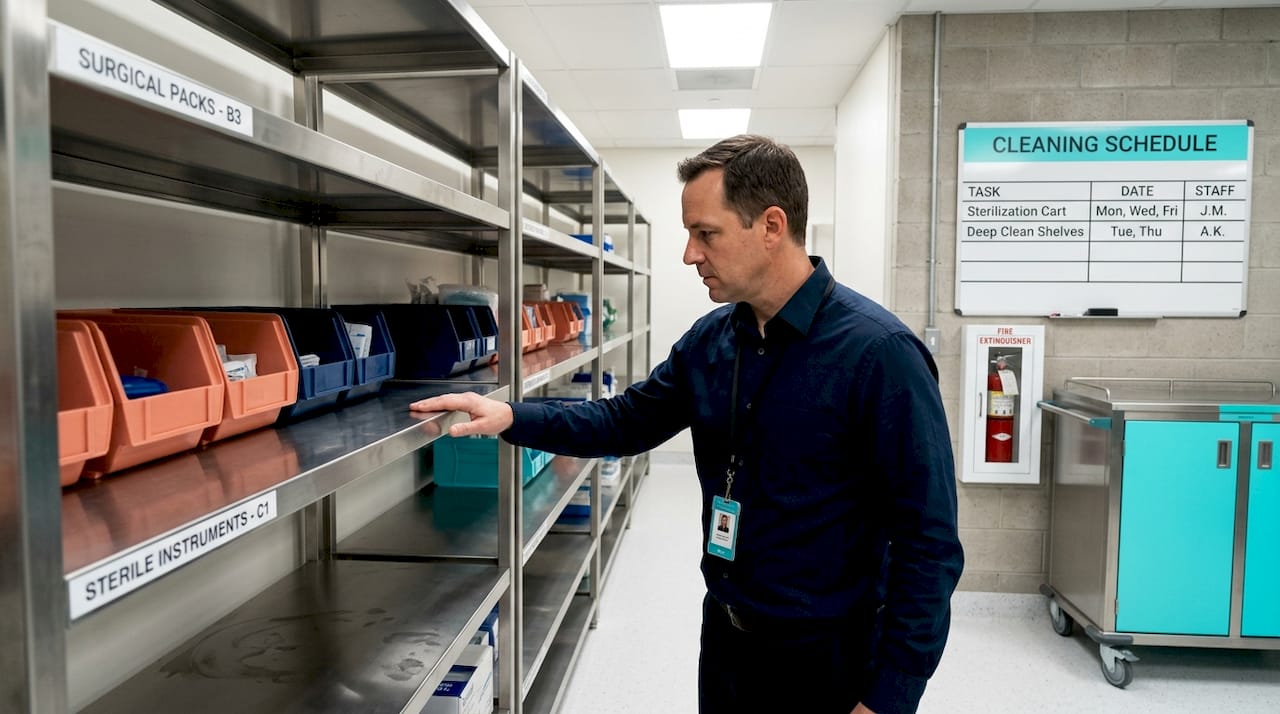
Shelving Type | Best Use Case | Key Advantage | Limitation |
316 stainless steel | Sterile and cleanroom storage | Corrosion and disinfectant resistant | Higher upfront cost |
Wire shelving (coated) | General supply storage | Airflow around items | Harder to fully disinfect |
Closed cabinet (solid door) | Single-use sterile items | Dust and particle protection | Requires labeling system |
Polymer/resin shelving | Non-sterile supply areas | Lightweight, easy to clean | Not appropriate for sterile zones |
Closed cabinets with solid doors are appropriate for sterile single-use items in areas with high foot traffic, where open shelving would expose products to increased particulate contamination. Open wire shelving remains acceptable in controlled environments with proper airflow.
6. Workflow zoning for decontamination and sterile storage
Proper spatial design reduces both sterility compromise and packaging damage during equipment movement. A functional storage area requires at least three distinct zones: decontamination, preparation and inspection, and sterile storage.
Traffic must flow in one direction. Reusable instruments enter through the decontamination zone and never backtrack through the sterile zone. This separation is not just best practice. It is an AAMI ST79 compliance requirement. Zone planning with temperature and humidity stability in each area prevents cross-contamination and supports consistent sterility assurance.
Facilities often underestimate the square footage needed for adequate separation. During space planning, budget at least 50% more room than you think you need for the decontamination zone, because instrument volume always grows after a facility expands services.
7. Written procedures and FDA compliance documentation
FDA QSR Section 820.150 is explicit: you must have written procedures governing storage. Not informal policies. Not floor-level habits. Written, approved, version-controlled procedures that cover receipt, identification, storage, distribution, and return of medical devices.
These storage control records must be maintained in compliance with 21 CFR Part 11 if they are electronic, which means audit trails, access controls, and data integrity validation. Paper-based systems must include legible, date-stamped entries with clear identification of the person making each entry.
Required documentation minimum set:
Written storage and handling procedures (reviewed annually)
Temperature and humidity monitoring logs with timestamps
Equipment calibration records for all monitoring devices
Corrective action records for any excursion or non-conformance
Staff training records and competency assessments
Pro Tip: Treat your storage documentation the same way you treat a patient record: never alter, always date, and always document the reason for any correction. This mindset shift reduces FDA 483 observations significantly.
You can find a practical overview of how documentation requirements connect to broader retail medical compliance obligations in healthcare settings.
8. Inventory rotation and labeling controls
FIFO inventory rotation is the standard method for sterile and dated medical supplies. First-In, First-Out means the item with the earliest expiration date is always used first. This method requires physical shelving that supports front-to-back loading or clearly labeled date zones.
Labeling requirements must include product name, lot number, expiration date, and storage conditions. For items that require specific temperature ranges or handling precautions, that information must be visible at the point of storage. Do not rely on staff memory for product-specific handling requirements.
Segregation is equally important. Expired, quarantined, and recalled items must be physically separated from active inventory, preferably in a labeled, locked area. Mixing statuses is one of the most common causes of adverse events traced back to supply management failures. Cryo-label systems designed for racks and boxes help maintain clear identification even under low-temperature storage conditions.
9. Specialized storage for cold-chain and sensitive supplies
Not all medical equipment storage guidelines apply uniformly. Refrigerated diagnostic products, biological specimens, and temperature-sensitive sterilants each require separate protocols with tighter controls.
Refrigerated medical devices such as IVD reagents require 2°C to 8°C storage, while frozen biologics require temperatures at or below minus 20°C. Any temperature excursion, even brief, degrades product stability and must be documented with a formal impact assessment before the product is used or destroyed.
Specialized storage quick reference:
Refrigerated items (2–8°C): Dedicated pharmaceutical-grade refrigerators with temperature alarms, not staff break-room units
Frozen items (below minus 20°C): Ultra-low freezers with redundant monitoring and backup power protocols
Sterilants and disinfectants: Storage below 30°C, away from direct sunlight, with appropriate chemical segregation per SDS requirements
Blood products: Continuous temperature monitoring with a validated chain-of-custody record from receipt through use
Manufacturer labeling: Always treat manufacturer storage instructions as authoritative. Regulations set floors, not ceilings. Manufacturer specs may be stricter, and compliance with them is your legal defense.
For more on how temperature monitoring checks integrate into an overall environmental compliance program, detailed procedural guidance exists for healthcare-specific scenarios.
10. Storage requirement summary by equipment category
This comparison provides a quick reference for storage standards across the most common medical supply categories in a healthcare facility.
Category | Temp Range | Humidity | Clearance Required | Monitoring Frequency |
Sterile surgical supplies | ≤75°F (24°C) | 30%–60% | Full clearances apply | Continuous logging |
Refrigerated IVD reagents | 36–46°F (2–8°C) | Per manufacturer | Standard clearances | Continuous with alarms |
Frozen biologics | ≤minus 4°F (minus 20°C) | N/A | Dedicated freezer unit | Continuous with alarms |
Sterilants/disinfectants | Below 86°F (30°C) | Dry storage | Segregated chemical zone | Spot check with log |
General non-sterile supplies | Ambient | 30%–60% | Full clearances apply | Twice daily minimum |
Implementation recommendations:
Conduct a zone-by-zone risk assessment before modifying any existing storage layout
Use phased rollouts when implementing new sterile storage to maintain continuous environmental monitoring without workflow disruption
Audit each zone quarterly, not just during accreditation cycles
Invest in RFID or barcode-enabled inventory systems for high-turnover supply areas
My perspective on what the checklist does not tell you
I have worked through enough storage audits and facility transitions to say this plainly: most storage failures are not caused by ignorance of the requirements. They are caused by the assumption that an approved procedure on paper equals a compliant environment in practice.
The detail that consistently gets overlooked is transition monitoring. When facilities renovate, move equipment, or expand storage capacity, they focus on the end state and lose track of environmental controls during the changeover. Temporary lapses during these periods are where contamination risk peaks and where most post-renovation audit findings originate. Baseline monitoring before and during transitions is not optional. It is the difference between a smooth opening and a corrective action plan.
My other observation is that documentation culture determines everything. Facilities with strong storage compliance tend to have one thing in common: staff who treat every log entry as a patient safety act, not an administrative burden. That culture does not come from a policy. It comes from consistent leadership reinforcement and training that explains the why behind every requirement. Get that right, and the checklist takes care of itself.
— QB
How Queenssurgical helps you meet storage compliance requirements
Queenssurgical supplies healthcare facilities across the Americas with the products they need to implement and maintain compliant storage environments. From medical-grade supplies and instruments to labeling materials, monitoring accessories, and specialty storage-compatible consumables, the catalog is built around what procurement teams actually need, not just what looks good in a brochure.
Whether you are setting up a new sterile supply area, replacing aging shelving systems, or stocking cold-chain compatible products that meet FDA and manufacturer requirements, Queenssurgical provides competitively priced options with the quality documentation your facility requires. The platform serves both individual practitioners and large purchasing organizations, making it straightforward to source everything on your compliance checklist from one trusted partner.
FAQ
What temperature is required for sterile medical supply storage?
Sterile storage areas must maintain temperatures at or below 75°F (24°C), per AAMI ST79 standards. Relative humidity must stay between 30% and 60% to preserve packaging integrity and sterility assurance.
What physical clearances are required for medical equipment shelving?
Supplies must be stored at least 8 to 10 inches from the floor, 18 inches below the ceiling or sprinkler head, and 2 inches from exterior walls, per AAMI, AORN, and CDC guidelines.
What does FDA require for medical device storage documentation?
FDA QSR Section 820.150 requires written procedures and records covering storage conditions, monitoring logs, corrective actions, and staff training. Electronic records must comply with 21 CFR Part 11 data integrity requirements.
How should refrigerated medical devices be stored?
Refrigerated items such as IVD reagents must be stored between 2°C and 8°C in dedicated, alarmed pharmaceutical-grade refrigerators. Any temperature excursion requires a documented impact assessment before the product is used.
What is FIFO and why is it required in medical storage?
FIFO stands for First-In, First-Out. It requires that items with the earliest expiration dates are used first to prevent degradation and waste. AAMI ST79 and industry best practices cite FIFO as the standard rotation method for sterile and dated medical supplies.
Recommended
Comments