How Medical Supply Donations Work for Organizations

Medical supply donations are the organized process through which nonprofits collect, verify, and distribute surplus medical supplies to underserved healthcare facilities to improve patient care and reduce waste. Understanding how medical supply donations work for organizations means grasping three core elements: strict quality standards, documented logistics, and partnership-driven distribution. Organizations like MATTER 360 and MedWish have built repeatable systems that turn surplus inventory into life-changing resources. This guide breaks down every stage of that process so your organization can participate effectively, stay compliant, and maximize impact.
How medical supply donations work: criteria and quality standards
The medical supply donation process starts with a non-negotiable filter: only safe, functional, and compliant items move forward. Reputable organizations like MedWish require all donated items to be unopened and unexpired, with at least 12 months of shelf life remaining. Items must also be clean, sanitized, and structurally intact before they are accepted.
The reasoning is straightforward. Sending substandard supplies to a clinic in need creates downstream waste, not downstream value. Items that fail these requirements are discarded immediately upon arrival, which means your organization absorbs the cost of shipping something that ends up in a landfill anyway.
Commonly rejected items include:
Broken or cracked instruments
Tubing or devices that have contacted a patient
PPE with expired or unverifiable dates
Items with damaged or missing packaging
Supplies that do not match the recipient facility’s clinical needs
Proper donation safety standards also require careful confirmation of expiration dates, especially for PPE like masks and gloves, where degradation is not always visible. MATTER 360 goes further by facilitating cleaning and repairs before redistribution, which expands the range of items that can be saved from disposal.
Organizations should also align donations with WHO guidelines and local regulations to avoid sending supplies that create storage burdens or regulatory problems for recipients. This is especially relevant for international donations, where recipient country essential medicine lists and health system policies must be respected.
Pro Tip: Before scheduling a donation pickup, run every item through a three-point check: confirm the expiration date, verify the packaging is sealed and intact, and confirm the item has never been used on a patient. This saves time and protects your organization’s reputation with receiving partners.
For a deeper look at what compliance requires at the organizational level, Queenssurgical’s guide on medical compliance requirements covers the regulatory obligations that apply when handling and transferring medical goods.
How do organizations manage donation logistics effectively?
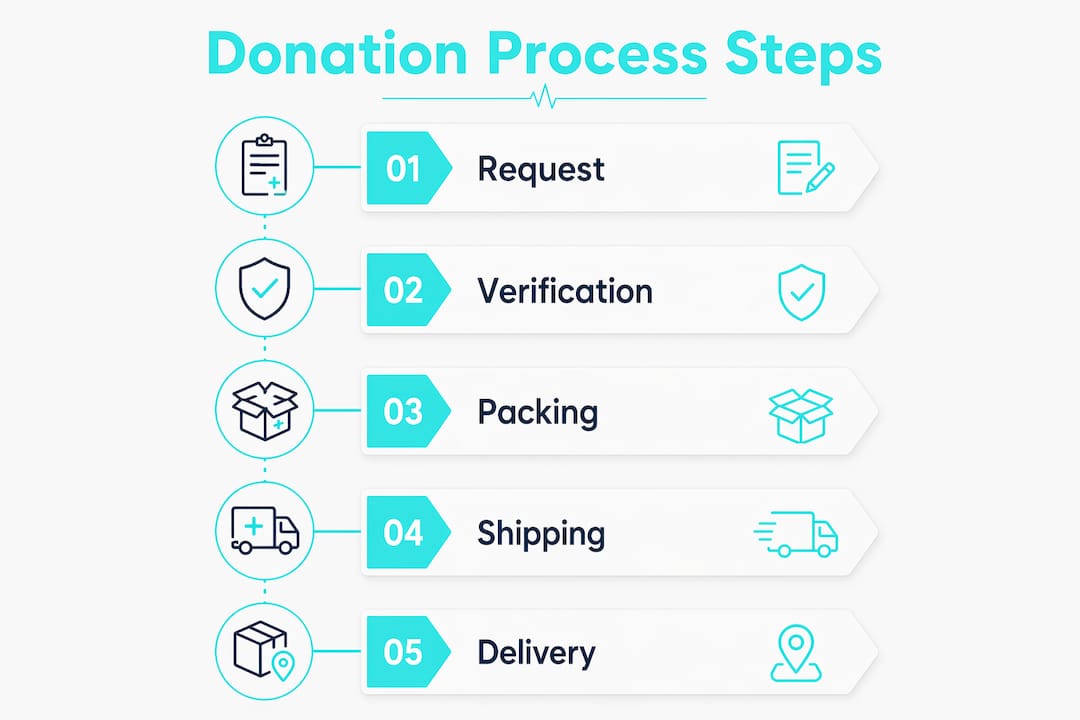
Logistics is where most donation programs succeed or fail. The medical aid donation guidelines used by leading organizations treat logistics as a formal operational process, not an afterthought. For large-scale or corporate donors, the process begins with a formal request submitted through a CSR portal or donation intake system.

Corporate in-kind donations require submission 60–90 days in advance to allow receiving organizations to align inventory cycles and prepare distribution plans. That lead time is not bureaucratic padding. It gives logistics teams the window they need to match your supplies to specific facility needs, arrange transport, and prepare documentation.
A standard donation workflow looks like this:
Assess your inventory. Identify surplus items that meet quality criteria and estimate total volume and weight.
Submit a formal donation request. Use the receiving organization’s intake portal or contact their corporate giving team directly.
Provide item documentation. Include product descriptions, quantities, lot numbers, and expiration dates.
Coordinate pickup or drop-off. MATTER 360 offers pickups for larger donations; smaller contributions can be dropped off Tuesday through Friday, 8:00 AM to 4:30 PM at MedWish facilities.
Receive a donation receipt. For donations valued over $250, IRS compliance requires a formal written acknowledgment from the receiving organization.
File documentation for tax purposes. Accurate valuation and gift acknowledgment are required for donors claiming deductions under IRS rules.
Modern automated platforms can finalize donation movement and paperwork in under 5 days. That speed matters for organizations managing quarterly inventory cycles or responding to urgent healthcare needs.
Pro Tip: Request a sample donation receipt from your receiving partner before your first shipment. Confirming their acknowledgment format meets IRS requirements saves you from scrambling during tax season.
Understanding regulated medical device transfer rules also helps organizations avoid compliance gaps when donating devices that fall under FDA oversight.
What are the benefits of medical supply donations for donors and recipients?
The benefits of medical supply donations extend well beyond goodwill. For donor organizations, the financial case alone is compelling. Donating excess inventory can generate enhanced tax deductions under IRS Section 170(e)(3), which typically yields more financial benefit than a standard disposal write-off. Turning surplus into a documented charitable contribution is a smarter financial move than paying to destroy it.
“Donations bolster healthcare systems institutionally as much as they benefit recipients, enabling resource reallocation to staffing and expanding care.” — Medical Supplies Strengthen Healthcare Systems
That quote captures something most organizations miss. When a clinic receives donated supplies, it does not just gain equipment. It frees up budget that would have gone to purchasing those supplies. That freed budget can then go toward hiring staff, expanding outreach, or improving care quality in ways that supplies alone cannot achieve.
The environmental impact is equally significant. MATTER 360 saved over 7.1 million pounds of medical waste from landfills in 2024 alone, and more than 25 million pounds since 2019. Every pound diverted from a landfill represents a supply that reached someone who needed it instead.
Brand reputation is another concrete benefit. Selling surplus through discount channels risks brand erosion and price undercutting. Donation channels, by contrast, generate documented humanitarian impact that supports organizational sustainability and donor goodwill.
Point | Details |
Tax advantage | IRS Section 170(e)(3) deductions outperform standard disposal write-offs for excess inventory. |
Budget reallocation | Recipient clinics redirect freed purchasing budgets to staffing and expanded care. |
Environmental impact | MATTER 360 diverted 7.1 million pounds of medical waste from landfills in 2024. |
Brand protection | Donation channels preserve brand value better than discount liquidation. |
Healthcare access | Redistributed supplies reach underserved facilities that cannot afford market prices. |
What challenges should organizations avoid in medical supply donations?
The biggest risk in medical supply donations is treating the process as a disposal solution rather than a clinical responsibility. Medical giving requires the same rigor as patient care. Sending supplies without verifying compliance with WHO guidelines and recipient country regulations can cause harm, create legal exposure, and damage your organization’s relationships with receiving partners.
Common pitfalls to avoid:
Sending misaligned supplies. Donating items a facility cannot use creates storage burdens and forces them to manage disposal on your behalf.
Skipping customs and transport planning. International donations require advance coordination for customs clearance, cold chain requirements, and in-country storage capacity.
Underestimating documentation requirements. Missing or incomplete records can disqualify your tax deduction and create audit risk.
Treating donation as a one-time transaction. Organizations that build ongoing partnerships with recipients achieve better supply matching and sustained impact than those making one-off contributions.
Ignoring recipient feedback. The most effective donation programs include a feedback loop so receiving facilities can communicate what they actually need.
International donation alignment with recipient health system policies is not optional. Failure to align with essential medicine lists and local regulatory frameworks creates reputational risk, regulatory barriers, and ineffective aid. The solution is direct communication with receiving organizations before any shipment is prepared.
Building sustainable donation partnerships also requires clear impact reporting. When your organization can show donors and stakeholders exactly where supplies went and what outcomes they supported, you create the kind of accountability that keeps partnerships alive long term. Platforms like MATTER 360 provide this through their matching and tracking systems, which connect donated equipment to specific global partner needs.
For organizations looking to source supplies that meet donation-grade quality standards from the start, Queenssurgical’s resource on efficient surgical supplies sourcing covers practical strategies for procurement that supports both use and eventual donation.
Key takeaways
Medical supply donations work best when organizations treat them as structured partnerships governed by quality standards, documented logistics, and compliance requirements rather than simple surplus disposal.
Point | Details |
Quality standards are non-negotiable | Items must be unopened, unexpired with 12+ months of shelf life, sanitized, and never patient-contacted. |
Plan logistics 60–90 days ahead | Large-scale donations require advance requests to align inventory cycles and prepare documentation. |
Tax benefits are real and significant | IRS Section 170(e)(3) deductions for donated inventory outperform standard disposal write-offs. |
Donations strengthen entire systems | Recipient clinics redirect freed budgets to staffing and outreach, multiplying the impact of every donation. |
Compliance protects everyone | Aligning with WHO guidelines and recipient country policies prevents waste, legal risk, and reputational harm. |
Why donations are partnerships, not just paperwork
After working closely with medical supply chains across the Americas, the pattern I keep seeing is this: organizations that treat donations as a compliance checkbox get mediocre results. Organizations that treat them as ongoing partnerships get transformational ones.
The difference shows up in the details. A partnership-minded organization calls the receiving facility before shipping anything. They ask what is actually needed, what formats work, and what the facility’s storage constraints are. That conversation takes 20 minutes and prevents months of mismatched supply headaches.
The impact storytelling piece is also underused. When MATTER 360 reports 7.1 million pounds diverted from landfills in a single year, that number does not just describe environmental impact. It tells a story that motivates donors, justifies program budgets, and builds the kind of institutional credibility that attracts more partners. Your organization can do the same thing at a smaller scale by documenting every donation with photos, recipient confirmations, and outcome data.
The hardest lesson I have seen organizations learn is that generosity without clinical rigor is not generosity. Sending expired PPE or misaligned equipment to a clinic in need shifts your disposal problem onto them. The organizations doing this right are the ones who hold their donations to the same standard they would hold a purchase order.
— QB
Source quality medical supplies through Queenssurgical
Organizations committed to strong donation programs need a reliable supply source for the items they use and eventually donate. Queenssurgical stocks a full range of donation-grade medical supplies, including the CPE Thumb Loop Isolation Gown and the Isolation Gown Fluid Resistant Universal, both widely used in clinical and donation contexts across the Americas.
Queenssurgical serves nonprofits, clinics, and healthcare facilities through both wholesale and retail channels, making it straightforward to source supplies that meet the quality standards donation programs require. Whether you are stocking up for current operations or building inventory for a future donation cycle, Queenssurgical’s catalog covers the essentials at competitive prices.
FAQ
What qualifies as a donatable medical supply?
Items must be unopened, unexpired with at least 12 months of shelf life remaining, sanitized, and never used on a patient. Broken, patient-contacted, or expired items are rejected immediately upon arrival at most receiving organizations.
How do organizations donate supplies to nonprofits?
Organizations submit a formal donation request to a receiving nonprofit like MATTER 360 or MedWish, provide item documentation, coordinate logistics, and receive a written acknowledgment for IRS compliance. Large donations require 60–90 days of advance notice.
What tax benefits come from donating medical supplies?
Donors can claim enhanced deductions under IRS Section 170(e)(3) for donated excess inventory, which typically yields greater financial benefit than a standard disposal write-off. Donations valued over $250 require a formal written acknowledgment from the receiving organization.
How does the medical supply donation process help healthcare systems?
Donated supplies free up clinic budgets that would otherwise go to purchasing equipment, allowing facilities to redirect funds toward staffing, outreach, and expanded care. MATTER 360 alone diverted over 7.1 million pounds of medical waste from landfills in 2024.
What are the biggest risks in international medical supply donations?
Sending supplies that do not align with recipient country essential medicine lists or WHO guidelines creates storage burdens, regulatory barriers, and reputational risk. Direct communication with receiving organizations before shipment is the most effective way to prevent misaligned donations.
Recommended
Comments