Comparing Medical Supply Wholesalers: 2026 Buyer's Guide

Comparing medical supply wholesalers is one of the most consequential decisions a procurement team makes, yet most organizations approach it without a structured framework. Pick the wrong distributor and you face delayed shipments, compliance violations, and costs that spiral well beyond the initial purchase order. This guide gives healthcare professionals and procurement managers a practical, step-by-step process for evaluating distributors on the factors that actually drive outcomes: regulatory standing, total cost, logistics reliability, and contract terms. By the end, you will know exactly what to look for and what to avoid.
Table of Contents
Key takeaways
Point | Details |
Compliance comes first | Verify accreditation, Medicare enrollment, and surety bond status before evaluating any other factor. |
Unit price misleads buyers | A cheaper product with a shorter lifespan often costs more when you factor in replacement and labor. |
Logistics performance matters | Fill rates, delivery reliability, and return policies affect care quality as much as product quality. |
Use structured comparison tools | Audit-ready matrices and weighted scoring prevent emotional or politically driven supplier decisions. |
Document everything | Maintain supplier qualification records for audits, contract renewals, and future sourcing reviews. |
Comparing medical supply wholesalers: foundational requirements
Before you request a single quote, you need a qualification filter. Skipping this step means you will spend hours evaluating suppliers who cannot legally serve your facility.
Regulatory compliance checks
For any distributor serving DMEPOS (Durable Medical Equipment, Prosthetics, Orthotics, and Supplies) categories, the baseline requirements are non-negotiable. CMS requires DMEPOS suppliers to obtain accreditation, enroll through the PECOS system, and post a $50,000 surety bond per NPI. A supplier missing any one of these cannot bill Medicare, which creates immediate risk for your organization if reimbursement depends on compliant procurement.
Beyond DMEPOS specifics, ask every distributor candidate for the following documentation upfront:
Current accreditation certificates and expiration dates
FDA 510(k) clearance numbers for relevant product categories
ISO certification documentation
Proof of surety bond and renewal schedule
State distribution licenses covering your facility’s location
Pro Tip: Tools like SpecLens extract FDA 510(k) and ISO data directly from vendor documents and generate audit-ready comparison matrices, saving procurement teams hours of manual cross-referencing.
Supplier qualification scoring table
Qualification factor | What to verify | Risk if missing |
Medicare/PECOS enrollment | Active enrollment status in PECOS | Cannot bill Medicare; compliance violation |
Accreditation | Accrediting body and expiration date | Ineligibility for certain contracts |
Surety bond | Bond amount, NPI coverage, renewal date | Enrollment termination risk |
FDA 510(k) clearance | Product-specific clearance numbers | Regulatory and liability exposure |
State distribution license | License coverage by your state | Potential illegal distribution |
Understanding retail vs. wholesale differences also helps you set realistic expectations around minimum order quantities, pricing tiers, and documentation requirements before the comparison process begins.
Pricing models and total cost of ownership
The lowest unit price is rarely the lowest total cost. This is the single most common error in medical supply supplier comparison, and it costs healthcare organizations real money.

Consider the math: a product priced 40% lower than a competitor may have a replacement cycle twice as fast. You also have to factor in the nursing or clinical staff time spent on restocking, the procurement labor for reordering, and the operational disruption when a product fails mid-procedure. A product costing twice as much but lasting three times longer is, by definition, a better financial decision.
Here is a practical process for evaluating total cost of ownership across competing wholesalers:
Establish a baseline unit cost for each SKU using a standardized quantity (per unit, per case, per 1,000 units).
Estimate replacement frequency based on product lifespan data provided by the supplier or your own usage history.
Calculate labor cost per procurement cycle, including time spent on receiving, inspection, restocking, and reordering.
Factor in logistics and freight costs, including fuel surcharges. Medicine wholesalers have faced fuel-cost pressure exceeding 25% since early 2026, and those costs get passed downstream.
Assess service level impact, including stockout frequency, backorder rates, and any documented quality incidents.
Compare private-label versus branded options category by category. Private-label gloves may deliver genuine savings; private-label diagnostic equipment may not.
Pro Tip: Build a simple scenario planning spreadsheet that models three cost scenarios: best case, expected, and worst case for each supplier. This catches hidden costs like minimum order penalties, freight volatility, and return fees before you sign a contract.
Procurement decisions that ignore downstream effects like staff time and replacement frequency consistently result in higher actual spending, even when the initial purchase price looks favorable.
Operational performance and logistics
Logistics performance is where the best medical supply wholesalers separate themselves from the average ones. A distributor’s ability to physically move product to your facility on time, intact, and correctly documented is not a secondary concern. It is a primary one.
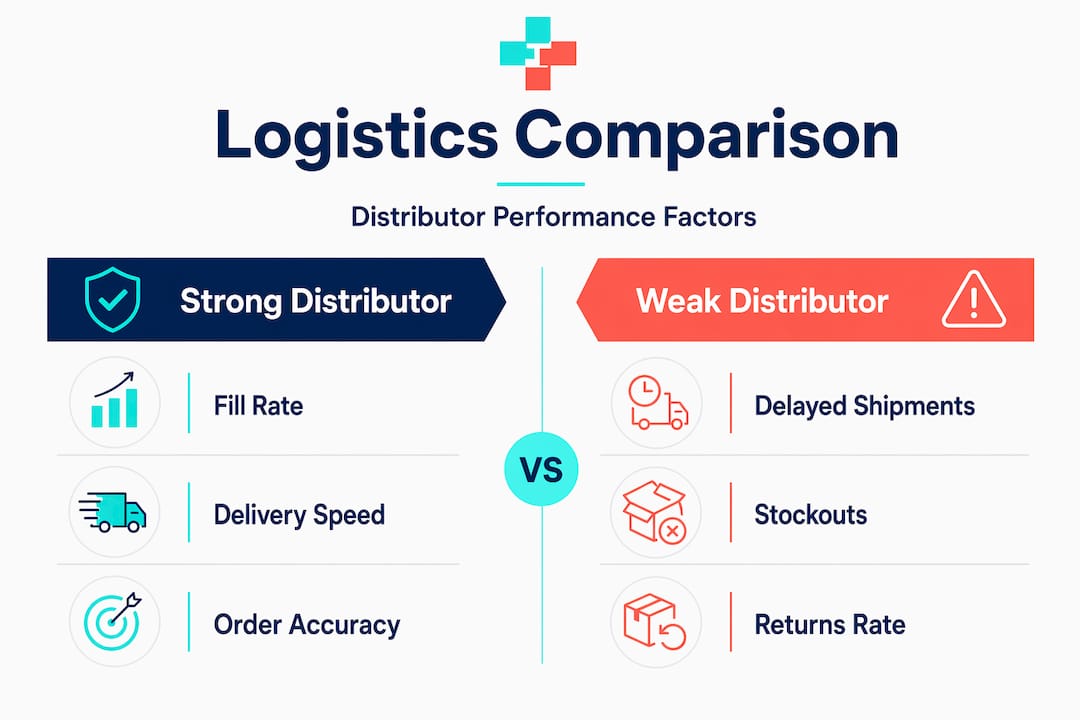
Distributors are the only supply chain partner with legal ownership and physical possession of medicines during warehousing and delivery. This legal accountability matters. It means your distributor carries real responsibility for cold chain integrity, damage prevention, and delivery accuracy in ways that a broker or agent does not.
The operational factors worth evaluating in any wholesale medical supply review include:
Fill rate performance: What percentage of line items ship complete on the first delivery? Anything below 95% warrants scrutiny.
Order cycle time: How quickly does the distributor process and ship orders after confirmation?
Return and recall responsiveness: What is the documented process for product returns, and how does the distributor handle manufacturer recalls?
Technology integration: Does the distributor offer EDI ordering, real-time inventory visibility, or integration with your purchasing system?
Consolidated ordering capability: Can you consolidate orders across product categories to reduce shipping frequency and cost?
The financial case for choosing a distributor with strong logistics is significant. Healthcare distributors save the healthcare system up to $78 billion annually by consolidating orders and reducing redundant handling. That efficiency directly reduces your procurement costs when you choose the right partner.
Logistics comparison table
Logistics factor | Strong distributor | Weak distributor |
Fill rate | 97%+ on standard lines | Frequent partial shipments |
Order cycle time | Same day to 48 hours | 5+ business days with no tracking |
Return policy | Clear SLA, prepaid labels | Case-by-case, no defined timeline |
Technology | EDI, online portal, real-time inventory | Phone and email only |
Consolidated orders | Multi-category, single invoice | Separate orders per category |
How to run a structured supplier comparison
A structured process prevents two common failures: picking a supplier based on a sales relationship rather than performance data, and making a decision you cannot defend during an audit. Here is a repeatable framework for how to choose medical suppliers with confidence.
Define your sourcing requirements. List the product categories, volume thresholds, delivery frequency, and compliance requirements your facility demands. This becomes your must-have filter.
Verify compliance documentation. Collect accreditation certificates, PECOS enrollment confirmation, and surety bond status for every candidate. Bond rider corrections must be completed within 10 business days under CMS rules, so check expiration dates carefully.
Request standardized pricing. Use a product matrix with identical SKUs, quantities, and packaging specifications across all suppliers. Without standardization, price comparisons are meaningless.
Evaluate logistics and service performance. Ask for documented fill rates, references from facilities similar to yours, and a sample SLA. Then verify those references.
Request product samples for high-value categories. Gloves, gowns, and disposable instruments all have tactile quality factors that do not appear on a spec sheet.
Build a weighted scoring matrix. Assign percentage weights to each evaluation category (compliance, price, logistics, service, technology). Score each supplier objectively. This creates a defensible, documented decision.
Engage stakeholders. Clinicians, infection control officers, and department heads often have direct experience with specific products or suppliers. Their input catches issues that purchasing data misses.
Document and archive. Keep every comparison document, reference check, and SLA in a procurement file organized by supplier and contract period.
Pro Tip: Audit-ready comparison matrices, especially for capital equipment with varying configurations, prevent downstream disputes when a product underperforms. Document the exact specs compared, not just the final scores.
Weighted scoring example
Evaluation category | Weight | Supplier A score | Supplier B score |
Regulatory compliance | 30% | 9/10 | 7/10 |
Total cost of ownership | 25% | 7/10 | 8/10 |
Logistics performance | 25% | 8/10 | 6/10 |
Contract terms and SLA | 20% | 8/10 | 9/10 |
Weighted total | 7.9 | 7.4 |
Common pitfalls when evaluating top medical supply distributors
Even well-resourced procurement teams make avoidable errors during supplier evaluations. These are the most frequent ones, and how to prevent them.
Choosing on unit price alone. The math almost never supports this in healthcare. Factor total cost of ownership into every comparison, not just the line item cost.
Skipping compliance verification. Assuming a well-known distributor is compliant without checking current documentation is a real risk. Accreditations lapse. Bonds expire. CMS recovered only $263,000 from $50 million in DMEPOS overpayments between 2009 and 2011, demonstrating how quickly compliance gaps cause financial damage.
Comparing non-equivalent products. Procurement teams often compare SKUs that differ in configuration, material grade, or packaging. Use specification sheets and, for capital equipment, audit-ready matrices to confirm you are comparing identical items.
Overlooking contract terms. Price gets attention. Warranty duration, return windows, and termination clauses often do not. These terms govern your recourse when things go wrong.
Underestimating enrollment timing. The 10-business-day correction window CMS enforces for surety bond issues can delay supplier qualification unexpectedly. Build this into your procurement timeline.
Procurement mistakes in medical supply sourcing are not just budget problems. They create supply chain vulnerabilities that affect patient care directly and generate compliance exposure that outlasts any cost savings from a poor decision.
My take on what actually matters in supplier comparison
I have reviewed a lot of supplier comparison processes, and the pattern is consistent: organizations that treat compliance verification as a checkbox item eventually pay for it. Not always immediately, but the exposure accumulates.
The thing most procurement guides do not say clearly enough is that distributors do not control patient out-of-pocket costs. The pressure to cut supplier costs to reduce patient costs is a false premise. What distributors do control is logistics reliability and service quality. That is where the real leverage is.
In my experience, a distributor with a 97% fill rate, clean compliance documentation, and responsive account management is worth more than a distributor offering 8% lower unit prices with a 90% fill rate and unclear bond status. The math works out, but more importantly, the operational stability works out. Stockouts have real costs in clinical environments that never appear on a purchase order.
The other lesson is this: procurement managers under pressure to reduce costs quickly often reach for the lowest unit price as proof of action. That is a career-limiting move in healthcare. The right move is to show the total cost comparison, including the downstream risks, and make the case for value over price. It takes more work upfront, but it produces decisions you can defend two years later.
— QB
Why Queenssurgical belongs in your supplier evaluation
If you are in the process of evaluating top medical supply distributors across the Americas, Queenssurgical belongs on your comparison list. The platform offers a broad product catalog covering gloves, masks, surgical instruments, medical equipment, and wellness products, all competitively priced and organized for straightforward procurement.
Queenssurgical serves both individual healthcare providers and larger purchasing organizations, with B2B capabilities that support volume ordering and consolidated purchasing. For procurement managers building a supplier comparison matrix, the platform’s product depth, clear pricing, and focus on industry-standard quality give you the transparent data points your evaluation requires. Explore their full product catalog to see current availability and pricing across categories relevant to your facility’s sourcing needs.
FAQ
What is the most important factor when comparing medical supply wholesalers?
Regulatory compliance is the foundational requirement. Verify accreditation, Medicare enrollment status, and surety bond currency before evaluating price or service factors.
How do I calculate total cost of ownership for medical supplies?
Add unit cost, estimated replacement frequency costs, procurement labor, logistics fees, and stockout risk costs across each supplier. A product with a lower unit price but higher replacement frequency frequently costs more overall.
What compliance documents should I request from a DMEPOS supplier?
Request current accreditation certificates, PECOS enrollment confirmation, a $50,000 surety bond per NPI, FDA 510(k) clearances for relevant products, and state distribution licenses covering your facility.
How often should I review my medical supply wholesaler relationships?
Review supplier performance annually at minimum, and conduct a full competitive comparison every two to three years. Trigger an off-cycle review when fill rates drop below 95%, compliance documentation changes, or pricing increases materially.
What is a realistic fill rate expectation from a quality medical distributor?
Strong distributors consistently achieve fill rates of 95% or higher on standard product lines. Rates below this threshold indicate inventory management issues that will affect your supply reliability over time.
Recommended
Comments