6 Step Needle Gauge Chart and OD/ID Reference for Clinicians

Higher gauge numbers mean thinner needles, not thicker ones. In everyday practice, a range of gauges covers blood draws, IV access, viscous fluids, intramuscular injections, subcutaneous and insulin work, as well as the finest injections, like certain dermal procedures, with gauge sizes increasing as needle thickness decreases. The full needle gauge chart below breaks down exact millimeter and inch measurements, plus the thin-wall “s” variants worth knowing.
TL;DR:
Thinner needles with higher gauge numbers (25G and above) are used for microdosing, delicate procedures, and insulin delivery, not for thicker fluids or deep injections.
The Birmingham gauge system is non-linear, so gauge differences do not directly translate into consistent millimeter or inch changes, requiring verification of actual diameters.
Selection of needle gauge and length depends primarily on the injection route, with longer needles for obese patients and finer gauges for pediatric or microvolume procedures.
Color coding on needle hubs is unreliable for precise sizing; always read the printed gauge and length on the packaging before use.
Checking lot number, expiration date, and proper fit of the needle and syringe ensures safety, accuracy, and minimal dead volume for precise medication delivery.
Table of Contents
Needle Gauge Chart: OD, ID, Wall Thickness, and Uses
The numbers below come straight from the Birmingham gauge (BWG) system, the standard nearly every hypodermic needle manufacturer builds against. Outer diameter (OD) determines how much the needle hurts going in and whether it fits your syringe hub. Inner diameter (ID) determines flow rate and how much medication gets stranded inside the needle after injection.
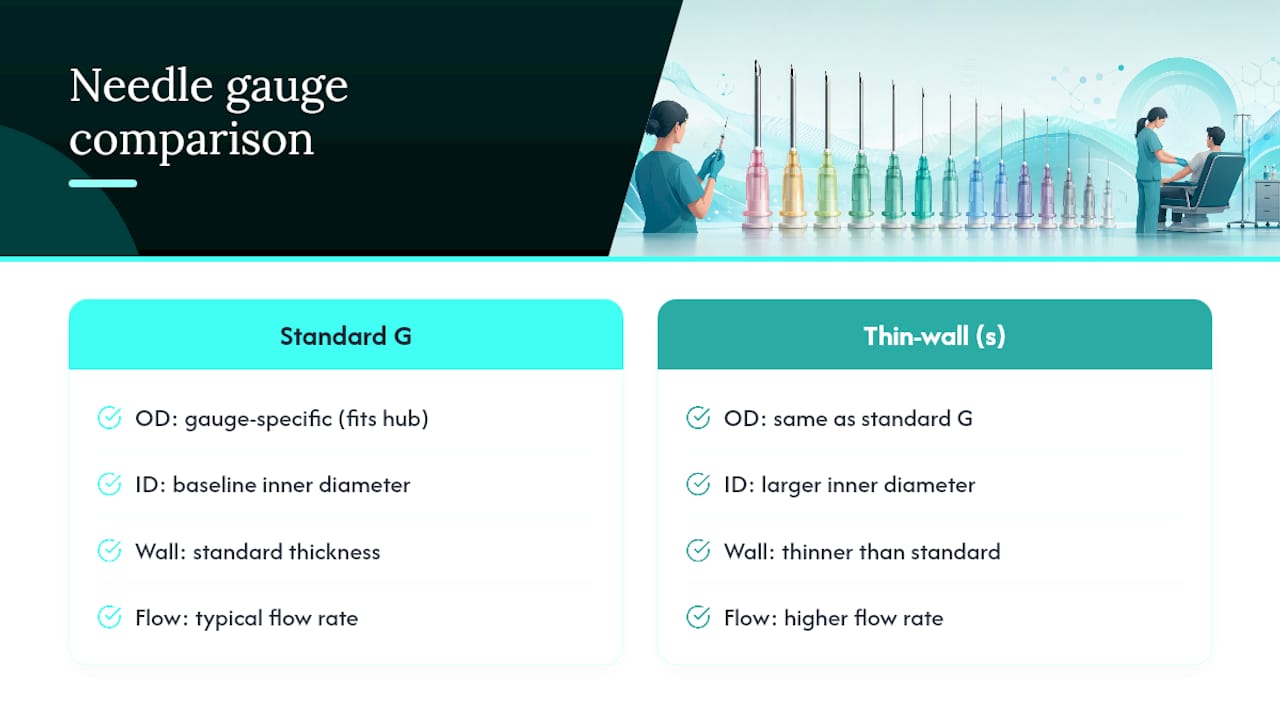
Here’s a reference indicating typical outer diameter, inner diameter, and wall thickness for common gauges along with typical uses, but precise millimeter and inch values can vary slightly across manufacturers and should be verified for exact match.
These figures track the Birmingham gauge table and the dimension tables Darwin Microfluidics publishes, which list OD and ID in both inches and millimeters for cross-checking. Where you see “s” appended to a gauge (26s, for example), the outer diameter stays the same as the standard 26G, but the wall gets thinner, so the inner diameter, and therefore the flow rate, goes up. That distinction matters more than it looks on paper, especially once you get into small-volume dosing.
How Do You Read a Needle Gauge Chart Correctly?
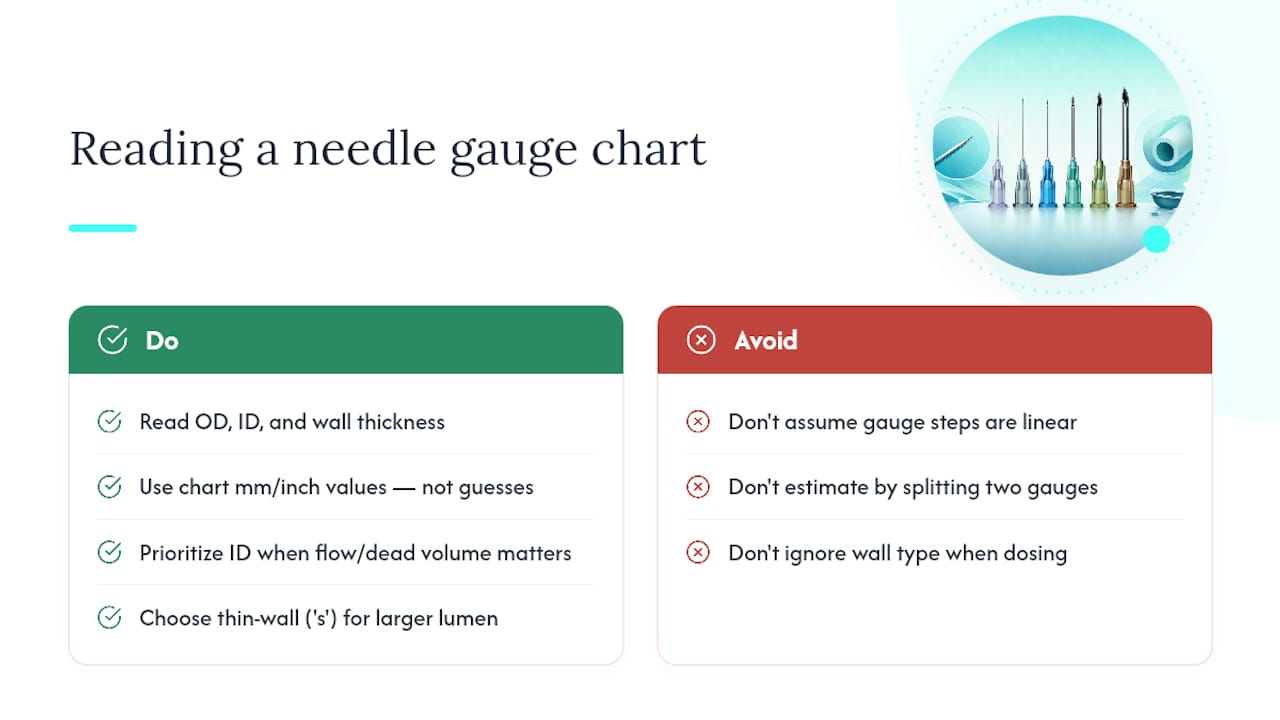
Three numbers matter on any chart: outer diameter, inner diameter, and wall thickness. OD dictates puncture size and tissue trauma; ID governs flow speed and dead volume; wall thickness is simply the gap between the two.
The trap most students fall into is assuming gauge numbers scale in even steps, like a ruler. They don’t. The BWG system is non-linear, so the jump from 20G to 21G is not the same physical distance as the jump from 30G to 31G. Guessing a needle’s diameter by splitting the difference between two known gauges will give you a wrong answer more often than a right one. Always pull the actual mm or inch value off the chart.
Regular-wall needles are the default; thin-wall (“s”) needles trade a little rigidity for a meaningfully larger lumen at the same outer diameter. That trade-off is worth it whenever dead volume or flow rate matters more than needle stiffness, which comes up constantly in small-volume dosing and lab work.
Which Needle Gauge and Length Fit Each Injection Route?
Route drives gauge selection more than any other single factor. Here’s how it typically breaks down:
IV access and blood draws: 18 to 22G, length matched to vein depth and vessel size; 20 to 22G covers most adult peripheral lines.
Intramuscular (IM) injections: 21 to 23G, typically 1 to 1.5 inches for adults, adjusted down for pediatric patients and up for larger body habitus.
Subcutaneous (SC) injections: 25 to 27G, usually 3/8 to 5/8 inch, since you’re only aiming for the fat layer, not muscle.
Insulin delivery: 29 to 31G on pen needles, often shorter (4 to 8 mm) than a standard hypodermic needle.
Viscous medications or rapid infusion: drop to a lower gauge (18 to 20G) regardless of route, since thick fluids need the wider lumen to move at a usable rate.
Obese patients often need longer needles to reach muscle reliably on IM injections, while pediatric and geriatric patients frequently call for shorter lengths and finer gauges to reduce trauma. Specialty devices like tuberculin syringes and insulin pens use their own markings and gauge conventions, so check the device spec sheet rather than assuming standard hypodermic norms apply. Clinical guidance from Lecturio’s needle sizing reference backs this general approach: pick the thinnest gauge the fluid and route allow.
What’s the Step-by-Step Process for Choosing the Right Needle?
Selecting a needle isn’t a single decision, it’s a short sequence of filters. Work through them in order and you’ll rarely land on the wrong size.
Identify the route. IV, IM, SC, or specialty device each narrows the gauge range immediately.
Check the medication’s viscosity and flow needs. Thick fluids and rapid infusions need a wider lumen regardless of route norms.
Match length to depth. Deeper target tissue (muscle in a larger patient) needs a longer needle than a thin subcutaneous layer.
Account for patient body habitus. Adjust length up for obese patients, down for pediatric or thin patients.
Confirm syringe and device compatibility. Check Luer fit and dead volume, especially with small-volume or specialty syringes.
Verify the packaging before opening. Read the printed gauge and length one more time before you commit the needle to a patient.
The thinnest, shortest needle that still allows proper flow minimizes tissue trauma without compromising delivery, which is the balance clinical best practice actually optimizes for rather than defaulting to the thinnest needle available.
Pro Tip: Reach for a thin-wall (“s”) needle whenever you’re priming a small-volume syringe or working with an expensive medication where every microliter of dead space counts. The wider lumen at the same OD means less product gets stranded inside the needle.
Can You Trust Needle Color Coding?
Color-coded hubs are a fast visual shortcut, and most departments lean on them out of habit. Orange often means 25G, blue often means 23G, pink often means 18G, but these correspondences shift between manufacturers, and no regulatory body enforces a single universal standard.
Treat color as a first glance, never a final confirmation.
Read the printed gauge and length on the hub or the packaging before every use.
Cross-check against the manufacturer’s spec sheet when precision actually matters, like in pediatric or microvolume work.
Pro Tip: In a busy or dimly lit room, tilt the hub toward the light and read the printed numbers directly rather than trusting color memory, especially when switching between brands stocked on the same unit.
How Do You Verify a Needle Before Use?
Dead volume is the fluid that stays trapped inside the needle after the plunger bottoms out, and it’s usually expressed as microliters per unit length. Hamilton’s dimension tables list dead volume alongside OD, ID, and wall thickness, because with a 10 microliter syringe, even a small amount of trapped fluid can throw off an entire dose. Thin-wall needles reduce that trapped volume at the same outer diameter, which is exactly why they show up so often in lab and microdosing work.
Before you draw up anything, check the lot number and expiration date, confirm the printed gauge and length match your order, and test the Luer fit if you’re pairing an unfamiliar needle with an unfamiliar syringe. Small-volume syringes often need a manual prime to clear air and displace dead volume before the first accurate dose. Every needle is single-use, and sharps go straight into an approved disposal container immediately after use, no exceptions.
A Note From the Editorial Desk on Chart Reliability
Most needle gauge charts circulating online get copied from one source to another without anyone checking the original numbers, and small transcription errors creep in over the years. The version above draws directly from the Birmingham gauge standard and manufacturer-published dimension tables, not a secondhand summary.
Queens Surgical has spent years sourcing and cataloging clinical consumables for procurement teams who need spec accuracy, not marketing copy. Every needle and syringe listing on the Queenssurgical product pages carries the gauge, length, and packaging detail a buyer actually needs to verify before ordering. If you’re spec-checking a bulk order, that’s the level of detail to look for.
— QB
Where to Order Verified Needles and Syringes
Once you know the gauge and length you need, the next step is sourcing it from a supplier who lists specs clearly instead of burying them in a PDF. Queenssurgical stocks the clinical consumables that pair with the selection process above, from standard hypodermic needles to the accessories that support safe handling, like the Halsey stainless steel needle holder for procedural work.

Before placing a bulk order, check each product page for gauge, length, and thin-wall (“s”) variant availability, since not every gauge ships in both wall thicknesses. Queens Surgical’s catalog spans consumables clinics restock constantly, including medical face masks and BP cuff barrier sleeves, alongside the needle and syringe lines your procedures depend on. For related injection route guidance, the complete guide to injection types is worth a read before you finalize an order. Browse the Queenssurgical catalog and check spec sheets on individual product pages before you check out.
This article is general information, not a substitute for advice from a qualified doctor. Consult a qualified healthcare professional about your own circumstances before acting on anything here.
Sources
Recommended
Comments