Avoid Rejected Loads: Biohazard Bag Colors for U.S. Facilities
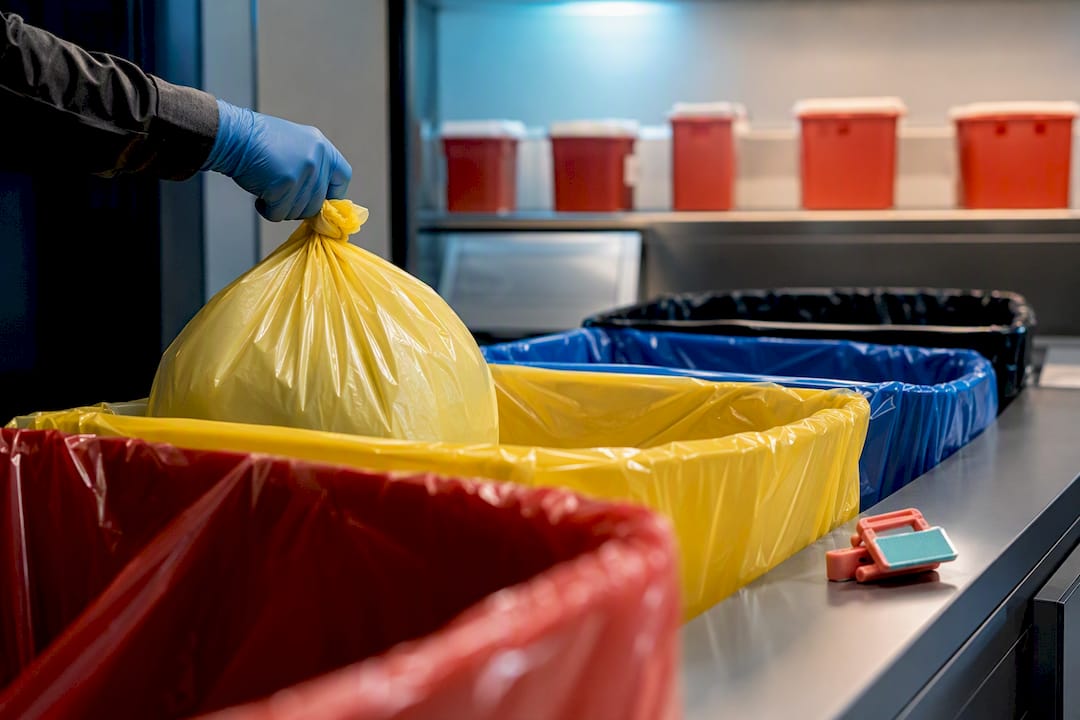
Red bags hold general infectious waste bound for autoclaving, yellow bags carry pathological and chemotherapy waste destined for incineration, blue bags handle contaminated glass and non-hazardous pharmaceutical waste, black bags contain RCRA-regulated hazardous pharmaceuticals, and white or translucent rigid containers hold sharps. OSHA’s baseline rule, under 29 CFR 1910.1030, only mandates that anything holding blood or other potentially infectious materials carry a fluorescent orange or red-orange biohazard label, or simply be red. Everything past that federal floor depends on your state health department and your waste hauler’s own matrix, so confirm before you standardize.
TL;DR:
OSHA requires only red or fluorescent orange labels for containers holding blood or OPIM, while most other color codes depend on state or hauler standards.
Using incorrect bag colors or failing to confirm treatment methods can cause loads to be rejected, leading to delays and added costs.
Bags must meet ASTM impact and tensile strength standards, with thickness around 1.5 mil or higher, and sharps require puncture-resistant, labeled containers.
Facilities should audit waste streams, align bag colors with treatment requirements, and clearly document and train staff on a customized waste matrix.
Most errors stem from sharps in soft waste bags or assuming hauler acceptance based solely on color, so integrating vendor acceptance criteria into procurement is essential.
Table of Contents
What Each Biohazard Bag Color Means for Waste Segregation
The color on a biohazard bag tells the treatment facility how that waste needs to be processed before it can leave the regulated stream. Get the mapping wrong and loads get rejected at the door, which costs facilities real money and delays.
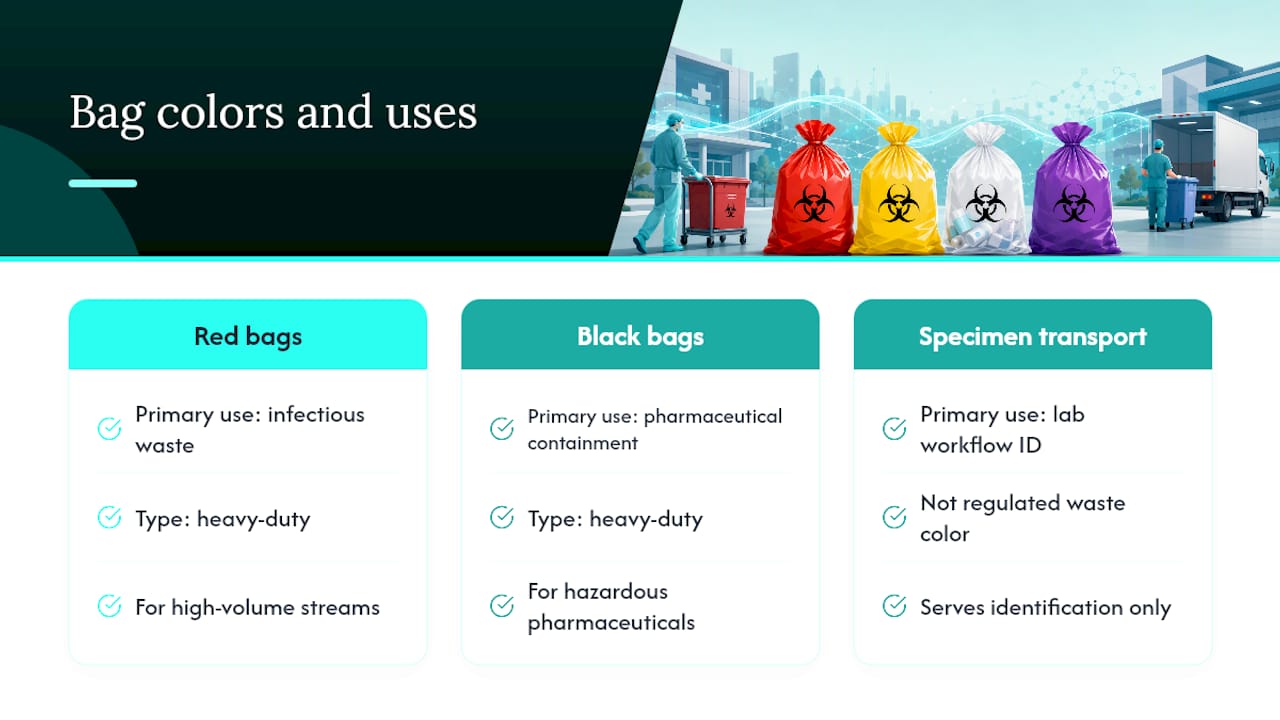
Red bags carry the bulk of routine infectious waste: blood-soaked gauze, contaminated gloves and gowns, IV tubing (once needles are removed), and other soft waste saturated with blood or body fluids. Most of this goes through autoclave or steam sterilization before landfill disposal. A common mistake is tossing a stray needle into a red bag. Sharps belong in a rigid container, full stop, regardless of how much blood is on the gauze next to it.
Yellow bags handle pathological waste (tissue, organs, recognizable body parts) and chemotherapy or cytotoxic waste. Both categories typically require incineration rather than autoclaving because chemical residues and pathological material don’t break down safely under steam alone. Trace chemo, meaning items with only residual drug contact, often stays in yellow. Bulk or unused chemo agents usually need to move into a separate hazardous stream instead.
White or translucent rigid containers are for sharps only: needles, scalpels, lancets, broken glass ampules. These containers need puncture resistance a plastic bag simply cannot offer, which is why OSHA and FDA guidance treat sharps containers as a distinct category rather than a bag color variant.
Blue bags, where a facility’s vendor supports them, typically hold contaminated glass and non-RCRA pharmaceutical waste, like empty vials or expired non-hazardous medications.
Black bags are reserved for RCRA-hazardous pharmaceutical or chemically hazardous waste, per EPA’s RCRA program. Don’t confuse black with your facility’s general heavy-duty trash bags. If a black bag is doing double duty for hazardous pharma, treat it as a regulated stream, not a garbage upgrade.
OSHA, EPA, and the Patchwork of State Rules
Federal law sets a narrow but firm baseline. OSHA’s Bloodborne Pathogens Standard requires a fluorescent orange or red-orange label reading “Biohazard” on any container holding blood or OPIM, unless the container itself is red. That’s the entire federal color mandate. Everything else, including yellow for pathological waste, blue for glass, and black for hazardous pharma, comes from state health departments, your licensed waste hauler’s acceptance criteria, or industry convention documented by groups like university biosafety programs.
EPA’s RCRA framework governs when a pharmaceutical waste stream crosses into hazardous-waste territory, which usually determines whether it needs a black container and higher-temperature incineration. The Department of Transportation adds another layer for bulk shipments, requiring proper manifests and labeling for any regulated waste leaving your facility by truck.
Here’s the number that surprises a lot of new EHS staff: internationally, WHO estimates that a substantial proportion of healthcare waste is hazardous, and many countries assign completely different colors to the same waste categories. That’s exactly why importing a color scheme from an overseas facility, or from a general impression of “how it’s done,” creates compliance gaps in the U.S.
OSHA sets the labeling floor, not the full color code.
EPA/RCRA determines hazardous pharma classification.
State health departments and haulers set most non-red assignments.
DOT rules apply once waste leaves your building.
Bag Strength, Labeling, and Sharps Container Standards
Color means nothing if the bag fails structurally. Manufacturers commonly reference ASTM D1709 for impact resistance and ASTM D882 for tensile strength when specifying biohazard bags, and reputable suppliers will provide that data on request. Thickness matters too. Bags carrying regulated medical waste commonly need a minimum gauge, often cited around 1.5 mil or higher depending on load weight, and must resist tearing and moisture leakage.
Labeling has to include the biohazard symbol, the word “Biohazard,” and, per OSHA, a fluorescent orange or red-orange color if the bag itself isn’t red. Sharps containers need to be rigid, puncture-resistant, and clearly labeled, with closure mechanisms that lock securely once full.
Pro Tip: Ask your supplier for the ASTM test data sheet before you order in bulk, not after a load gets rejected for insufficient thickness.
Run through this before signing off on a purchase order:
Confirm bag color matches your facility’s approved waste matrix.
Verify biohazard symbol and wording are printed, not on a removable sticker.
Check manufacturer thickness specs against your waste hauler’s minimum.
Confirm sharps containers have secure, tamper-resistant closures.
Request lot documentation or certificates of compliance for audit trails.
Building or Auditing Your Facility’s Color-Coding Matrix
Start by auditing every waste stream you currently generate and its volume. Map each stream to its required treatment method, then align your bag colors to both the OSHA baseline and whatever matrix your licensed waste hauler actually accepts. Skipping that last step is where most facilities get burned.
Pull your current waste volumes by category (infectious, pathological, chemo, sharps, hazardous pharma).
Confirm each category’s required treatment with your hauler and your state health department.
Assign colors matching OSHA’s minimum and your vendor’s accepted scheme.
Document the finalized matrix in your standard operating procedures.
Train staff on the matrix and post signage at every collection point.
Write the accepted color matrix directly into your waste vendor contract.
Involve infection prevention, EHS, procurement, and your licensed hauler in that process, not just one department working in isolation. A well-documented matrix, paired with clear signage practices at disposal points, cuts down on staff guessing which bin gets what.
Where Facilities Get This Wrong
Sharps ending up in soft-waste bags is the most common and most dangerous mistake, and it’s almost always preventable with better container placement near point-of-use. A close second: assuming a bag’s color automatically means it’s accepted by your hauler, when in reality every vendor sets its own matrix.
Mixing sharps into red or yellow soft-waste bags.
Using uncertified bags without verified ASTM or thickness data.
Leaving containers unlabeled or using stickers that peel off in transit.
Pro Tip: Build acceptance criteria directly into your vendor contract language, so a rejected load becomes their problem to flag, not a surprise your staff discovers on pickup day.
Procurement Notes From Queenssurgical
Queenssurgical stocks biohazard medical waste bags across the color categories facilities need, including heavy-duty red bags built for high-volume infectious waste streams and heavy-duty black bags for hazardous pharmaceutical containment. Note that colored specimen transport bags serve lab workflow identification, not regulated waste-color coding. Run every order through the procurement checklist above before it ships.
A Practical Take on Getting Color Coding Right
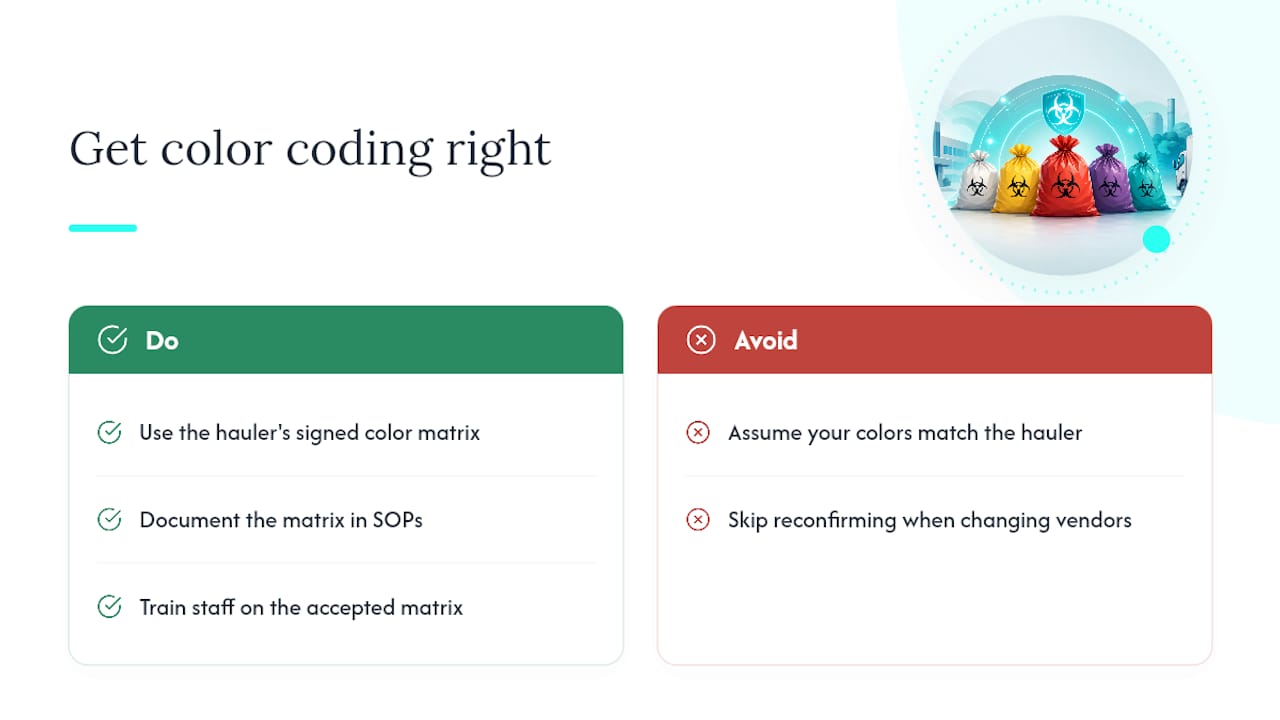
The facilities that struggle with this almost never lack good intentions. They lack a documented matrix that matches what their hauler actually accepts. I’ve seen the pattern repeat: someone standardizes on a color scheme that looks compliant on paper, then a full truck gets turned away because the vendor’s system doesn’t recognize blue for pharmaceutical glass the way the facility assumed it would.
The fix isn’t complicated. Train your staff on the specific matrix your hauler signed off on, document it in your SOPs, and confirm it again whenever you switch vendors.
— QB
Order Compliant Bags and Containers From Queenssurgical
Sourcing biohazard bags that match ASTM specs and OSHA labeling requirements shouldn’t mean juggling three different suppliers for red, yellow, and black stock. Queenssurgical carries biohazard medical waste bags built for the color-by-treatment matrix your facility already runs, so procurement teams can order compliant supplies alongside the PPE and protective gear they’re already buying, like the CPE thumb loop isolation gown many facilities pair with waste handling protocols.

If your current bag stock hasn’t been checked against your hauler’s acceptance matrix, that’s worth doing before your next order goes in. Browse the biohazard bag lineup, confirm thickness and labeling against your facility’s SOP, and place your order directly through the supplier’s product catalog.
Sources
Before finalizing your facility’s color matrix, check these directly:
Recommended
Comments